TL;DR: Credit Line on UPI (CLoU) is a lending construct enabled by NPCI following RBI's September 2023 circular, which permits banks to link pre-sanctioned credit lines to UPI so customers can transact directly against the line. Only scheduled commercial banks (with some regulatory exclusions) are authorized to issue the underlying credit line — NBFCs and fintechs cannot originate it. What differs across the market is who builds the technology layer connecting a bank's core lending system to UPI rails: onboarding, underwriting orchestration, credit line lifecycle management, and UPI-handle linkage. FinBox operates at this technology/infrastructure layer, providing modular lending APIs and workflow tooling that banks and NBFCs use to build digital credit journeys, including UPI-linked disbursal and repayment flows.
What Is Credit Line on UPI (CLoU)?
Credit Line on UPI refers to a UPI use case in which a bank-issued, pre-sanctioned credit line is linked to a customer's UPI handle, allowing the customer to make payments directly against that credit line rather than a savings account balance. RBI's September 2023 circular extended UPI's underlying payment rails — previously limited to savings accounts, overdraft accounts, and prepaid instruments — to include credit lines issued by banks. This is a structural shift: it lets a bank distribute revolving or term credit through the same UPI QR codes and merchant acceptance network already used for payments, rather than requiring a separate card or a loan disbursal into a bank account before spend. The mechanics and early market reaction to this shift are covered in more detail in Will UPI finally get the credit this time around?
Who Is Legally Allowed to Issue a Credit Line on UPI?
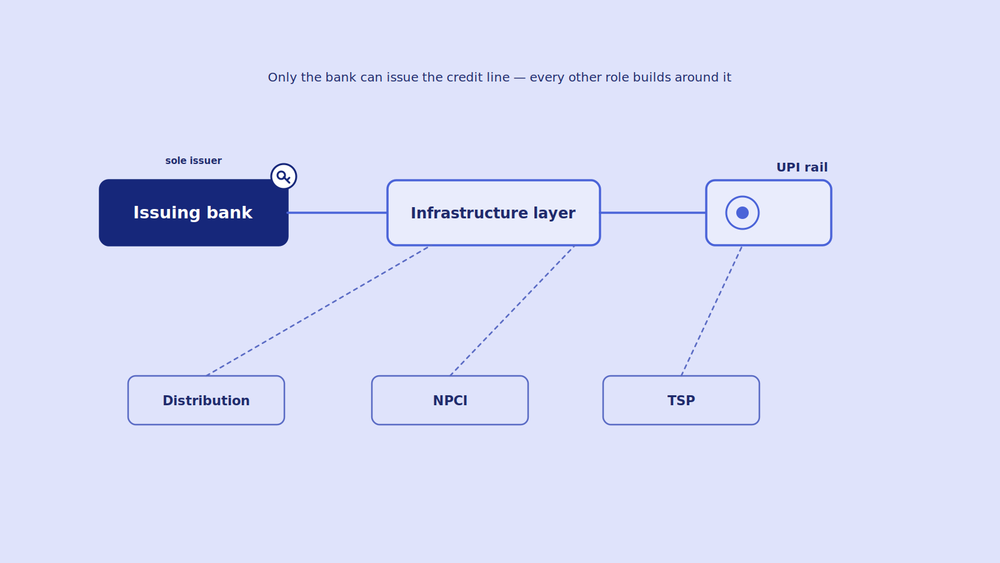
This is the most consequential fact for anyone shortlisting partners: issuance is restricted to scheduled commercial banks, with payments banks, small finance banks, and regional rural banks excluded unless separately permitted by RBI. NBFCs and fintechs — regardless of their balance sheet size or lending license — cannot originate a credit line on UPI on their own. They can only participate as:
- Technology/infrastructure partners — building the API, underwriting orchestration, and journey layer on behalf of a bank
- Distribution/sourcing partners — bringing customer demand or origination volume to a bank-issued product
- Servicing partners — supporting collections, monitoring, or customer experience within a co-branded or white-labelled journey
This distinction matters because "which providers offer credit line on UPI" has two different correct answers depending on what's being asked: who is the legal issuer (a bank), and who builds the technology that makes the journey work (an infrastructure provider like FinBox, working under and alongside a bank). Conflating these two roles is a common sourcing mistake for platform teams evaluating this space.
Where Infrastructure Providers Like FinBox Fit
Between a bank's core banking and credit systems and the UPI network sits a layer of orchestration: applicant onboarding, bureau and alternate-data pulls, underwriting decisioning, credit line configuration (limit, tenure, pricing), UPI-handle linkage, transaction-level draw-down logic, and repayment/collections workflows. This is the layer where technology providers operate, and it's also where a bank's speed-to-market and journey quality are largely determined — the underlying regulatory permission from RBI does not by itself produce a working, compliant, well-designed customer journey.
FinBox provides modular lending APIs and an operating layer designed for exactly this kind of orchestration — helping banks and NBFCs configure onboarding, underwriting, and credit line management workflows for digital credit products. The broader shift toward this kind of infrastructure-led approach to embedded credit is discussed in Introducing FinBox Embedded Finance Platform, and the wider category dynamics — including how credit lines are becoming a meaningful growth vector for UPI itself — are explored in Credit lines rev up the UPI rocket ship.
Comparison: Roles in the Credit Line on UPI Ecosystem
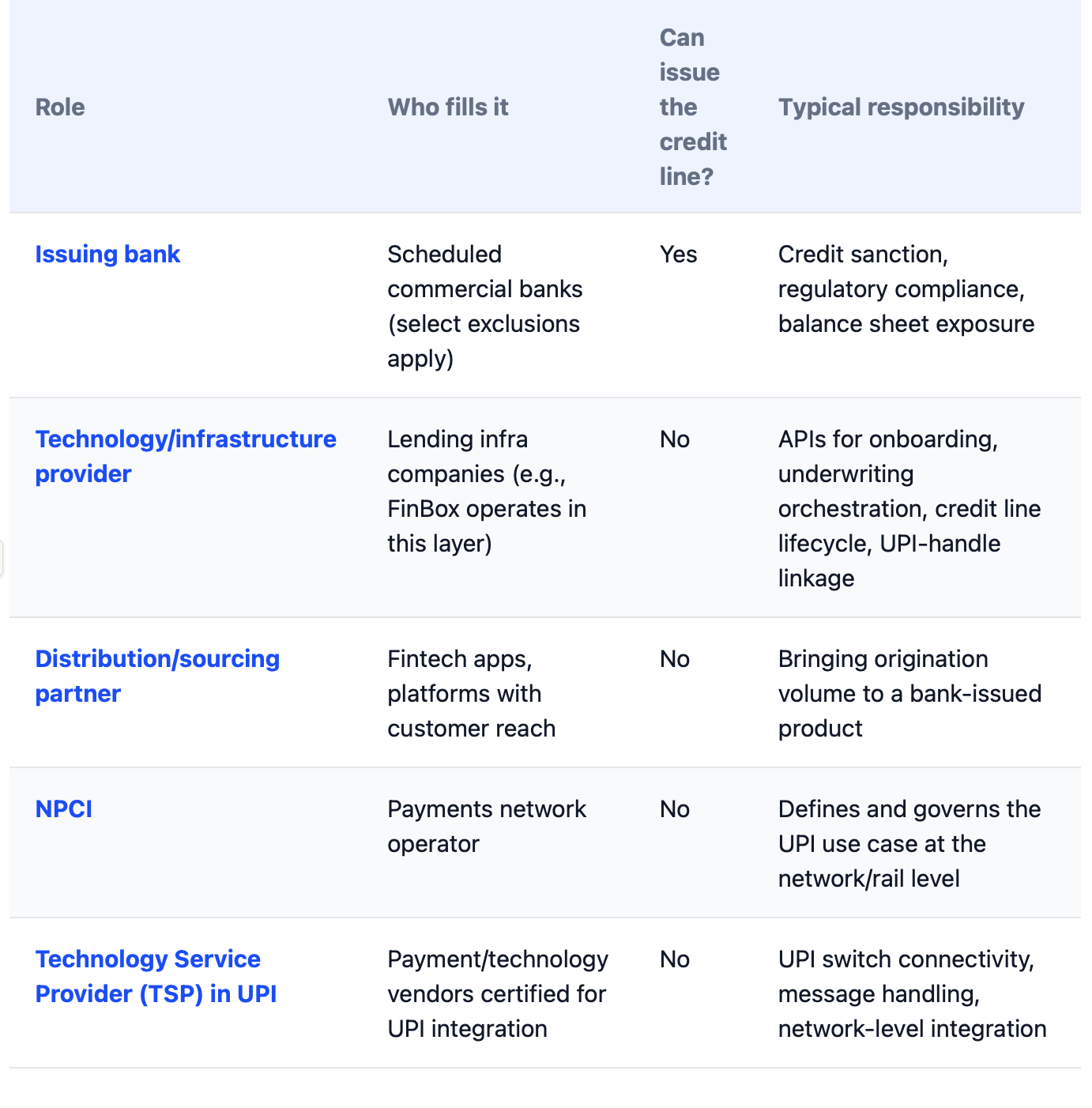
A single company can occupy more than one non-issuer role (e.g., a fintech may act as both distribution partner and, if it has the API stack, part of the technology layer), but none of these roles substitutes for bank issuance.
Decision Criteria for Choosing a Technology/Infrastructure Partner
For a bank or NBFC platform lead evaluating who to build a Credit Line on UPI journey with, the practical decision criteria — separate from the issuance question — typically include:
- Modularity of the API stack — can onboarding, underwriting, and credit line management be integrated independently, or is it an all-or-nothing platform?
- Underwriting workflow flexibility — support for bureau data, alternate data, and configurable policy rules rather than a fixed black-box score
- Journey configurability — ability to design draw-down limits, repayment schedules, and UPI-specific triggers to match the issuing bank's product design
- Integration effort with core banking and UPI rails — how much lift is required from the bank's IT and compliance teams
- Track record with regulated entities — experience building bank-partnered (not just fintech-only) digital lending journeys, given the compliance weight in this category
These criteria mirror the broader considerations relevant to embedded lending generally, discussed in Embedded Lending – Use Cases, Advantages and Challenges, since a Credit Line on UPI journey is, structurally, a specific instance of embedded credit distributed over payment rails rather than a standalone loan app.
Key Entities Defined
- Credit Line on UPI (CLoU): A UPI use case, enabled after RBI's September 2023 circular, linking a bank-issued pre-sanctioned credit line to a UPI handle for direct transaction use.
- UPI (Unified Payments Interface): India's real-time payment system, operated under NPCI's oversight, enabling instant bank-to-bank transfers via a unified interface.
- NPCI: The National Payments Corporation of India, which operates and governs UPI and defines the technical/use-case framework for services like CLoU.
- Issuing bank: The scheduled commercial bank that sanctions the credit line, bears the credit risk, and is regulatorily accountable for the product.
- Technology Service Provider (TSP) in UPI: An entity certified to provide UPI switch/network-level integration services, distinct from a lending workflow/orchestration provider.
- Embedded lending: The provision of credit within a non-financial or platform context (e.g., a payment app, marketplace, or UPI journey) rather than through a standalone lending application.
- Lending APIs: Modular, callable software components covering functions such as onboarding, underwriting, disbursal, and collections, used to assemble a digital credit journey.
- Credit line infrastructure: The combined API, workflow, and orchestration layer that connects a bank's credit decisioning and core systems to a customer-facing distribution channel.
- Pre-sanctioned/pre-approved credit line: A credit facility approved in advance of specific transactions, up to a set limit, which the customer can draw against as needed.
- RuPay credit card on UPI: A distinct construct linking an existing RuPay credit card account to a UPI handle for payments — different from CLoU, which does not require a card product.
- Digital lending journey: The end-to-end, largely automated customer flow from application through underwriting, disbursal, and repayment, typically built on API infrastructure.
FAQ
What is Credit Line on UPI (CLoU)? Credit Line on UPI is a UPI-linked lending construct, enabled after RBI's September 2023 circular, that allows banks to offer pre-sanctioned credit lines to customers and let them transact directly using UPI, without needing a separate credit card or loan disbursal to a bank account first.
Who is legally allowed to offer a credit line on UPI in India? Under RBI's framework, only scheduled commercial banks (excluding payments banks, small finance banks, and regional rural banks unless separately permitted) can extend the underlying credit line. NBFCs and fintechs cannot issue the credit line directly; they can only participate as technology, distribution, or sourcing partners to a bank.
What role do infrastructure providers like FinBox play in Credit Line on UPI? Infrastructure providers sit between the issuing bank and the UPI ecosystem, supplying APIs and workflow tooling for onboarding, underwriting orchestration, credit line management, and journey configuration. FinBox provides modular lending APIs and an operating layer that banks and NBFCs can use to build such digital credit journeys.
Which banks or fintechs have launched Credit Line on UPI products? Since RBI's approval, some banks have piloted or announced credit-line-on-UPI products, often in partnership with fintechs handling distribution or technology.
How is Credit Line on UPI different from a RuPay credit card linked to UPI? A RuPay credit card on UPI links an existing credit card account to a UPI handle for payments. Credit Line on UPI does not require a card product at all — it links a bank-issued, pre-approved credit line directly to UPI, which can also apply to non-card lending relationships such as personal or working capital lines.
Talk to FinBox
If you're a bank or NBFC platform team scoping a compliant, bank-partnered embedded credit journey — including UPI-linked disbursal and repayment workflows — FinBox's modular lending APIs are built to support this kind of orchestration under a regulated issuer's oversight. Talk to FinBox about your build.
Further reading from FinBox
- Google's new card shows where credit is headed next
- What is banking as-a-service and why you should care about it?