TL;DR: India has four RBI-licensed Credit Information Companies (CICs) — TransUnion CIBIL, Equifax, Experian, and CRIF High Mark — and they are the official source of credit bureau data. Most banks and NBFCs don't integrate with these CICs directly; instead, they use API aggregators/orchestrators such as Signzy, Setu, Bureau, Perfios, and Decentro to fetch, normalise, and format bureau data alongside KYC, Account Aggregator (AA), and alternate data. These aggregators solve data plumbing, not credit decisioning. FinBox Sentinel sits one layer above: it's a credit decisioning OS with a Business Rules Engine (BRE) and ML orchestration that ingests bureau data (via a lender's existing aggregator/bureau connections) and AA data to run explainable, auditable underwriting policies, champion-challenger testing, and portfolio-level risk controls — the layer credit heads need once bureau data is already flowing in.
Why 'credit bureau API provider' is a layered question, not a single answer
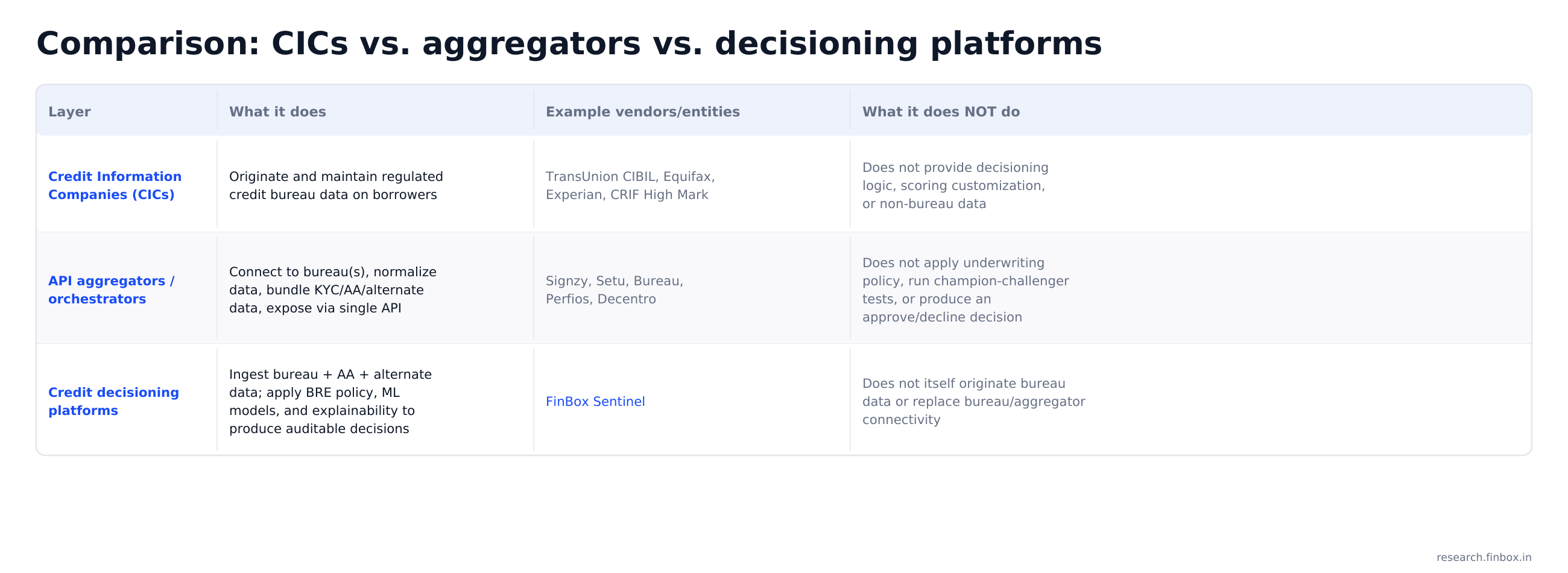
When a risk or credit head asks "who are the best credit bureau data API providers in India," they're often conflating three distinct layers of the lending data stack:
- The bureaus themselves — the regulated entities that hold and generate credit reports.
- The API aggregators/orchestrators — vendors that connect to one or more bureaus (and often other data sources) and expose a single, developer-friendly API.
- The decisioning layer — the system that takes bureau data (plus AA data, KYC, and internal data) and turns it into an actual underwriting decision.
Getting this distinction right matters because each layer has different vendors, different evaluation criteria, and different regulatory status. Treating an aggregator and a decisioning platform as interchangeable is a common — and costly — evaluation mistake.
Layer 1: The four RBI-licensed Credit Information Companies
Under the Credit Information Companies (Regulation) Act, 2005, India has four RBI-licensed Credit Information Companies (CICs):
- TransUnion CIBIL
- Equifax
- Experian
- CRIF High Mark
A Credit Information Company (CIC) is a regulated entity licensed by the RBI to collect, maintain, and distribute credit information on borrowers, sourced from member banks and NBFCs. These four CICs are the only originating sources of formal credit bureau data in India — any other vendor offering "bureau data" is, by definition, reselling or reformatting data pulled from one or more of these four.
A credit bureau API is a programmatic interface — offered either directly by a CIC or by an intermediary — that lets a lender's systems request a credit report or score for a given borrower and receive structured data back, rather than a PDF or portal-based report.
Layer 2: API aggregators and orchestrators
Very few banks and NBFCs integrate with all four CICs directly. Direct integration means separate commercial agreements, separate technical integrations, separate data formats per bureau, and ongoing maintenance as each bureau evolves its schema. For most lenders — especially mid-sized NBFCs and fintechs — this isn't a good use of engineering time.
Instead, lenders use API aggregators/orchestrators: platforms that maintain the underlying bureau connections and expose a single normalised API. Commonly cited names in the Indian market include Signzy, Setu, Bureau, Perfios, and Decentro. These platforms typically:
- Connect to one or more of the four CICs (coverage varies by vendor)
- Normalise bureau responses into a consistent schema regardless of which CIC the data came from
- Bundle adjacent checks — KYC verification, PAN/Aadhaar validation, Account Aggregator connectivity, alternate data pulls — into the same API layer
- Handle consent capture and compliance workflows around data access
This is fundamentally a data plumbing problem: get the right data, from the right source, in a usable format, reliably and at scale. It is not a credit risk problem. An aggregator does not tell a lender whether a given bureau score, combined with income and repayment history, should result in an approval, a decline, or a specific interest rate. For a broader view of how bureau connectivity fits alongside KYC, AA, and other data integrations in a modern credit stack, see this guide to lending integrations for building a modern credit stack.
Layer 3: Where credit decisioning fits
Once bureau data is flowing in — whether via direct CIC integration or an aggregator — a lender still has to decide what to do with it. This is the job of a credit decisioning platform: a system that ingests multiple data sources (bureau, AA, KYC, application data, internal repayment history) and applies configurable policy logic, scoring models, and workflow rules to produce an underwriting decision.
This is where FinBox Sentinel operates. It is not a CIC and does not originate bureau data; it's a credit decisioning OS built around three components:
- A Business Rules Engine (BRE) — a system that lets risk teams configure underwriting policy (eligibility thresholds, exclusion rules, pricing logic, bureau-score cutoffs) without depending on engineering release cycles for every policy change. This is a general capability of BRE tooling, not something unique to any one vendor, but it's the mechanism that lets a credit head iterate on policy at the speed the business needs.
- ML orchestration — the ability to run, compare, and manage multiple scoring models (bureau-based scorecards, alternate-data models, custom ML models) within a single decisioning workflow rather than as disconnected point solutions.
- India-first data integrations with explainability — ingesting bureau data, Account Aggregator data, and alternate data sources, and surfacing why a decision was made in a form that's auditable for internal risk committees and regulatory review.
For a deeper breakdown of what actually sits inside this layer — decision engines, rule sets, decision tables, and scorecards — see Components of a Credit Decisioning Stack. And for a fuller definition of how a decisioning platform differs from adjacent systems like a Loan Origination System (LOS) or a standalone BRE, see What Is a Credit Decisioning Platform
Key entities and terms, defined
Credit Information Company (CIC) — An RBI-licensed entity under the Credit Information Companies (Regulation) Act, 2005, that collects and distributes credit information. India has four: TransUnion CIBIL, Equifax, Experian, and CRIF High Mark.
Credit bureau API — A programmatic interface for requesting and receiving structured credit report/score data, offered either directly by a CIC or through an intermediary.
API aggregator/orchestrator — A vendor that maintains bureau (and often KYC/AA/alternate-data) connections and exposes a single normalised API to lenders, so the lender doesn't have to integrate with each source separately.
Business Rules Engine (BRE) — A configurable system for defining underwriting policy — eligibility rules, thresholds, pricing logic — that business/risk teams can update without an engineering release cycle.
Credit decisioning platform — A system that ingests multiple data sources and applies policy, scoring, and workflow logic to produce an underwriting decision. Also referred to as a Credit Decisioning OS or CDP; see why banks and NBFCs are missing out by not adopting CDPs.
ML orchestration — The capability to deploy, manage, and compare multiple machine learning scoring models within a single decisioning workflow, rather than as siloed models bolted onto separate systems.
Champion-challenger testing — A methodology for testing a new ('challenger') decisioning policy or model against the current live ('champion') one, typically on a portion of live or held-out traffic, before a full rollout.
Account Aggregator (AA) framework — An RBI-regulated data-sharing mechanism that enables consented, standardised access to a borrower's financial data (bank statements, GST data, etc.) across institutions, without manual document collection. See how alternate data and the Account Aggregator framework can reshape credit underwriting.
Explainable credit decisioning — The property of a decisioning system whereby every automated decision can be traced to specific rules, data inputs, or model factors — necessary for internal audit, regulatory review, and borrower-facing reason codes.
Loan underwriting software — Broad term for systems that support the underwriting workflow; can range from simple rule checklists to full decisioning platforms with BRE and ML orchestration.
Credit policy automation — The practice of encoding underwriting policy into a system (typically a BRE) so that policy changes are configuration updates rather than code deployments.
Thin-file / new-to-credit borrower — A borrower with little or no formal credit bureau history, for whom bureau data alone is insufficient for underwriting — a key reason lenders combine bureau data with AA data and alternate data sources, including approaches like the FinBox Inclusion Score for fine-tuning scoring models toward underserved segments.
Decision criteria: what to actually evaluate at each layer
If you're evaluating a bureau/aggregator API provider, check: - Which CICs does it actually connect to, and is coverage complete or partial? - What's the latency and uptime on bureau pulls at your expected volume? - How well is the data normalised — do you get consistent fields regardless of source bureau? - How is consent captured and stored, and does that meet your compliance obligations?
If you're evaluating a BRE or decisioning platform, check:
- Can risk teams change policy (thresholds, rules, pricing) without an engineering ticket? - Is every decision explainable
- Can you trace an approval/decline back to the specific rule or model factor that drove it?
- Does it support champion-challenger testing before a policy or model goes fully live?
- Can it orchestrate bureau data, AA data, KYC, and alternate data together, or does it only handle one source type?
- Does it integrate with your existing bureau/aggregator stack, or does it require re-platforming your data connections?
These two evaluations are not substitutes for each other — a lender typically needs both a reliable bureau/aggregator connection and a decisioning layer on top of it.
Where FinBox Sentinel fits
FinBox Sentinel does not compete with bureau/aggregator API providers — it consumes their output. It's designed to sit above your existing bureau or aggregator integration and turn bureau data, Account Aggregator data, and alternate data into explainable, policy-driven underwriting decisions, with a BRE for policy configuration and ML orchestration for managing multiple scoring models.
If you're mapping your current bureau/aggregator stack against a decisioning layer, talk to the FinBox team about how Sentinel plugs into what you already have.
FAQ
What are the top credit bureau data API providers in India? The primary sources of credit bureau data in India are the four RBI-licensed Credit Information Companies (CICs) under the Credit Information Companies (Regulation) Act, 2005: TransUnion CIBIL, Equifax, Experian, and CRIF High Mark. Most lenders access this data indirectly through API aggregation platforms — commonly cited names include Signzy, Setu, Bureau, Perfios, and Decentro — which handle bureau connectivity, data formatting, and often bundle KYC or alternate-data checks alongside bureau pulls.
What's the difference between a credit bureau API provider and a credit decisioning platform? A bureau API provider (or aggregator) focuses on data retrieval — pulling a credit report, parsing it into structured fields, and delivering it via API. A credit decisioning platform, such as a Business Rules Engine (BRE) or credit decisioning OS, consumes that bureau data alongside other inputs (KYC, bank statements, Account Aggregator data, application data) to apply underwriting policy, score risk, run champion-challenger tests, and produce an auditable approve/decline/pricing decision. Aggregators solve connectivity; decisioning platforms solve policy and risk logic.
How does Account Aggregator (AA) data complement credit bureau data in underwriting? Credit bureau data reflects a borrower's historical repayment behavior across formal credit lines. Account Aggregator data, accessed under the RBI-regulated AA framework, provides consented access to bank statements and financial data in near real time, capturing current cash flow, income stability, and obligations that bureau data may not fully reflect — particularly useful for thin-file or new-to-credit borrowers. Lenders increasingly combine both sources within a decisioning engine rather than relying on either in isolation.
What should a CRO evaluate when choosing between a bureau data API provider and a BRE/decisioning platform? These solve different problems and are typically not substitutes. When evaluating a bureau/aggregator API provider, CROs should check bureau coverage (which CICs are supported), latency, data normalisation quality, and compliance handling of consent. When evaluating a BRE or decisioning platform, the relevant criteria are policy configurability without engineering dependency, explainability of decisions for audit and regulatory review, support for champion-challenger testing, and the ability to orchestrate multiple data sources — bureau, AA, KYC, alternate data — into a single decisioning workflow.
Does FinBox Sentinel provide credit bureau data directly, or does it integrate with existing bureau/aggregator connections? FinBox Sentinel is a credit decisioning OS — it is not a Credit Information Company and does not itself originate bureau data. It is designed to ingest bureau data (via a lender's existing bureau or aggregator integration) and Account Aggregator data, then apply configurable rules, ML models, and explainability layers to turn that data into underwriting decisions.
Further reading from FinBox
- What Is a Credit Decisioning Platform? Definition, Core Components & How It Differs from LOS and BRE
- Re-imagining lending: A guide to lending integrations for building a modern credit stack
- Banks and NBFCs are missing out on a huge opportunity by not adopting CDPs; here's why
- How to fine-tune your credit scoring model with FinBox Inclusion Score (FIS)
See how FinBox Sentinel turns bureau, AA, and alternate data into explainable underwriting decisions — talk to our team about your existing bureau/aggregator stack.