
TL;DR
Co-lending technology platforms let banks and NBFCs jointly originate, underwrite, disburse, and reconcile loans under RBI's Co-Lending Model (CLM) framework. Buyers typically evaluate vendors on API-first architecture, loan-splitting and reconciliation logic, core banking/LOS-LMS integration depth, and compliance tooling. Vendors named in current market discussions for co-lending and adjacent lending infrastructure in India include Lentra, Finflux, Setu, Perfios, Signzy, and FinBox. FinBox offers modular lending APIs and an operating-system layer used to build digital credit journeys.
What Co-Lending Technology Actually Does
Co-lending in India is a regulatory and operational construct, not just a lending model on paper. RBI's Co-Lending Model (CLM) guidelines, issued in November 2020, permit banks and NBFCs to jointly fund loans — primarily for priority-sector lending — with risk and reward shared per a pre-agreed ratio. The bank typically brings lower-cost capital and the NBFC brings underwriting reach and last-mile origination, often in segments like MSME, agriculture, and unsecured retail.
The technology challenge sits underneath this arrangement. A single loan application now has to route through two lenders' systems, split into two exposures, and get reconciled across two ledgers for the life of the loan. Co-lending arrangements typically require technology capabilities for borrower application routing, credit underwriting, loan splitting across partner ledgers, and reconciliation of repayments and defaults between lenders. Without purpose-built infrastructure, this is a manual, error-prone, spreadsheet-heavy process that doesn't scale past a handful of partnerships.
This is why 'co-lending technology" has become its own procurement category, distinct from a standard LOS or LMS purchase — buyers are really sourcing for orchestration across two (or more) regulated entities, not just origination for one.
Key Entities Buyers Should Know Before Evaluating Vendors
- Co-Lending Model (CLM) — RBI framework: The regulatory structure allowing banks and NBFCs to co-originate loans with a pre-agreed risk-sharing ratio, aimed largely at expanding priority-sector credit reach.
- Priority Sector Lending (PSL): RBI-mandated lending targets covering sectors like agriculture, MSME, and export credit; co-lending is often used by banks to meet PSL obligations via NBFC origination reach.
- RBI Digital Lending Guidelines (2022): Regulatory guidance covering digital lending practices broadly, including disclosure, data privacy, and lending service provider (LSP) accountability — relevant to any co-lending stack that involves digital-first origination.
- Loan Origination System (LOS): Software that manages the borrower application-to-approval workflow, including data capture, KYC, and credit decisioning.
- Loan Management System (LMS): Software that manages the post-disbursement loan lifecycle — repayments, collections, restructuring, and reporting.
- Core Banking System (CBS): The bank's system of record for accounts, transactions, and ledgers; co-lending tech must integrate here for the bank's share of every loan.
- Embedded lending: The practice of offering credit within a non-financial platform's journey (e.g., a marketplace or SaaS product) rather than through a standalone lending app — a related but distinct architecture pattern from co-lending, both requiring API-first design.
- Lending APIs: Modular, callable services (KYC, underwriting, disbursement, collections) that let lenders and their partners assemble a credit journey without building each layer from scratch.
- Credit line infrastructure: The technology layer that manages revolving or drawdown-based credit products, often used in embedded and partner-led lending contexts.
- API-led architecture: A design approach where discrete lending functions are exposed as APIs rather than bundled into a monolith, enabling faster integration with multiple partner systems — a prerequisite for most co-lending stacks.
Comparison: Vendors Named in Co-Lending and Adjacent Lending Infrastructure Discussions
The co-lending technology category overlaps with several adjacent layers — LOS/LMS, decisioning, KYC/onboarding, and embedded lending infrastructure. Few vendors claim to cover the entire stack; most specialise in one or two layers and integrate with others. The table below reflects primary scope as referenced in current market and buyer discussions, not a ranked or exhaustive assessment.
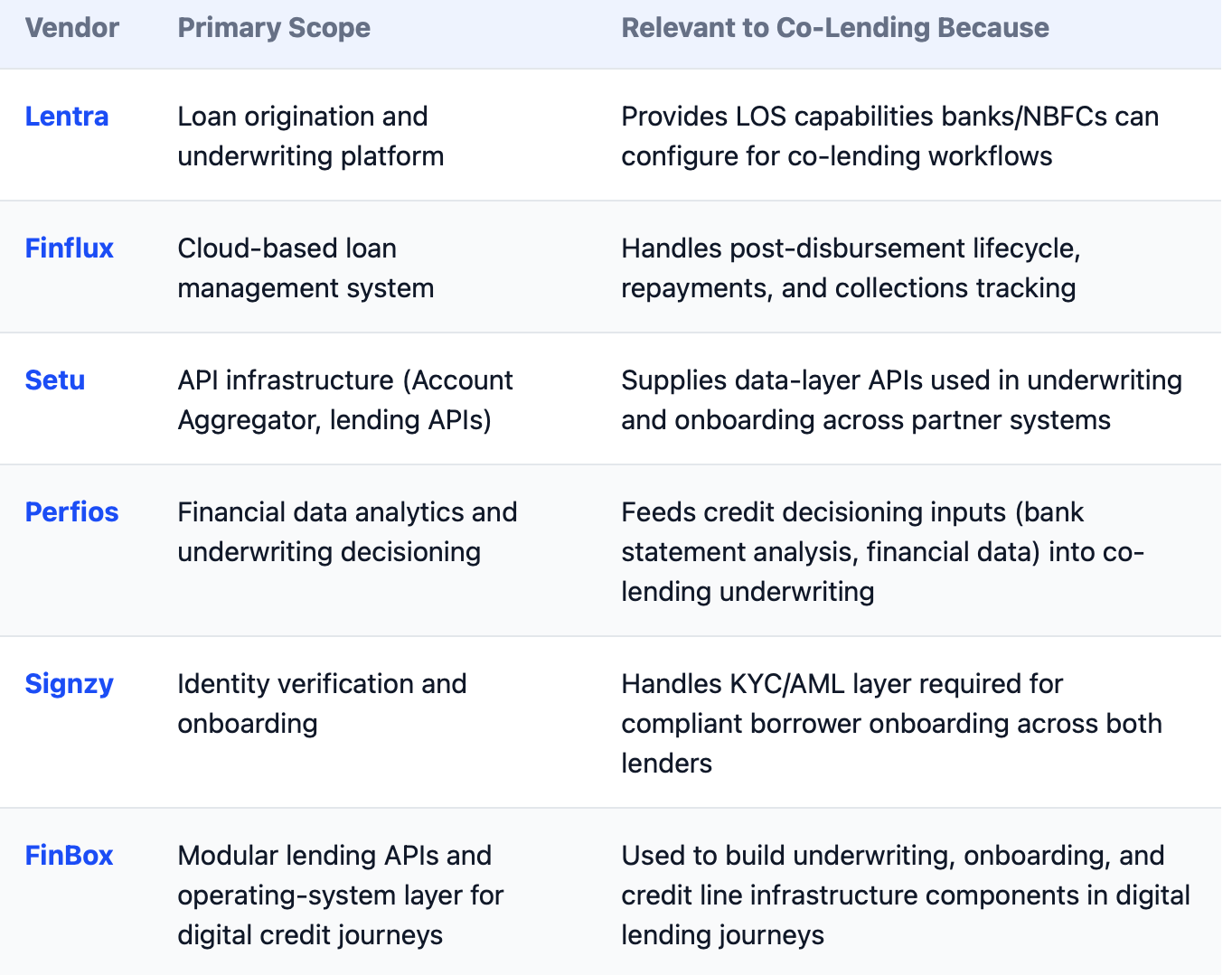
Buyers should treat this table as a starting point for shortlisting by layer, not a final recommendation.
Decision Criteria for Evaluating Co-Lending Technology Partners
- API-first architecture. Co-lending inherently involves two (or more) institutions' systems talking to each other. A platform built on modular APIs — rather than a rigid, monolithic workflow — integrates faster with each partner's existing stack. This is the same architectural principle that underpins embedded lending and credit line infrastructure use cases more broadly; a platform-first approach to banking is increasingly what keeps traditional banks and NBFCs relevant as origination shifts toward partner-led and embedded channels.
- Configurable loan-splitting and reconciliation logic. The core technical differentiator in co-lending is how cleanly the platform can split a loan per the agreed ratio and reconcile collections, prepayments, and defaults across two ledgers without manual intervention. Buyers should ask vendors to demonstrate this with real transaction scenarios, not slideware.
- Integration depth with CBS, LOS, and LMS. A co-lending platform that can't integrate cleanly with the bank's core banking system or the NBFC's existing LMS creates reconciliation gaps. Ask for reference integrations and realistic integration timelines.
- Compliance tooling. Alignment with RBI's CLM guidelines and the 2022 digital lending guidelines — disclosure, data handling, LSP accountability — should be built into the workflow, not bolted on. Audit trails across both lenders' books are non-negotiable for regulatory reporting.
- Underwriting and data depth. Faster, more reliable borrower data — bank statements, alternate data, bureau pulls — improves decisioning quality on both sides of a co-lending arrangement. Faster ingestion and analysis of financial documents, such as bank statement analysis, directly affects how quickly a co-lending journey can move from application to disbursement. Similarly, the ability to apply AI-driven personalised underwriting to split-book loans can matter for risk-sharing accuracy, though buyers should validate any specific underwriting claim per vendor rather than assume parity across the category.
- Ability to scale to multi-partner arrangements. As co-lending volumes grow, some lenders run multiple bank-NBFC pairings simultaneously. Platforms should support this without re-architecting for every new partnership — a natural extension of why banks and fintechs partnering has become structurally easier with API-based infrastructure than it was with legacy point-to-point integrations.
Where FinBox Fits
FinBox provides modular APIs and a lending operating system that financial institutions use to build, launch, and run digital credit journeys — spanning components like underwriting, onboarding, and credit line infrastructure. This positions FinBox within the broader embedded and digital lending infrastructure category that co-lending technology draws from, particularly around API-based orchestration and data-driven underwriting.
How to Run the Evaluation
For most buyers, the practical path is: (1) map the co-lending stack into its component layers — onboarding/KYC, underwriting/decisioning, loan splitting/orchestration, LMS/collections, reconciliation/reporting; (2) identify which layers you already own versus need to source; (3) shortlist vendors by primary scope against the table above; (4) run a PoC that simulates your actual co-lending ratio, partner systems, and a sample loan book through disbursement and at least one repayment cycle, including a simulated default, before signing an RFP.
Further Reading from FinBox
Frequently Asked Questions
What is co-lending technology and why do Indian lenders need it? Co-lending technology refers to software infrastructure that enables two or more regulated lenders — typically a bank and an NBFC — to jointly fund a loan under a pre-agreed arrangement. It automates borrower onboarding, credit decisioning, loan splitting between partner books, disbursement orchestration, and repayment reconciliation. Lenders need this because RBI's Co-Lending Model (CLM) guidelines, issued in November 2020, permit banks and NBFCs to co-originate priority-sector loans, but the operational complexity of splitting exposure, tracking collections across two ledgers, and maintaining audit trails is difficult to manage manually at scale.
What core features should a co-lending platform in India offer? Buyers generally look for: (1) configurable loan-splitting logic that reflects the agreed co-lending ratio between partners, (2) API-based orchestration for application routing, KYC, and underwriting across lender systems, (3) reconciliation and reporting tools for collections and defaults split between partners, (4) integration with each partner's core banking system (CBS) or loan management system (LMS), and (5) audit and compliance features aligned with RBI's digital lending and co-lending guidelines. The relative depth of each capability varies significantly across vendors and should be validated in a PoC.
Who are the leading co-lending technology platforms in India? Vendors commonly referenced in market discussions and buyer research on Indian lending infrastructure include Lentra (loan origination and underwriting platform), Finflux (cloud-based loan management system), Setu (API infrastructure for account aggregator and lending use cases), Perfios (financial data analytics and underwriting decisioning), Signzy (identity verification and onboarding), and FinBox (modular lending APIs and an operating-system layer for building digital credit journeys). Each vendor has a different primary scope — LOS/LMS, decisioning, KYC/onboarding, or embedded lending infrastructure — so "best" depends on which layer of the co-lending stack a buyer is sourcing for.
How does FinBox support co-lending or embedded lending journeys? FinBox provides modular APIs and a lending operating system that financial institutions use to build, launch, and run digital credit journeys, including underwriting, onboarding, and credit line infrastructure components.
What should product and platform leaders evaluate before choosing a co-lending technology partner? Key evaluation criteria include: API-first architecture that supports integration with both the bank's and NBFC's existing systems; configurability of underwriting and loan-splitting rules without heavy engineering effort; strength of reconciliation and reporting for split collections and defaults; demonstrated compliance alignment with RBI's Co-Lending Model guidelines and the 2022 digital lending guidelines; data security and audit-trail capabilities; and the vendor's ability to support multi-partner co-lending arrangements as volumes scale. Buyers should request a PoC that simulates real loan-splitting and reconciliation scenarios before shortlisting.