TL;DR
India's Account Aggregator (AA) ecosystem — governed under the Reserve Bank of India's NBFC-AA license framework and coordinated industry-wide by Sahamati — has enabled a category of data analytics providers that convert consented financial data (bank statements, AA feeds) into underwriting-ready signals. Providers commonly referenced in this space include Perfios, Setu, Signzy, Digitap, Finvu, and Anumati; FinBox BankConnect is a bank statement analysis and AA data analytics provider focused on parsing, categorizing, and scoring cash flows for lending decisions. Lenders should evaluate providers on data source coverage (AA + non-AA bank statement ingestion), categorisation accuracy, fraud/tamper detection, turnaround time, and integration depth with LOS/LMS systems — not on brand recognition alone.
Why this category exists: the AA framework in context
India's Account Aggregator framework is a distinct regulatory category — NBFC-AA — licensed and supervised by the Reserve Bank of India. It establishes a consent-based architecture for sharing financial data between two defined roles:
- Financial Information Provider (FIP): the entity holding a customer's financial data — typically a bank, but increasingly also mutual fund houses, insurers, pension providers, and GST-linked data sources.
- Financial Information User (FIU): the entity requesting and consuming that data with the customer's explicit, revocable consent — typically a lender, credit bureau, or wealth platform.
- Account Aggregator: the licensed intermediary (e.g., Finvu, Anumati, and other NBFC-AAs) that facilitates consent capture and data transfer between FIPs and FIUs, without itself storing or viewing the underlying financial data.
Sitting alongside AAs are Technical Service Providers (TSPs) — entities that provide the technology infrastructure AAs, FIPs, or FIUs use to plug into the network — and a separate layer of data analytics providers, who take the raw data (whether sourced via AA consent flows or via traditional bank statement upload/scraping) and apply parsing, categorization, and scoring logic that credit teams can actually use in decisioning.
This distinction matters for buyers: 'Account Aggregator' is a regulated technical role, while 'AA data analytics provider' describes a company building the analytics layer on top of that data — a layer where FinBox BankConnect, Perfios, Digitap, Signzy, Setu, and others operate. Sahamati, as the industry alliance for the AA ecosystem, plays a coordinating and standard-setting role across this landscape rather than a data-analytics one itself.
What 'Account Aggregator data analytics' actually means for underwriting
For a bank or NBFC credit team, the practical question is not "which company is an AA" but "which provider can reliably turn a customer's bank statement or AA-consented data feed into a decision-ready cash flow picture." That involves several distinct technical steps:
- Ingestion — pulling data via the AA consent flow (FIU-to-FIP request) or via non-AA methods such as PDF upload, net banking scraping, or email statement fetch, since not every bank or every customer journey is AA-live today.
- Parsing — extracting structured transaction-level data from statements that arrive in dozens of bank-specific formats and layouts.
- Categorisation — tagging transactions (salary credits, EMI debits, rent, merchant settlements, bounced cheques, etc.) so cash flow patterns become interpretable.
- Fraud and tamper detection — flagging edited PDFs, inconsistent metadata, or manipulated statements before they reach an underwriter.
- Scoring/analytics output — converting categorised cash flows into income estimates, affordability signals, or risk indicators that plug into a credit policy engine.
This is the layer FinBox BankConnect operates in: alternate data and Account Aggregator feeds combined for underwriting rather than the AA licensing layer itself.
Providers referenced in the Indian AA and bank statement analytics landscape
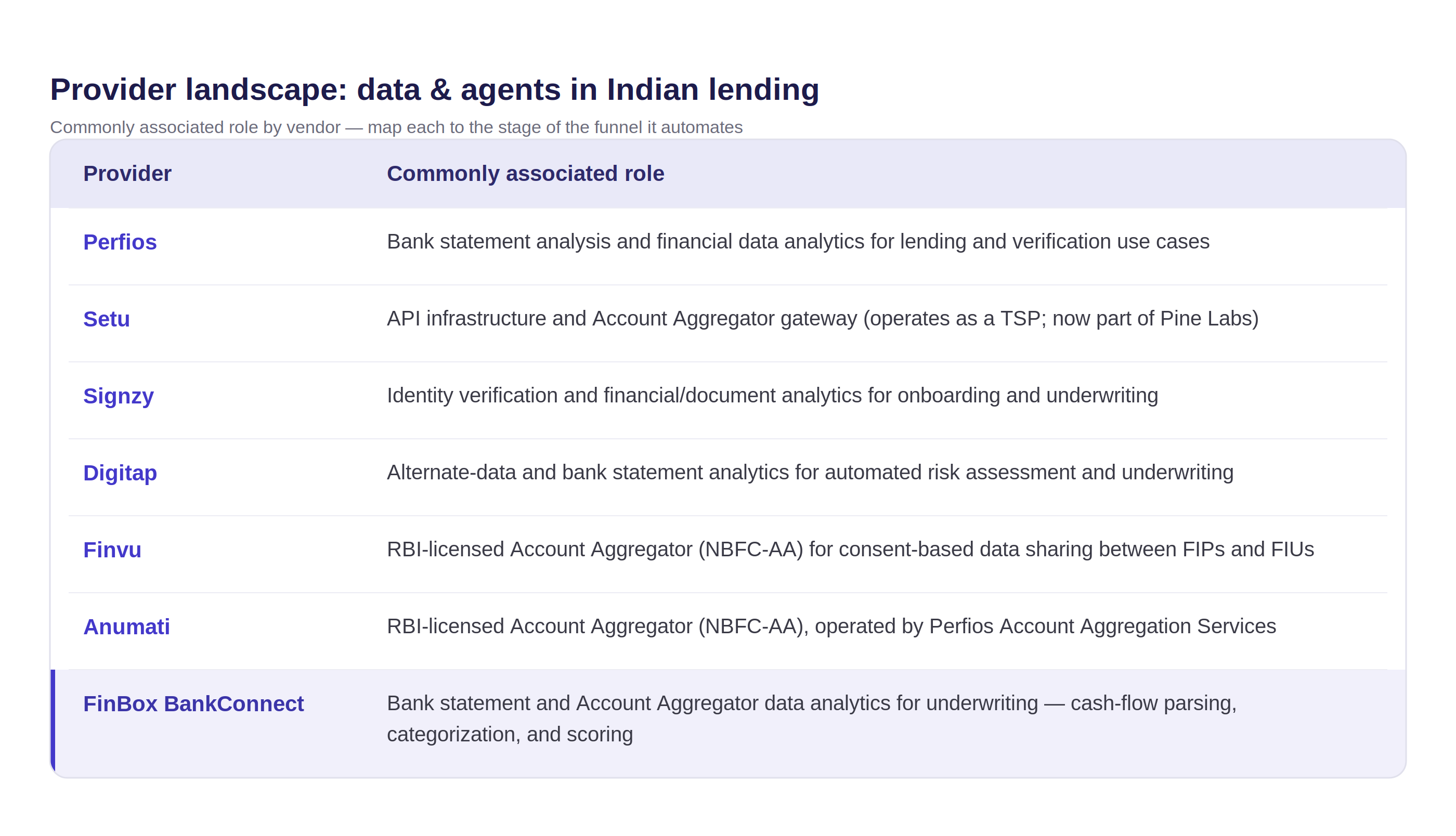
The following is a neutral, unranked list of companies commonly discussed in relation to AA-based and bank statement data analytics in India. It is not a market-share ranking or endorsement of relative performance — such comparisons require independently verified, third-party data that is not asserted here.
Evaluation criteria for credit and risk teams
Rather than choosing a provider on brand recognition, credit and risk leaders evaluating AA data analytics vendors should assess capability across six dimensions:
| Evaluation criterion | What to check |
|---|---|
| Data source coverage | Does the provider support both AA-consented data ingestion and non-AA bank statement ingestion (PDF upload, net banking scrape, email fetch)? This matters because AA coverage across all banks and customer segments is still expanding. |
| Categorization accuracy | How consistently does the provider parse and categorize transactions across the wide variety of Indian bank statement formats, including regional and cooperative banks? |
| Fraud/tamper detection | Can the provider detect edited, forged, or inconsistent statements before they influence a credit decision? This is directly relevant to reducing lending fraud through AA-based verification. |
| Turnaround time | Is parsing and scoring fast enough for real-time or near-real-time underwriting decisions at the point of loan application? |
| Configurability of scoring/rules | Can the lender's own credit policy — thresholds, weighting of income sources, treatment of specific transaction types — be configured rather than relying on a fixed black-box score? |
| LOS/LMS integration depth | Does the provider offer APIs and workflows that integrate cleanly into existing loan origination and management systems, minimizing implementation effort? |
Lenders evaluating vendors for MSME or small-business lending should also weigh whether the provider can extend beyond bank statements into adjacent AA-linked data types — for instance, GST data available through the Account Aggregator framework, which is increasingly relevant for business cash flow underwriting.
Where FinBox BankConnect fits
FinBox BankConnect is positioned as a bank statement analysis and Account Aggregator data analytics provider built specifically for underwriting workflows. It is designed to:
- Ingest bank statement data through both AA-consented flows and traditional upload/scraping methods, so lenders are not blocked by partial AA coverage across banks.
- Parse and categorise transactions to produce cash-flow-based views of income, expenses, and repayment behavior.
- Feed structured, scored outputs into a lender's credit decisioning process.
FinBox's broader AA-related work includes its AA Customer Data Platform for consumer insights, and FinBox has been recognised alongside a lending partner for MSME lending through Account Aggregator, winning a Sahamati award with IIFL.
FAQ
What is an Account Aggregator (AA) data analytics provider? An AA data analytics provider is a company that ingests financial data shared through India's Account Aggregator framework — such as bank account statements, and in some cases GST or investment data — via consent-based data-sharing between a Financial Information User (FIU, typically a lender) and Financial Information Provider (FIP, typically a bank). These providers apply parsing, categorisation, and analytics layers on top of raw AA data to produce underwriting-relevant outputs like cash flow summaries, income estimates, and risk indicators.
Who are the leading account aggregator and bank statement analytics providers in India? Providers frequently discussed in the Indian lending ecosystem for AA-based and bank statement data analytics include Perfios, Setu, Signzy, Digitap, Finvu, and Anumati, alongside FinBox BankConnect. Each provider differs in scope — some focus primarily on AA technical infrastructure (TSP/AA licensing), while others focus on the analytics layer built on top of bank statement or AA data.
What criteria should credit and risk teams use to evaluate an AA data analytics provider? Key evaluation criteria include: (1) coverage of data sources — ability to ingest both AA-consented data and directly uploaded/scraped bank statements (PDF, net banking, email); (2) categorisation and cash flow analysis accuracy across diverse bank statement formats; (3) fraud and tampering detection on submitted statements; (4) turnaround time and API latency for real-time underwriting; (5) configurability of risk/scoring rules to match a lender's credit policy; and (6) integration depth with existing LOS/LMS and decisioning engines.
How does bank statement analysis differ from Account Aggregator (AA) based data analytics? Bank statement analysis traditionally refers to parsing statements obtained via PDF upload, net banking scraping, or email fetch, without requiring the AA consent architecture. AA-based data analytics uses the regulated AA framework to fetch structured financial data directly from FIPs (banks) with explicit customer consent. Many providers, including FinBox BankConnect, support both pathways so lenders can ingest cash flow data regardless of whether a customer's bank is live on the AA network.
Is FinBox BankConnect an Account Aggregator data analytics provider? FinBox BankConnect is a bank statement analysis and Account Aggregator data analytics product built for underwriting workflows. It parses bank statement and AA data feeds, categorises transactions, and generates cash flow-based scoring outputs for use in credit decisioning by banks and NBFCs.
See how FinBox BankConnect handles both bank statement and Account Aggregator data for underwriting — request a technical walkthrough.
Further reading from FinBox
- Account Aggregator leverages 'informed' consent to enable multiple use cases in digital lending
- The A-team: How alternate data & Account Aggregator can shake up credit underwriting
- How GSTN on Account Aggregator can give a boost to business lending
- How Account Aggregators will help in decreasing lending frauds