
TL;DR
A credit bureau API lets a bank or NBFC programmatically pull a borrower's credit report and score from bureaus like CIBIL, Experian, Equifax, or CRIF High Mark directly into their loan origination system (LOS) or decisioning engine, replacing manual pulls. On its own, a bureau API only returns raw bureau data — it does not apply credit policy, score thresholds, or blend bureau data with Account Aggregator, GST, or bank-statement data. A credit decisioning platform like FinBox Sentinel sits on top of one or more bureau APIs, using a Business Rules Engine (BRE) and ML orchestration to convert bureau output into an underwriting decision, with full explainability and champion-challenger testing across policy versions.
What Is a Credit Bureau API?
A credit bureau API is a programmatic interface — typically REST-based — that allows a lender, or an authorised lending-technology partner acting on the lender's behalf, to request a borrower's credit report and score directly from a credit bureau in real time. Instead of a credit officer manually logging into a bureau portal, uploading a PAN, and downloading a PDF report, the LOS or underwriting system fires an API call with consented borrower identifiers and receives a structured (usually JSON or XML) response within seconds.
This matters operationally for three reasons:
- Speed — real-time bureau pulls are a prerequisite for instant or near-instant digital lending journeys.
- Consistency — API responses are structured and machine-readable, removing the manual parsing errors that come with PDF reports.
- Auditability — every API call and response can be logged with a timestamp and consent artifact, which matters for regulatory review.
Who operates credit bureau APIs in India
TransUnion CIBIL, Experian, Equifax, and CRIF High Mark are the four RBI-licensed Credit Information Companies (CICs) operating in India. Each is regulated under India's credit information company framework, which governs how consumer and commercial credit data is collected, stored, and shared with member lenders. Each bureau operates its own API, with its own authentication mechanism, field naming conventions, and response schema — which is one of the first points of friction lenders encounter when integrating directly.
What Does a Credit Bureau API Actually Return?
Regardless of which bureau is called, a typical consumer bureau API response includes:
- Credit score (bureau-specific scoring range and model version)
- Active and closed loan/credit accounts — lender name, loan type, sanctioned amount, outstanding balance
- Repayment history — days-past-due (DPD) grid, typically covering the last 24–36 months
- Credit enquiries — count and recency of hard enquiries from other lenders
- Credit utilisation — especially for revolving credit lines
- Identifiers and demographic fields used for identity matching (PAN, name, address, date of birth)
What the API does not return is a decision. It does not tell the lender whether this applicant meets their internal policy, how this score should be weighted against income data, or what to do with a thin-file applicant who has almost no bureau history. That interpretation layer is a separate system — and it's where most of the integration effort in a lending stack actually goes.
Direct Bureau API vs. Bureau API Aggregator vs. Credit Decisioning Platform
This is the decision most credit and engineering teams are actually navigating when they search "credit bureau API" — not just "how do I call CIBIL's API" but "what layer should sit between the bureau and my underwriting decision."
Three broad categories exist in the market:
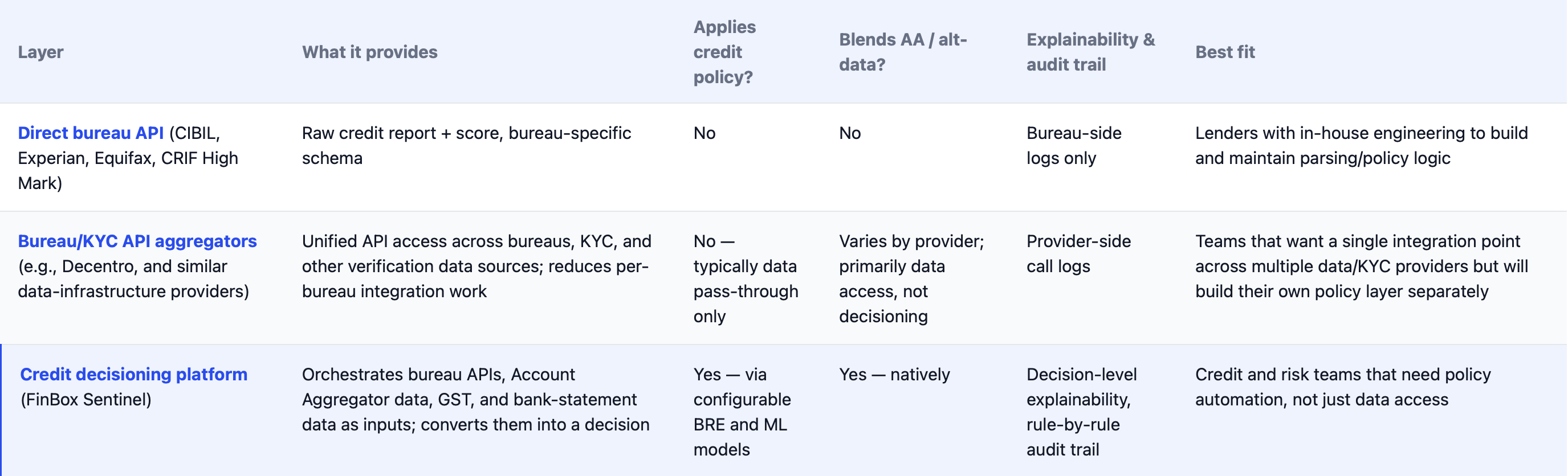
The key distinction: direct bureau APIs and bureau/KYC API aggregators solve data access. A credit decisioning platform solves decisioning — it's the layer that takes bureau output (from any of the above) and turns it into an approve/decline/refer outcome that a credit team actually configured. For a fuller breakdown of what separates a decisioning platform from a loan origination system or a standalone rules engine, see What Is a Credit Decisioning Platform? Definition, Core Components & How It Differs from LOS and BRE.
How a Credit Bureau API Fits Into the Broader Decisioning Stack
In a standalone integration, a lender's engineering team has to:
- Write and maintain the API call and authentication logic per bureau
- Parse each bureau's report format into usable fields
- Hard-code policy thresholds (e.g., "decline if score < 650") directly into application code
- Manually update this logic every time credit policy changes
This is brittle. Policy changes become engineering tickets, not credit-team configuration changes. It's also why most maturing lending operations eventually decouple bureau data access from policy logic.
In a decisioning OS such as FinBox Sentinel, the bureau API call is orchestrated as one data source among several — bureau data sits alongside Account Aggregator bank-statement data, GST returns, and other alternate data within a single ingestion layer. Parsed bureau attributes (score, DPD grid, utilisation, enquiry count) are fed directly into a configurable Business Rules Engine (BRE), where credit teams — not engineers — can adjust thresholds, add new rules, or run a new policy version against live traffic before full rollout. This structure of decision engine, rules, tables, and scorecards working together is covered in more detail in Components of a Credit Decisioning Stack: Decision Engine, Rules, Tables & Scorecards Explained.
For NBFCs specifically evaluating whether to build this layer in-house, integrate a point solution, or adopt a full platform, the trade-offs around implementation timeline, team ownership, and total cost of maintenance are laid out in Choosing the best credit underwriting software for NBFCs in India (2026 Comparison Guide).
Where Bureau Data Falls Short — and What Fills the Gap
Bureau data reflects formal credit history — existing loans, repayment discipline, enquiry patterns. It says very little about:
- Real-time income and cash-flow stability
- Banking behavior — bounce frequency, average balances, inflow consistency
- Borrowers who are "new-to-credit" or thin-file, where there simply isn't enough bureau history to score confidently
This is where Account Aggregator (AA) framework data becomes complementary rather than competitive. Under the RBI-regulated AA framework, borrowers can consent to share bank statement and transaction-level data directly with a lender or its authorised technology partner, separate from and in addition to bureau data access, which is governed under CIC regulations. Combining the two — bureau history plus consented cash-flow data — gives a materially fuller risk picture, particularly for new-to-credit or self-employed applicants where bureau thickness alone underrepresents actual repayment capacity. The interplay between alternate data and AA data in underwriting is explored further in The A-team: How alternate data & Account Aggregator can shake up credit underwriting.
A decisioning OS that treats bureau APIs and AA data as parallel inputs into the same BRE — rather than two systems a credit analyst has to reconcile manually — removes a meaningful chunk of the operational overhead that shows up during underwriting review.
Decision Criteria: What to Evaluate Before Choosing a Bureau API Integration Path
When a credit or engineering team is deciding how to bring bureau data into their stack, the practical questions to work through are:
- How many bureaus do you need concurrently? Multi-bureau pulls (e.g., CIBIL + CRIF High Mark for cross-verification) multiply integration and reconciliation effort if built in-house.
- Who owns policy changes — engineering or credit risk? If credit policy needs to change without a code deployment, a BRE layer is not optional.
- Do you need explainability for audit or regulatory review? Explainable credit decisioning — the ability to trace exactly why a rule, score, or model output led to a given approve/decline/refer outcome — is increasingly a baseline expectation for internal audit, not a nice-to-have.
- Will you need to test policy changes safely? Champion-challenger testing allows a credit team to run a new policy or model version against the existing one on live traffic before committing to a full rollout, reducing the risk of a bad policy change reaching the entire portfolio.
- Do you need alternate data (AA, GST, bank statements) alongside bureau data, now or later? If yes, building a bureau-only integration today likely means a second integration project later.
For a side-by-side look at how different platforms handle these criteria — including BRE configurability, ML orchestration, and multi-bureau support — see Best AI Credit Decisioning Platforms for Indian Lenders (2026 Evaluation Guide).
FAQ
What is a credit bureau API? A credit bureau API is a programmatic interface that lets a lender or lending-tech platform request a borrower's credit report and credit score directly from a credit bureau, in real time, instead of manually uploading or downloading reports. In India, this typically means an API connection to TransUnion CIBIL, Experian, Equifax, or CRIF High Mark, returning data such as credit score, active loan accounts, repayment history (DPD), enquiries, and credit utilization.
Which credit bureaus in India offer APIs for lenders? The four RBI-licensed credit information companies — TransUnion CIBIL, Experian, Equifax, and CRIF High Mark — each offer API access for regulated lenders and their authorized technology partners, subject to bureau membership and RBI's credit information company regulations. Exact API specifications, response fields, and commercial terms vary by bureau and are set directly by each CIC.
How does a credit bureau API integrate with a loan origination or underwriting system? Typically, the LOS or decisioning engine calls the bureau API with borrower consent and identifiers (PAN, mobile, etc.), receives a structured bureau report, and passes it into a rules or scoring layer. In a standalone integration, a lender's team has to write and maintain this pull logic, parse bureau report formats, and manually update policy thresholds. In a decisioning OS like FinBox Sentinel, the bureau API call is orchestrated as one data source among several (bureau + Account Aggregator + bank statement + GST), with parsed bureau attributes fed directly into a configurable Business Rules Engine — reducing integration and maintenance effort for the credit team.
What is the difference between a credit bureau API and a credit decisioning engine? A credit bureau API is a single data source — it returns raw credit report data and a score. A credit decisioning engine (or credit decisioning platform) is the layer that consumes one or more such data sources (bureau APIs, Account Aggregator bank statement data, GST, alternate data) and applies credit policy — via a Business Rules Engine, scorecards, or ML models — to arrive at an approve/decline/refer decision with explainability. FinBox Sentinel is positioned as this decisioning layer: it does not replace the bureau relationship but sits above bureau APIs to operationalise policy, run champion-challenger tests, and log decision rationale for audit and regulatory review.
How does Account Aggregator data complement credit bureau API data in underwriting? Credit bureau data reflects a borrower's formal credit history — existing loans, repayment behavior, and enquiries — but does not capture real-time cash flow, income stability, or banking behavior. Account Aggregator (AA) data, sourced with explicit consent under the RBI-regulated AA framework, provides bank statement and transaction-level data that can be used alongside bureau data for a fuller risk picture, particularly for thin-file or new-to-credit borrowers. A decisioning OS with native AA and bureau integrations, such as FinBox Sentinel, allows credit teams to combine both data types within a single rules and scoring framework rather than reconciling them in separate systems.
Further Reading From FinBox
- Grow your loan books with FinBox BankConnect Score
- Best AI Credit Decisioning Platforms for Indian Lenders (2026 Evaluation Guide)
See how FinBox Sentinel orchestrates credit bureau APIs, Account Aggregator data, and custom rules in a single explainable decision — talk to our credit solutions team.