
TL;DR: AI credit decisioning platforms for Indian lenders fall into two broad categories: point solutions focused on a single layer (data verification, bureau pulls, or loan origination) and full-stack lending infrastructure that spans decisioning, data aggregation, origination, and risk intelligence in one modular system. When evaluating vendors — including Perfios, Lentra, Finflux, and FinBox — lenders should assess model explainability, alt-data and bureau integration depth, configurability of decision rules/ML models, RBI Digital Lending Guidelines alignment, and how well the platform integrates with existing LOS/LMS and core banking systems. FinBox positions itself as modular lending infrastructure (decisioning + data + origination + risk intelligence) rather than a single-function decisioning engine, which matters for lenders wanting one architecture instead of stitching multiple vendors together.
What 'AI credit decisioning' means in the Indian lending context
Before shortlisting vendors, it helps to fix definitions, since the category is used loosely in RFPs and vendor decks.
AI credit decisioning refers to systems that combine machine learning models with (or alongside) rules-based logic to arrive at a lending decision — approve/reject, loan amount, pricing, or tenure — using bureau data, banking transaction data, and alternative data. This is distinct from a purely rules-based credit engine, which applies static, manually configured thresholds (bureau score bands, income cutoffs, FOIR limits) without a learned model in the loop.
Digital lending is the broader category: the end-to-end digitisation of the lending lifecycle — sourcing, KYC, underwriting, disbursal, and collections — of which credit decisioning is one layer.
Lending infrastructure describes the underlying technology stack that powers digital lending: data aggregation, decisioning/underwriting, origination workflows, loan management, and risk/portfolio monitoring, whether bought as separate point tools or as a connected system. FinBox's own framing of this stack is laid out in its Digital credit infrastructure guide, which is a useful reference for lenders mapping their own architecture before an RFP.
A few adjacent terms matter for evaluation:
- Loan origination system (LOS): the workflow layer that manages application intake, document collection, and approvals.
- Lending management system (LMS): manages the post-disbursal loan lifecycle — repayments, restructuring, collections.
- Alternative data underwriting: using non-traditional signals (bank statements, UPI/transaction data, GST returns, utility payments, Account Aggregator data) to assess creditworthiness, particularly for thin-file or new-to-credit borrowers.
- Credit bureau data: India's four licensed bureaus — CIBIL (TransUnion CIBIL), Experian, Equifax, and CRIF High Mark — supply credit history data that underpins most underwriting models.
- Model explainability in credit risk: the ability to articulate why a model produced a particular score or decision, in a form a risk officer, auditor, or regulator can interrogate — not just a black-box output.
- RBI Digital Lending Guidelines: the regulatory framework governing digital lending in India, covering disclosure, data usage, and — relevant here — algorithmic accountability.
- Risk intelligence: ongoing, post-disbursal monitoring of portfolio risk (early warning signals, delinquency prediction, portfolio segmentation) rather than a one-time underwriting decision.
- API-based lending stack: a decisioning/data/origination architecture built as composable APIs rather than a monolithic system, allowing lenders to integrate selectively.
- Bank statement analysis / financial data verification: parsing and analysing bank statements (and increasingly Account Aggregator-consented data) to verify income, cash flow, and repayment behaviour as an underwriting input.
The Indian AI credit decisioning landscape: Point Solutions vs. Lending Infrastructure
Indian lenders evaluating this category will generally encounter two archetypes of vendor:
Point solutions address one layer of the lending lifecycle well — for example, financial data verification and bank statement analysis, or bureau data aggregation, or loan origination workflow software. These are often best-of-breed for their specific function but require the lender to integrate and maintain multiple vendor relationships and reconcile data across systems.
Modular lending infrastructure platforms aim to cover multiple layers — decisioning, data aggregation, origination, and risk monitoring — as a connected (but still modular) system, so a lender can adopt one architecture rather than stitching together several point tools. FinBox describes its own positioning in this category, and the practical trade-off for buyers is architectural: fewer integration points and a single data model versus best-of-breed selection per layer with more integration overhead.
Both approaches can incorporate AI/ML into the decisioning layer; the difference is scope, not necessarily model sophistication. FinBox's own commentary on separating genuine AI/ML value from vendor marketing is worth reading before evaluating any vendor's ML claims — see Fact over fiction: How lenders can create real business value with AI/ML.
Comparison table: Perfios, Lentra, Finflux, FinBox
This table reflects publicly understood category positioning, not a certified feature audit. Lenders should confirm current product scope directly with each vendor as part of an RFP.
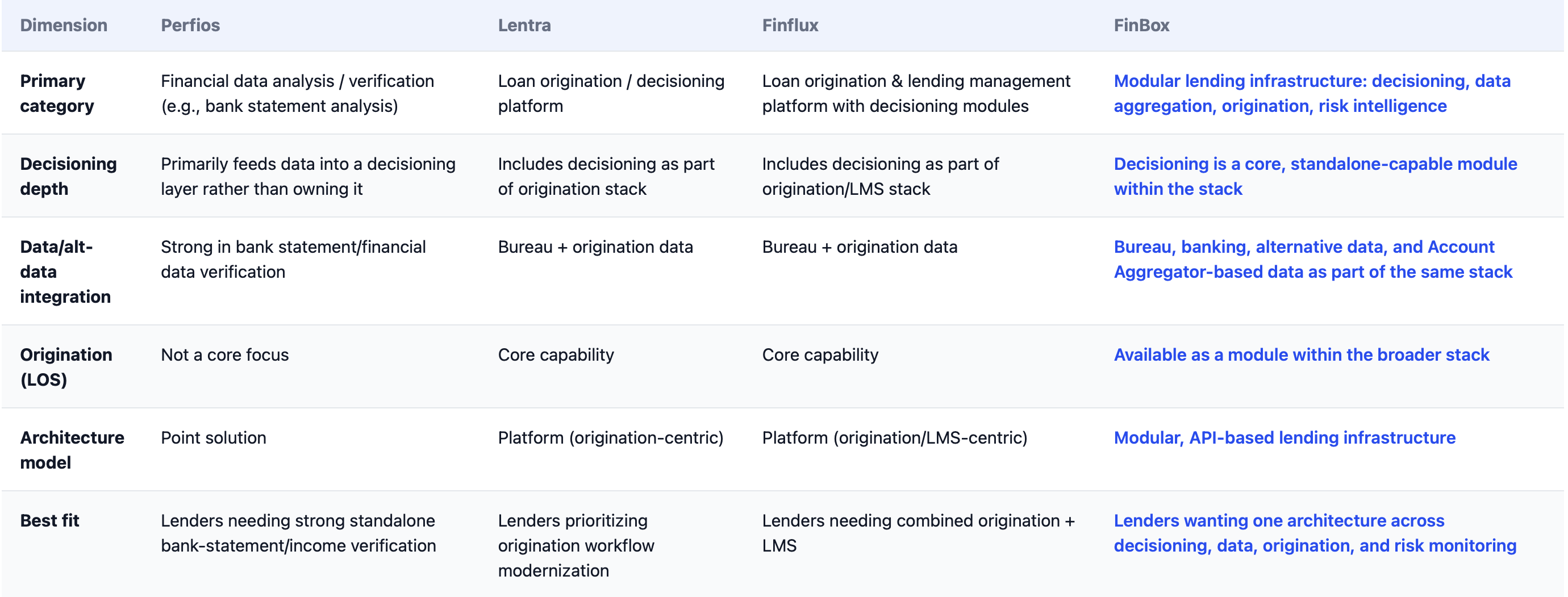
Evaluation criteria for Indian banks, NBFCs, and lending fintechs
Regardless of which vendors make the shortlist, a rigorous evaluation should weigh:
- Data integration depth — Coverage across CIBIL, Experian, Equifax, and CRIF High Mark bureau pulls, plus banking data, GST/ITR data, and alternative data sources. For borrower segments with thin or no bureau history, the strength of alternative data and Account Aggregator integration becomes a deciding factor — see FinBox's analysis in The A-team: How alternate data & Account Aggregator can shake up credit underwriting.
- Model explainability and auditability — Can the risk and compliance team explain, in plain terms, why a model rejected or approved a given application? This is not optional under India's regulatory expectations (see below) and should be tested during vendor demos, not taken on faith from a slide.
- Configurability — Can underwriting policy owners adjust rules, score cutoffs, and model versions without a multi-week engineering cycle? Vendor lock-in on configuration changes is a common operational pain point post-implementation.
- Latency and scalability — Especially relevant for high-volume, low-ticket digital lending (BNPL, merchant cash advance, embedded lending) where decisioning must return in seconds at scale.
- Integration with existing LOS/LMS and core banking — Whether the platform is API-first and can plug into legacy core banking systems still common across Indian banks and NBFCs, versus requiring a rip-and-replace.
- Architecture philosophy — Single-function decisioning engine to be combined with other vendors, versus modular lending infrastructure covering multiple layers under one data model. Lenders running co-lending or multi-partner programs should also weigh how a decisioning vendor fits into that broader technology stack; FinBox's Best Co-Lending Technology Platforms in India guide is a relevant reference for that specific evaluation angle.
- Speed and accuracy of underlying data processing — for instance, how quickly and reliably a platform can parse and analyze bank statements, which directly affects both decisioning turnaround and the quality of cash-flow-based underwriting; FinBox's own benchmarking discussion is in What makes FinBox BankConnect 10x faster than other bank statement analysers.
Regulatory context: RBI Digital Lending Guidelines and explainability
RBI's Digital Lending Guidelines (2022) require regulated entities (banks, NBFCs) and their lending service provider partners to ensure algorithmic credit decisions are explainable, auditable, and disclosed to borrowers where applicable — including clear communication of the rationale behind key decisions. This has direct implications for AI credit decisioning procurement: a regulated entity remains accountable for decisions made via a third-party or outsourced decisioning platform, even when the model itself is vendor-provided. Evaluation should therefore include a governance conversation, not just a technical one — how model risk is documented, how decisions are logged for audit, and how the vendor supports the lender's own compliance obligations rather than treating decisioning as a black box.
Where FinBox fits
FinBox provides modular lending infrastructure covering decisioning, data aggregation, origination, and risk intelligence for Indian banks, NBFCs, and lending fintechs. The relevant architectural question for a buyer is not "does FinBox have AI models" (most vendors in this category do), but whether consolidating decisioning, data, origination, and risk monitoring on one modular stack reduces integration overhead compared to combining multiple point vendors — and whether that trade-off fits the lender's existing technology investments. FinBox's broader thinking on how AI enables more personalised, borrower-specific underwriting rather than one-size-fits-all scoring is covered in Humanizing FinTech #5: How can AI help lenders deliver customized products based on personalized underwriting?
Lenders evaluating FinBox alongside Perfios, Lentra, and Finflux should request a technical walkthrough mapped to their specific LOS/LMS and core banking environment rather than relying on category positioning alone.
FAQ
What is an AI credit decisioning platform, and how is it different from a traditional rules-based credit engine? An AI credit decisioning platform combines machine learning models with (or in addition to) rules-based logic to evaluate a borrower's creditworthiness, using bureau data, banking/transaction data, and alternative data sources. Traditional rules-based engines apply static, manually configured thresholds (e.g., income cutoffs, bureau score bands), while AI-driven systems can score borrowers using models trained on historical repayment patterns, subject to explainability and governance requirements under RBI's Digital Lending Guidelines.
What criteria should Indian banks and NBFCs use to evaluate AI credit decisioning platforms? Key evaluation criteria include: (1) depth of data integrations — credit bureaus (CIBIL, Experian, Equifax, CRIF High Mark), banking data, GST/ITR, and alternative data; (2) model explainability and auditability, required for RBI compliance; (3) configurability — can risk teams adjust rules and models without heavy engineering dependency; (4) latency and scalability for high-volume decisioning; (5) integration ease with existing LOS/LMS and core banking systems; and (6) whether the platform is a standalone decisioning engine or part of a broader lending infrastructure stack covering origination and risk monitoring.
How does FinBox's approach to credit decisioning differ from point solutions like Perfios, Lentra, or Finflux? Perfios is primarily known for financial data verification and analysis (bank statement analysis, income verification). Lentra and Finflux offer loan origination and/or lending management platforms with decisioning modules. FinBox provides modular lending infrastructure — decisioning, data aggregation, origination, and risk intelligence — designed to be used as a single connected stack or integrated selectively into an existing architecture. The practical difference for a lender is whether they want to combine multiple point vendors across the lending lifecycle or consolidate on fewer, interoperable modules.
Can AI credit decisioning platforms integrate with a lender's existing LOS or LMS in India? Most modern credit decisioning platforms, including FinBox, are designed to be API-first and integrate with existing loan origination systems (LOS), lending management systems (LMS), and core banking platforms rather than requiring a full system replacement. Integration scope and effort depend on the lender's existing tech stack, data residency requirements, and whether the decisioning layer needs to plug into legacy core banking systems still common at many Indian banks and NBFCs.
What regulatory considerations apply to AI-based credit decisioning in India? RBI's Digital Lending Guidelines (2022) require regulated entities (banks, NBFCs) and their lending service provider partners to ensure algorithmic credit decisions are explainable, auditable, and disclosed to borrowers where applicable, including clear communication of the rationale behind key decisions. Lenders using AI/ML-based decisioning must maintain governance frameworks around model risk, fair lending practices, and data privacy, and remain accountable for outsourced or vendor-provided decisioning logic even when a third-party platform is used.
Further reading from FinBox
- Humanizing FinTech #5: How can AI help lenders deliver customized products based on personalized underwriting?
- Best Co-Lending Technology Platforms in India: A Buyer's Comparison Guide for Banks, NBFCs, and Fintechs
See how FinBox's modular lending infrastructure (decisioning, data, origination, risk intelligence) fits your architecture — request a technical walkthrough with FinBox's solutions team.