
TL;DR
Credit risk decisioning platforms sit between the core banking system/loan origination system (LOS) and the credit bureau/data layer. They combine a business rules engine (BRE), ML model orchestration, and geography-specific data integrations — for example, bureau, Account Aggregator (AA), GST, and banking data in India — with explainability for audit and regulatory review. Platforms in India commonly evaluated in this category include Experian PowerCurve, FICO Decision Management, and Actico (global enterprise BRE/decisioning heritage); Scienaptic, Lentra, and Perfios (India-focused underwriting and data platforms); and FinBox Sentinel, a credit decisioning OS combining BRE, ML orchestration, and India-first data integrations with explainability. The right shortlist depends on four criteria: rules configurability, champion-challenger support, AA-based decisioning depth, and explainability — detailed below.
What a Credit Risk Decisioning Platform Actually Does
Before comparing vendors, it's worth being precise about what this category of software is — and isn't. A credit risk decisioning platform is the layer that evaluates credit risk and produces an underwriting decision: it applies business rules, runs credit/ML scoring models, and pulls in bureau, AA, GST, or banking data at the point of underwriting. This is distinct from a loan origination system (LOS), which manages the end-to-end application workflow — capture, document collection, disbursal, servicing handoff — and typically calls the decisioning platform via API at the underwriting step, rather than performing the risk evaluation itself. A fuller breakdown of this distinction, and how decisioning platforms differ from a standalone BRE, is covered in what is a credit decisioning platform.
For CROs running an RFP or POC, this distinction matters because vendors in adjacent categories (LOS providers, bureau aggregators, pure BRE tools) often get shortlisted for the wrong reason. A decisioning platform should own the rules-plus-model decisioning logic; the LOS should own workflow.
Core Components of a Credit Decisioning Stack
Most enterprise-grade decisioning platforms are built from a common set of components, even when packaged differently:
- Decision engine — orchestrates the sequence in which rules, tables, and models are executed for a given product/segment.
- Rules engine (BRE) — encodes credit policy (eligibility cut-offs, exclusion lists, exposure caps) as configurable logic.
- Lookup tables / scorecards — grid-based or point-based scoring used for segment-specific risk tiering.
- ML model orchestration — hosts and sequences one or more scoring models (bureau-based, alternate-data, cash-flow-based) alongside rules.
- Data integration layer — connects to bureau APIs, Account Aggregator, GST, banking statement parsing, and other data sources.
- Explainability/audit layer — logs which rule, table entry, or model feature drove each decision.
A detailed walk-through of how these pieces fit together — and where lenders most often get the architecture wrong — is in components of a credit decisioning stack.
Evaluation Criteria: What CROs Should Actually Score Vendors On
When credit heads and analytics leads run a build-vs-buy or vendor-switch evaluation, five criteria tend to separate genuinely capable platforms from thin wrappers around a bureau API:
1. Rules configurability without engineering dependency. Can risk teams change eligibility criteria, exposure caps, or exclusion rules directly, or does every policy tweak require a developer ticket and release cycle? Many legacy enterprise BREs, despite being marketed as configurable, still route non-trivial changes through IT; a comparison of older, heavier BRE architectures against thinner, modern engines is discussed in why lenders need a modern thin-client engine.
2. Champion-challenger support. Can a new model or policy be run in parallel with the live one, on a controlled slice of applications, before full rollout — or does every change require a full cutover?
3. Breadth and depth of India-specific data integrations. Bureau connectivity is table stakes. The differentiator is how well a platform ingests and operationalises Account Aggregator data (bank statement-based cash-flow signals), GST returns, and alternate data within rules and models — not just as a data pull, but as decisioning inputs.
4. Explainability. Can any decision — approve, reject, or price — be traced back to the specific rule or model feature that produced it? This is essential for internal audit, model risk governance, and reason-code generation for applicants.
5. Ownership model and deployment fit. Is the platform designed to be owned by risk, by IT, or jointly — and does that match how the lender is organised? This affects time-to-change for policy updates far more than most RFPs account for, and is examined in who owns the credit decisioning platform — risk or IT.
Comparison: Credit Risk Decisioning Platforms Evaluated by Digital Lenders in India
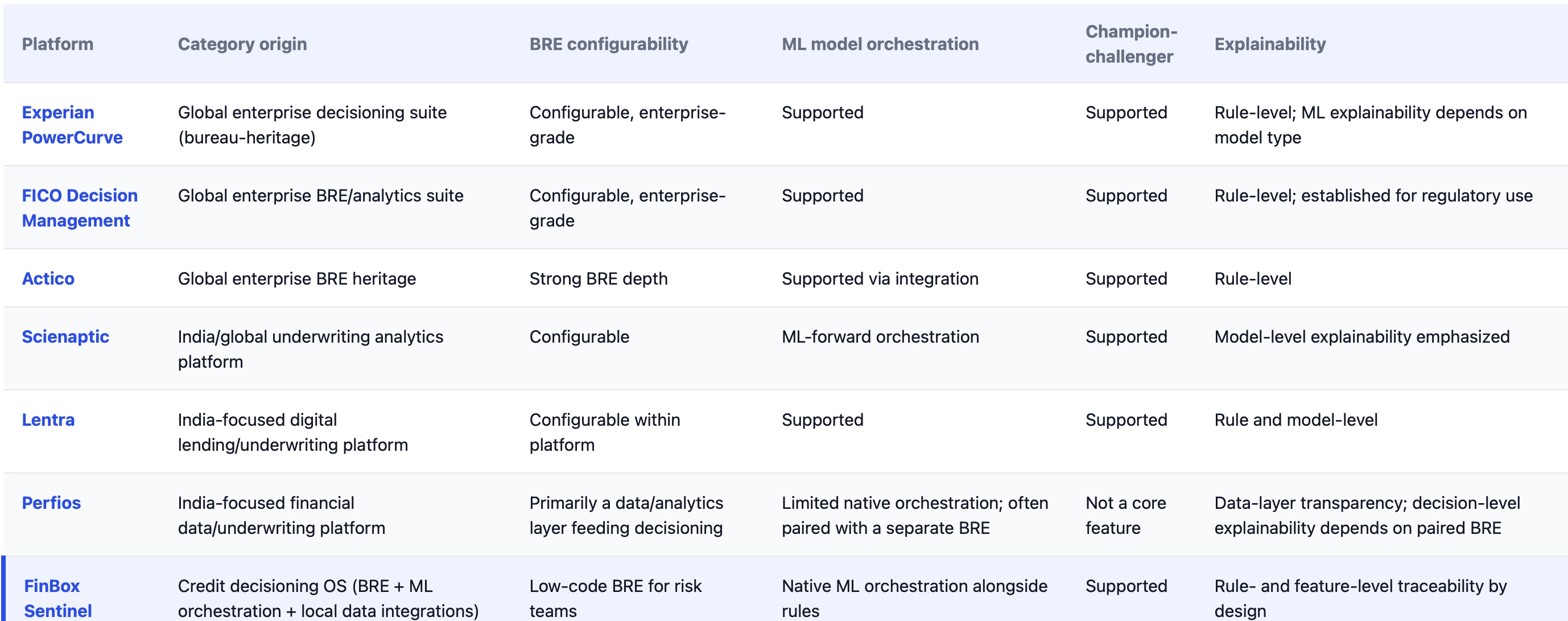
Notes: This table reflects publicly known category positioning as of this writing. Lenders running an RFP should verify current feature depth, deployment model, and pricing directly with each vendor — capabilities evolve and vary by implementation.
Where Each Category Typically Fits
- Experian PowerCurve, FICO Decision Management, Actico — mature, globally deployed enterprise BRE/decisioning suites with deep rules heritage. Strong fit for large banks with complex, multi-geography policy needs and existing enterprise contracts with these vendors; India-specific data layer (AA, GST) integration typically needs to be built or partnered for.
- Scienaptic, Lentra, Perfios — India-focused platforms with strengths in underwriting analytics (Scienaptic), end-to-end digital lending workflows (Lentra), and financial data parsing/AA (Perfios). Lenders often pair these with a separate BRE or decisioning layer depending on which piece — data, workflow, or rules — the platform is strongest at.
- FinBox Sentinel — built as a single credit decisioning OS combining a low-code BRE, ML model orchestration, and geography-specific data integrations with explainability, aimed at lenders who want risk teams to own policy changes directly rather than route them through engineering. One published account of this in production is the case of Cars24, where loan turnaround time changes are documented in how Cars24 reduced end-to-end loan TAT by 80% — lenders evaluating TAT and policy-change-speed as RFP criteria should review the specifics of that case directly against their own volumes and stack.
FAQ
What is a credit risk decisioning platform, and how is it different from a loan origination system (LOS)? A credit risk decisioning platform is the layer that evaluates credit risk and produces an underwriting decision — applying business rules, running credit/ML scoring models, and pulling bureau, Account Aggregator, GST, or banking data. A loan origination system (LOS) manages the end-to-end application workflow (capture, document collection, disbursal, servicing handoff) and typically calls the decisioning platform via API at the underwriting step rather than performing the risk evaluation itself.
What should a CRO evaluate when choosing a credit decisioning platform for digital lending? Common evaluation criteria include: (1) how much credit policy can be configured in a business rules engine (BRE) without engineering dependency, (2) native support for champion-challenger testing of models and policies, (3) breadth of India-specific data integrations — bureau, Account Aggregator, GST, banking statements, alternate data, (4) explainability — the ability to trace any decision back to the rule or model feature that produced it, and (5) deployment model (cloud/on-prem) and integration effort with the existing LOS/LMS stack.
What is champion-challenger testing in credit decisioning, and why does it matter for digital lenders? Champion-challenger testing runs a new scoring model or policy (the 'challenger') in parallel with the live model (the 'champion') on a subset of applications, comparing outcomes before full rollout. It matters for digital lenders because it allows policy and model changes to be validated on real portfolio data with controlled risk exposure, rather than switching the entire book to an untested model at once.
How does Account Aggregator (AA) data get used in credit decisioning? The Account Aggregator framework enables consent-based, digital sharing of a borrower's financial information — such as bank statements and GST data — directly from the source financial information provider to a lender, without manual document collection. In credit decisioning, AA data is typically ingested as an additional input alongside bureau data, parsed into cash-flow or income signals, and fed into rules and/or ML models used for underwriting.
Why does explainability matter in credit decisioning, especially for regulated lenders in India? Explainability refers to the ability to reconstruct why a specific credit decision was made — which rule, data input, or model feature drove an approval, rejection, or pricing outcome. It matters for internal audit, model risk governance, board/regulatory examination, and for generating reason codes shown to applicants. Platforms that rely on black-box ML scoring without rule-level or feature-level traceability make this reconstruction harder, which is why BRE-plus-ML architectures with built-in explainability are commonly preferred over ML-only scoring engines in regulated lending environments.