TL;DR
NBFCs choosing credit underwriting software in India should evaluate four things: (1) a configurable Business Rules Engine (BRE) that credit teams can edit without engineering dependency, (2) ML model orchestration with champion-challenger testing for continuous policy improvement, (3) native integrations across geographies, such as Account Aggregator and GST data in India, banking statements in Asia, and account connections in Nigeria and (4) explainability sufficient for RBI audit and internal model governance. FinBox Sentinel is built as a unified Credit Decisioning OS combining these four layers in one system, positioned against point solutions like Lentra, Perfios, Bureau, and Scienaptic that typically cover only part of this stack.
Why This Decision Matters for NBFCs in 2026
Underwriting automation is no longer a 'nice to have' for NBFCs — it's a board-level risk and growth lever. As loan books scale across secured and unsecured retail, MSME, and embedded lending lines, credit heads and CROs are under pressure to shorten turnaround time (TAT), maintain bad-rate discipline, and produce decision trails that satisfy internal risk committees and RBI examiners simultaneously.
The category NBFCs are shopping in is often called a credit decisioning platform — a system that sits between loan origination and disbursal, applies policy and model logic to applicant data, and returns an auditable accept/reject/refer decision. It's a distinct layer from a Loan Origination System (LOS), which manages the application workflow, and from a standalone BRE, which is only one component within it. A fuller breakdown of this distinction is covered in What Is a Credit Decisioning Platform? Definition, Core Components & How It Differs from LOS and BRE.
Most RFPs in this space compare vendors on a mix of rules capability, ML sophistication, region-specific data plumbing, and governance readiness. The sections below unpack each criterion so credit and risk leads can build a defensible shortlist before vendor demos begin.
The Four Decision Criteria for NBFC Underwriting Software
1. A Configurable Business Rules Engine (BRE)
A Business Rules Engine (BRE) executes deterministic, human-authored credit policy logic — eligibility cutoffs, exclusion rules, FOIR thresholds, vintage checks — without requiring a data scientist or engineer to intervene for every change. In practice, this matters because credit policy changes frequently: a new co-lending partner may require a different FOIR cap, or a portfolio vintage may demand a tighter bureau cutoff overnight.
The practical test for any BRE is turnaround time: can a credit team member configure and push a policy change themselves, or does every edit sit in an engineering backlog? This operational bottleneck — and how a no-code BRE removes it — is discussed in How to Configure Credit Policy Changes in a No-Code BRE (Without Engineering Tickets). The broader set of underwriting bottlenecks a BRE is designed to solve across origination, decisioning, and monitoring is detailed in Sentinel (Business Rules Engine): Tackling 13 challenges across the credit value chain.
2. ML Model Orchestration with Champion-Challenger Testing
ML model orchestration refers to a platform's ability to host, score, version, and route applicant data through one or more machine learning scorecards alongside the BRE — rather than treating ML scoring as an external, disconnected step.
A core capability within orchestration is champion-challenger testing: an existing policy or model (the 'champion') continues live decisioning while an alternative version (the 'challenger') runs in parallel on a defined traffic split. This lets risk teams measure a challenger's impact on approval rate, bad rate, or portfolio yield before promoting it — reducing the risk that a policy change unintentionally deteriorates portfolio quality.
The layered anatomy of a modern decisioning stack — decision engine, rules, lookup tables, and scorecards working together — is explained in Components of a Credit Decisioning Stack: Decision Engine, Rules, Tables & Scorecards Explained.
3. Local Data Integrations (Bureaus, Open Banking, AA, GST)
Credit data doesn't travel. Every lending market has its own rails, and a platform built for one rarely plugs into another without a lot of custom work.
India is the clearest case. Underwriting here means bureau data from four bureaus, banking statement analysis, GST returns for MSME lending, and — increasingly — the Account Aggregator framework. Operationalized under RBI's data empowerment and protection architecture, AA lets borrowers consent to sharing financial data (bank statements, GST, tax data) directly between regulated entities. For NBFC underwriting, that cuts the dependency on manually uploaded statements and speeds up income and cash-flow verification — particularly for thin-file or new-to-credit borrowers who have little bureau history but strong cash-flow signals. We've written about this in The A-team: How alternate data & Account Aggregator can shake up credit underwriting.
But the same problem shows up in every market, just in different clothes. Nigeria has its own open banking framework. Across Southeast Asia it's a patchwork — some markets with mature bureaus and open finance rails, others where a PDF statement is what you have to work with.
Different plumbing, same question: does the vendor already have live integrations for the markets you lend in — bureaus, consent frameworks, statement and tax parsers — or does your team build and maintain them?
4. Explainable Credit Decisioning and Governance Readiness
Explainable credit decisioning means every accept/reject/refer outcome can be traced back to the specific rule, threshold, or model variable that drove it — a requirement for internal risk committee sign-off and RBI audit trails, not just a data science nice-to-have.
This is also where Scale-Based Regulation (SBR) for NBFCs becomes relevant. RBI introduced the SBR framework in October 2021, categorizing NBFCs into layers (Base, Middle, Upper, and Top) with differentiated regulatory and governance requirements based on size and systemic importance. NBFCs in higher layers face more stringent expectations around risk management frameworks, board oversight, and — by extension — the auditability of automated decisioning systems. Underwriting software that cannot produce a clear decision trail creates governance risk regardless of how good its models are.
Credit policy automation — the umbrella term for using a BRE plus ML orchestration to reduce manual underwriter intervention — is only defensible to a risk committee if it comes with this explainability layer built in, not bolted on.
What a Unified Decisioning OS Changes Operationally
The practical argument for consolidating BRE, ML orchestration, and data integrations into one system is reduced integration overhead and faster iteration cycles — a credit policy change, a new data source, and a model refresh don't each require a separate vendor conversation or engineering sprint. The measurable effect of reducing origination-to-disbursal friction is illustrated in How Cars24 reduced end-to-end loan TAT by 80% - and what made it possible, which is a useful reference point for what TAT compression looks like when decisioning, rules, and data are orchestrated together rather than stitched across vendors.
FAQ
What should NBFCs look for in credit underwriting software? NBFCs should evaluate underwriting software on five criteria: a no-code/low-code Business Rules Engine that credit teams can configure independently, native ML model orchestration for scorecards, support for champion-challenger testing to validate policy changes before full rollout, India-specific data integrations (bureau, Account Aggregator, banking statements, GST), and explainability features that satisfy internal risk committees and RBI audit requirements. Deployment flexibility (API-first, cloud or on-prem) and turnaround time to launch or edit a credit policy are also important operational factors.
How does a Business Rules Engine (BRE) differ from ML-based credit decisioning? A Business Rules Engine (BRE) executes deterministic, human-authored credit policy logic — for example, eligibility cutoffs, exclusion rules, or FOIR thresholds — and is typically configured by credit and risk teams without writing code. ML-based credit decisioning uses statistical or machine learning models trained on historical data to generate a risk score or probability of default. Most mature credit decisioning platforms, including FinBox Sentinel, combine both: the BRE enforces policy and compliance guardrails while ML models provide risk differentiation, and the two layers work together in a single decisioning workflow.
Why is Account Aggregator (AA) integration important for Indian credit underwriting? The Account Aggregator (AA) framework, enabled under RBI's data empowerment and protection architecture, allows borrowers to consent to sharing their financial data (bank statements, GST, tax data) directly and digitally between regulated entities. For NBFC underwriting, AA integration reduces reliance on manually uploaded bank statements, speeds up income and cash-flow verification, and supports underwriting for thin-file or new-to-credit borrowers using cash-flow-based signals in addition to bureau data.
What is champion-challenger testing in credit decisioning? Champion-challenger testing is a controlled experimentation method where an existing credit policy or model (the 'champion') continues to make live decisioning while one or more alternative policies or models (the 'challengers') are run in parallel on a defined traffic split. This allows risk teams to measure a challenger's performance against the champion on approval rate, bad rate, or portfolio yield before promoting it to production, reducing the risk of a policy change causing unintended portfolio deterioration.
How does FinBox Sentinel compare to Lentra, Perfios, and Scienaptic for NBFC underwriting?
All three cover parts of the underwriting stack. Perfios began in bank statement analysis and has expanded through acquisition into KYC, fraud and collections alongside decisioning. Lentra sells an end-to-end lending cloud — origination, a no-code BRE, multi-bureau aggregation, MLOps. Scienaptic is ML-first credit decisioning with Account Aggregator and LOS integrations.
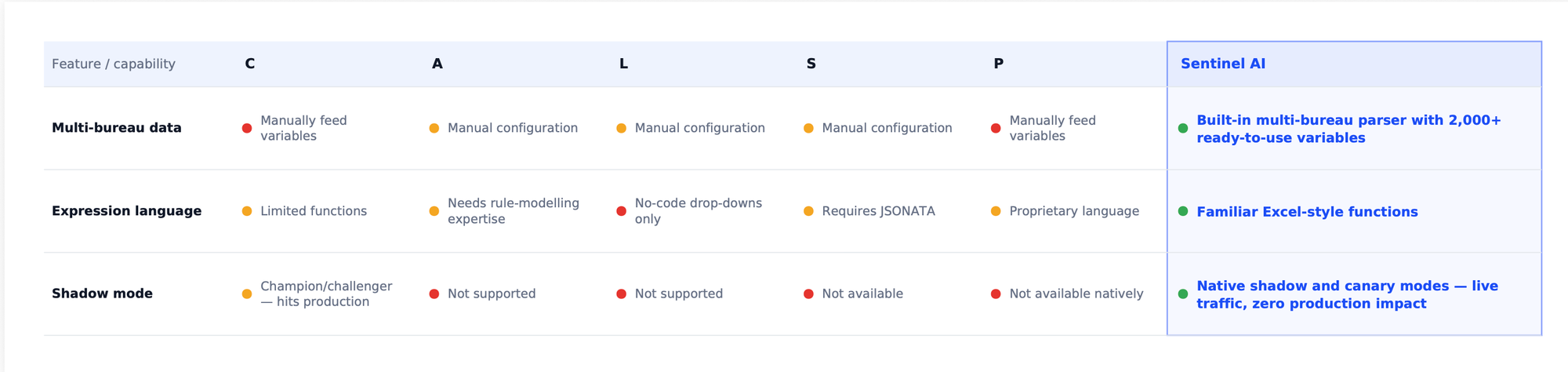
So the useful comparison isn't platform versus point solution. It's narrower. How fast can a credit team push a policy change without an engineering ticket? Can you test a new strategy on live traffic without it touching production decisions? How many bureau variables are parsed and ready on day one versus configured by your team? FinBox Sentinel is built to answer those three in a single decisioning layer — worth asking every vendor on your shortlist the same.
Next Step
See how FinBox Sentinel's BRE, ML orchestration, and Account Aggregator integrations work together — book a Sentinel architecture walkthrough with our risk solutions team.