
TL;DR
Choosing an AI platform for loan portfolio risk monitoring in India requires evaluating five things beyond model accuracy: breadth and freshness of data inputs (bureau, banking, GST, alternate data), explainability of risk signals for audit and regulatory review, real-time vs batch monitoring capability, integration depth with existing LOS/LMS and core banking systems, and how the platform fits within RBI's outsourcing and digital lending governance expectations. Lenders should also assess configurability across products (secured vs unsecured, retail vs MSME) and total cost of ownership including ongoing model maintenance. This guide lays out the evaluation criteria without assuming a specific vendor. FinBox provides modular lending infrastructure spanning decisioning, data, origination and risk intelligence, and is one option lenders can evaluate against this framework.
What is loan portfolio risk monitoring?
Loan portfolio risk monitoring is the ongoing process of tracking the credit health of a lender's live book — not just at origination, but through the life of the loan — to identify accounts likely to default, restructure, or need collections intervention before they become non-performing. It sits downstream of credit decisioning (the underwriting decision made at loan approval) and works alongside collections and asset quality reporting functions.
This is distinct from traditional NPA tracking, which relies on backward-looking indicators such as DPD (Days past Due) buckets and SMA (Special Mention Account) classification — a regulatory category (SMA-0, SMA-1, SMA-2) that flags accounts based on how many days payments are overdue. By the time an account is classified SMA-2, repayment behavior has already deteriorated. AI-based portfolio monitoring instead attempts to generate EWS (Early Warning Signals) — statistical flags derived from transactional, bureau, and alternate data patterns — that surface risk before it shows up in DPD numbers.
Why AI-based monitoring differs from traditional approaches
AI-driven loan portfolio risk monitoring typically relies on transactional, bureau, and alternate data (bank statement transaction patterns, GST filing data, utility payment history, and similar sources) to generate early warning signals ahead of visible delinquency. This is a meaningful departure from DPD/SMA-based tracking, which is inherently retrospective — it can only tell you what has already happened.
The practical value of this shift lies in giving risk and collections teams a longer lead time to act — through credit line adjustments, proactive restructuring conversations, or prioritized collections outreach — rather than reacting after an account has already slipped. Underwriting and collections risk, however, are not the same problem, and lenders evaluating monitoring platforms should be cautious of vendors that treat them interchangeably; the reasons collections risk warrants separate treatment from underwriting risk are worth understanding before designing a monitoring framework.
Five things to evaluate before choosing a platform
1. Breadth and freshness of data inputs
The quality of any risk monitoring output is bound by the data feeding it. Lenders should ask:
- Does the platform ingest bureau data (CIBIL, Experian, CRIF, Equifax), banking transaction data, GST data, and other alternate data sources relevant to the borrower segment?
- How frequently is data refreshed — is monitoring based on periodic batch pulls, or can it reflect near-real-time account behaviour?
- Is the data pipeline built to handle the lender's actual customer mix (e.g., thin-file retail borrowers vs GST-registered MSMEs), or is it generic across segments?
A monitoring platform trained or calibrated primarily on data that doesn't reflect the lender's own portfolio composition — product type, geography, borrower segment — is a common source of poor signal quality, regardless of how sophisticated the underlying model architecture is.
2. Explainability of risk signals
Explainability of risk models — the ability to trace which data inputs and thresholds triggered a risk flag — is a practical requirement for internal audit and regulatory examination in Indian lending, not merely a technical preference. Risk committees, internal auditors, and examiners need to understand why an account was flagged, not just that it was flagged. Platforms that operate as opaque black boxes create friction during audit cycles and make it harder for credit teams to build institutional trust in the signals, which in turn slows adoption. Evaluators should ask vendors to demonstrate, with a real account example, how a specific risk flag traces back to specific data inputs and thresholds — and how that trail would be presented to an internal risk committee or examiner. Understanding how to separate genuine business value from AI/ML marketing claims is a useful discipline to apply at this stage of evaluation.
3. Real-time vs batch monitoring capability
Not every use case requires real-time monitoring, and not every platform genuinely offers it despite marketing claims. Lenders should clarify:
- Is monitoring event-driven (triggered by new bureau pulls, bank statement updates, GST filings) or run on a fixed batch cycle (daily/weekly)?
- What is the latency between a risk-relevant event occurring and the platform surfacing a flag?
- Does the monitoring cadence match the operational rhythm of the lender's collections and credit teams — is there a workflow to act on flags at the speed they're generated?
A platform that generates real-time signals is of limited value if the lender's downstream collections or credit workflows only review flags weekly.
4. Integration depth with existing systems
Integration depth with existing LOS/LMS, core banking and collections systems is a primary determinant of implementation timelines for AI risk monitoring platforms in Indian lending institutions. Key questions:
- Can the platform integrate via APIs with the existing LOS (Loan Origination System) and LMS (Loan Management System) without requiring a rip-and-replace?
- Does it support configurable business rules that can be layered on top of ML-based signals — particularly important for lenders operating multi-lender or co-lending stacks, where rule logic may need to differ by lending partner? A business rule engine approach designed for multi-lender stacks is worth understanding as a complementary (not competing) layer to statistical risk models.
- How does the platform handle institutions running multiple LOS/LMS instances across business lines (retail, MSME, secured, unsecured)?
Modular, API-based integration is generally preferable to monolithic replacement, especially for institutions with existing technology investments they don't want to discard.
5. Regulatory and governance alignment
Under RBI's regulatory expectations for digital lending and outsourcing, regulated entities (banks and NBFCs) retain accountability for credit and risk decisions even when monitoring or decisioning tools are sourced from third-party technology providers. This has direct implications for platform selection:
- The lender, not the vendor, needs to be able to demonstrate model governance to regulators and boards — so the platform must support this, not obscure it.
- Model risk governance processes — periodic revalidation, drift monitoring, documented change logs — should be either built into the platform or clearly the lender's responsibility, with no ambiguity.
- For lenders operating under co-lending or Lending Service Provider (LSP) arrangements, the regulated partner entity typically needs visibility into how risk monitoring is performed by any technology or origination partner, since ultimate accountability sits with the regulated entity.
- Data ownership, retention, and security terms with the vendor should be contractually clear, not left implicit.
Configurability across products and segments
A platform built primarily for unsecured retail lending may not transfer well to secured or MSME lending without meaningful reconfiguration. Risk signals relevant to a personal loan borrower (transaction velocity, bureau inquiry patterns) differ from those relevant to an MSME borrower (GST filing consistency, working capital cycle indicators). Lenders operating across multiple product lines should evaluate whether a platform's risk logic is configurable per product, or whether it applies a single model architecture uniformly — the latter is a common source of poor signal quality on secondary product lines.
Underwriting model quality itself is often assessed using statistical measures such as the Gini coefficient, a standard metric for evaluating how well an underwriting model discriminates between good and bad borrowers — a concept worth understanding when evaluating any vendor's model performance claims, even though portfolio monitoring and underwriting are related but distinct disciplines.
Total cost of ownership
Beyond licensing or subscription fees, lenders should account for:
- Integration and implementation cost (engineering time, data pipeline setup)
- Ongoing model maintenance and revalidation cost
- Cost of change management for credit and collections teams to actually act on AI-generated signals
- Cost of any parallel run period needed before fully relying on the platform's outputs
Underestimating the operational change management needed for teams to adopt AI-generated signals into daily workflows is one of the more common — and avoidable — implementation pitfalls.
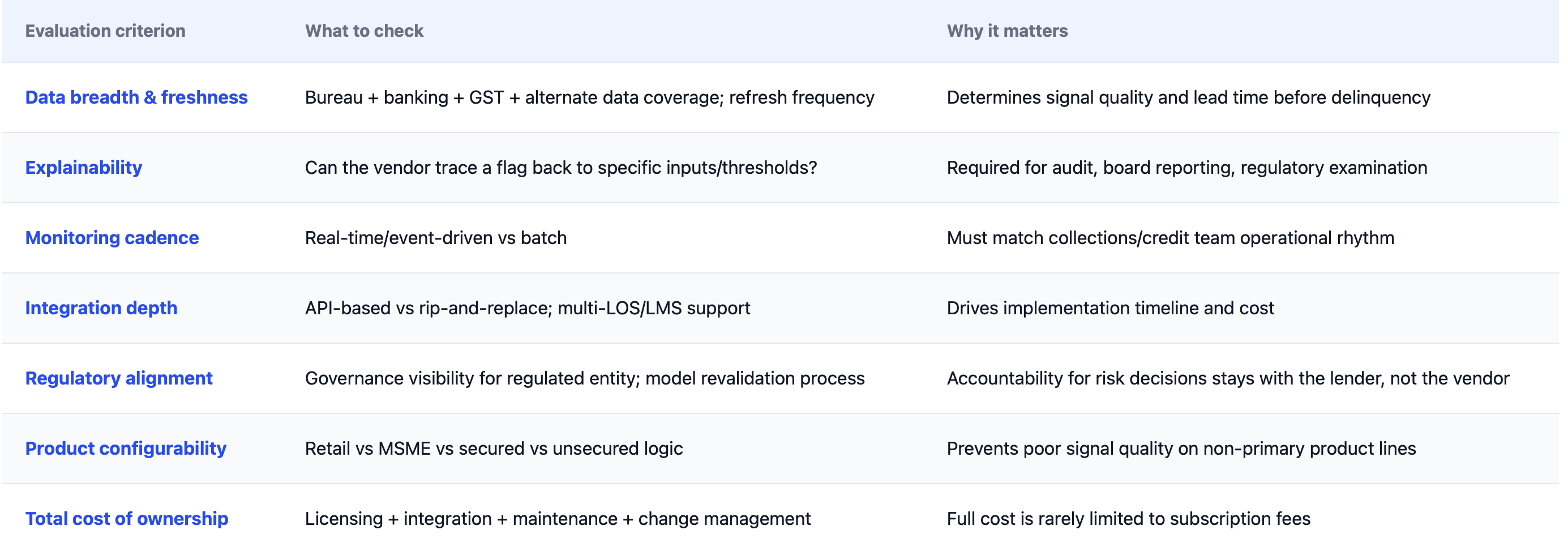
Comparison framework: evaluation criteria at a glance
Where a CDP or customer data layer fits in
Many lenders evaluating risk monitoring platforms overlook a related gap: the absence of a unified view of customer data across origination, servicing, and collections systems. Banks and NBFCs that haven't adopted a CDP (Customer Data Platform) approach often find that fragmented data across systems undermines even a well-chosen risk monitoring tool, since the monitoring layer is only as good as the data consolidation feeding it. This is a useful adjacent consideration during platform evaluation, not a separate project to defer indefinitely.
How FinBox approaches this space
FinBox provides modular lending infrastructure spanning decisioning, data, origination and risk intelligence, designed to integrate with a lender's existing LOS/LMS rather than replace it outright.
Lenders evaluating any platform — FinBox included — against the criteria above should ask for a live demonstration using a representative account from their own portfolio, not a generic demo dataset, to properly assess data fit, explainability, and integration effort before committing.
FAQ
What is AI-driven loan portfolio risk monitoring and how is it different from traditional NPA tracking?
Traditional NPA tracking is largely backward-looking — it flags stress after repayment behavior has already deteriorated (e.g., DPD buckets, SMA classifications). AI-driven portfolio risk monitoring uses statistical and machine learning models on transactional, bureau, GST, banking and other alternate data to generate EWS (Early Warning Signals) before an account shows visible delinquency, allowing lenders to intervene earlier through restructuring, credit line adjustments or collections prioritisation.
What evaluation criteria matter most for banks versus NBFCs versus lending fintechs?
Banks typically prioritise model governance, audit trails and integration with legacy core banking systems given stricter regulatory scrutiny. NBFCs often weigh configurability across multiple loan products and speed of deployment. Lending fintechs partnering with regulated entities (co-lending or LSP models) need platforms that can demonstrate explainability and data lineage to satisfy their partner bank/NBFC's compliance requirements, since the regulated entity retains ultimate accountability for risk decisions under RBI's digital lending framework.
How does explainability of AI risk models affect regulatory compliance in India?
RBI's guidelines on digital lending and IT/financial outsourcing place accountability for credit and risk decisions on the regulated entity (bank/NBFC), even when models or monitoring tools are sourced from a third party. This makes explainability — the ability to show which variables and thresholds triggered a risk flag — important for internal audit, board reporting and regulatory examination, rather than treating the model as a black box.
What integration capabilities should be checked before adopting an AI risk monitoring platform?
Lenders should verify that the platform can ingest data from existing bureau integrations, core banking/LMS systems, collections platforms and alternate data sources (bank statements, GST, utility data) without requiring a rip-and-replace of existing loan origination or loan management systems. API-based, modular integration is generally preferable to monolithic replacement, especially for institutions with existing technology investments.
What are common implementation risks or pitfalls when adopting an AI-based risk monitoring platform?
Common pitfalls include: monitoring models trained on data that doesn't reflect the lender's actual portfolio mix (product type, geography, borrower segment), lack of a defined process for model revalidation and drift monitoring over time, insufficient explainability for internal risk committees, unclear data ownership/security terms with the vendor, and underestimating the operational change management needed for credit and collections teams to act on AI-generated signals.
Further reading from FinBox
- Banks and NBFCs are missing out on a huge opportunity by not adopting CDPs; here's why
- Sentinel (Business Rules Engine): Tackling 13 challenges across the credit value chain
- Gini Coefficient Explained: The most important measure of a lender's underwriting prowess
Talk to FinBox
See how FinBox's modular risk intelligence layer fits into an existing loan origination and monitoring stack — talk to the FinBox team about your portfolio's specific risk monitoring requirements.