Hello everyone,
Welcome to the 225th edition of The Pattern, a weekly newsletter on the latest in finance, technology, and the economy.
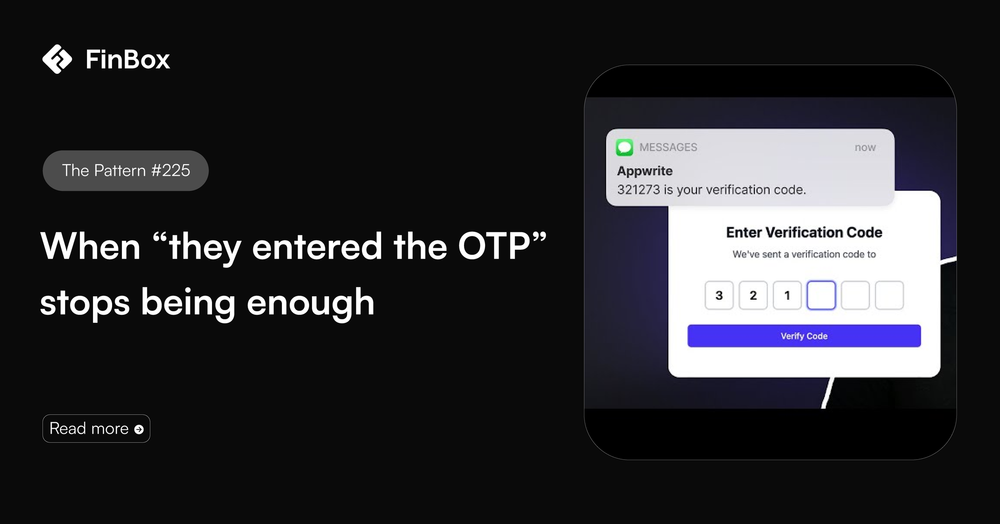
For about a decade, the OTP has been the best alibi in Indian banking.
Six digits, typed by the customer, on the customer's own phone. Once those were entered, the question of who was responsible for a transaction was more or less settled. If the money went to a fraudster, that was unfortunate, but the customer had approved it.
Now think about how far that alibi stretches in a digital arrest scam. Take a retired schoolteacher who has never moved more than ₹50,000 at a time. Within a few hours, she sends ₹40 lakh to an account that was opened just three weeks ago and has done nothing since except receive large sums from strangers. She types in every OTP herself, so on paper, each of those transfers is authorised.
This week, the Supreme Court made that alibi a lot weaker.
It also opens up a question the industry has avoided for a long time. When a customer is tricked into sending money, and the warning signs were sitting right there, who should carry the loss? I think the answer matters for lenders just as much as it does for banks.
A 2017 rule built for stolen cards and cloned SIMs
India already has a fairly customer-friendly rule for one type of fraud. Back in 2017, the RBI said that if money leaves your account through an unauthorised electronic transaction and you report it within three working days, your liability is zero. The same framework puts the burden of proving customer liability on the bank, not the customer.
That rule does its job when someone clones your card or gets hold of your login. It's far less useful when you're the one who pressed send. In a digital arrest scam, the victim enters the OTP on their own phone while someone they believe is a police officer tells them exactly what to do. As far as the system is concerned, nothing about that looks unauthorised.
This gap is where the scam grew. Data from the Home Ministry's cybercrime centre shows losses to digital arrest scams rose from ₹91 crore in 2022 to ₹339 crore in 2023, and then to over ₹1,900 crore in 2024. Things have cooled a little since, but between January and August this year, the centre still reported more than 21,900 complaints involving over ₹647 crore to the Supreme Court.
The court's new question: could you have seen it coming?
This week, while hearing a case on digital arrest scams, the Supreme Court went straight at that gap. The bench said banks and financial institutions should compensate victims wherever a lapse in due diligence helped the fraud go through. It also indicated that banks could face prosecution in such cases.
What surprised me was how practical the court got. It talked about specific safeguards it would expect to see:
- Briefly holding back a transfer that looks nothing like the customer's usual behaviour
- Sending automated alerts, and doing a physical check when something looks off
- Informing the local police station when the pattern suggests a digital arrest is underway
Nothing is final yet. The bench will now look at whether the RBI's KYC Amendment Directions, 2026 give victims enough relief. But for years, "the customer authorised it" ended most of these disputes. Now the question is whether the institution's own systems could have seen that something was wrong.
The bench also spoke of banks and financial institutions, a category that includes NBFCs and digital lenders. Lenders shouldn't read this as someone else's story.
Britain made banks pay, and scams went down
The UK has already tried this. In October 2024, its payments regulator made reimbursement mandatory for scams where the customer is tricked into sending money, capped at £85,000 per claim, with the cost split equally between the sending and receiving banks.
The industry pushed back hard, fearing customers would get careless and claims would explode. An independent evaluation this July found the opposite:
- Scam losses over Faster Payments dropped by about 21%, roughly £73 million a year
- The share of losses returned to victims went from 54% to 65%
The cost did fall unevenly across firms, mostly depending on how good they already were at catching fraud early. But fraud prevention moved up the agenda the moment it hit balance sheets. If India goes the same way, institutions already watching for odd behaviour in real time will barely notice, and the rest will find out what their blind spots cost.
Singapore turned "should have noticed" into a checklist
Singapore took a different route. Its Shared Responsibility Framework, in force since December 2024, gives banks and telcos specific anti-scam duties, and those who fail to meet them pay the victim. One duty will sound familiar: banks must block or hold for 24 hours suspicious transactions above S$25,000.
What I find most relevant for India is that banks aren't the only ones on the hook. The bank is checked first, then the telecom company, and the customer carries the loss only if both did their part. Digital arrest scams here run almost entirely over calls and messaging apps, so leaving telcos out would miss half the story. The framework doesn't cover every kind of fraud, though, which shows how hard "should have noticed" is to define.
Which model fits India better, in your view? The UK's shared bill, or Singapore's list of duties with telcos in the chain?
What "due diligence" means for a lender
It's easy for lenders to see this as a problem for whoever holds the savings account. I'd push back on that for two reasons.
First, the court's yardstick is due diligence, and lenders do a lot of it: verifying the borrower, checking that the disbursal account belongs to them, and judging whether the application is genuine. These are exactly the checks fraudsters try to beat, through loans in someone else's name or disbursals routed elsewhere. If courts ask what an institution could have seen, this is where lenders will be asked to show their work.
Second, speed. A digital loan can go from application to disbursal in minutes, which suits genuine borrowers and fraudsters alike. Smaller NBFCs have reportedly lost around ₹300 crore to cyberattacks in recent months.
In the 223rd edition, I wrote that about half of urban Indians would borrow digitally if fraud protection were guaranteed. Lenders whose checks hold up under scrutiny will find that trust easier to earn.
Diwali makes "unusual" look normal
We're also in the middle of the festive season, when lending and spending both peak. In the 223rd edition, I mentioned that 77% of people say they spend at least 50% more during festivals.
This is where it gets tricky for risk teams. The court wants institutions to catch behaviour that looks out of character, but during Diwali, almost everyone looks a little out of character. Applications spike, first-time borrowers come in and ticket sizes jump. A loan application in someone else's name is far easier to hide in that crowd than in a quiet week in March.
Three questions for credit and risk teams
Let's suppose courts do start asking what an institution could have seen. The conversation inside lending teams would change too, and these are three questions I think would be worth raising:
- When an application doesn't quite add up, say the bank account, the device or the documents don't match the person applying, how quickly does someone actually catch it?
- If we were asked to show every warning sign we had on an account and what we did about each one, how long would it take us to put that together?
- How well do we know the accounts our disbursals land in, and would we spot it if one of them was being used to park stolen money?
I'll admit I haven't fully made up my mind on this. Part of me feels it's long overdue. If a system could have flagged a ₹40 lakh transfer to a three-week-old account and didn't, it's hard to argue that a frightened retiree should carry the whole loss. But I also keep wondering where the line will be drawn, and who gets to draw it.
Feel free to write back and tell me what you think. Any thought, big or small, is welcome.
Just write back, whether it's an answer or any other thoughts you'd like to share. And do pass this on to at least one person you think would enjoy it.
Reading list
- How borrower verification is becoming part of credit infrastructure in Southeast Asia
- When AI starts doing the work: how the LOS is evolving into an agentic credit platform
- How IIFL replaced hard-coded rules with FinBox Sentinel to move at the speed of risk
- Bajaj Finance rolls out new term-loan variants from November 1 as the RBI weighs a revolving credit ban for NBFCs
- Overdue gold loans are rising at NBFCs even as branch expansion continues
- RBI Bulletin: banks passed on 93 bps of the 125 bps repo cut to borrowers
- RBI raises the Floating Rate Bond 2034 coupon by 81 bps, a signal on short-term rates
- Research: why lending rates tend to rise faster than they fall, a meta-analysis
Until next week,
Mayank
All opinions expressed are my own and do not necessarily reflect the views of FinBox or its promoters.