Picture a model review at a mid-sized NBFC. The validator has one request: rebuild last year's personal loan scorecard from its original training data, so the board can see how it was made.
The data engineer opens the file and stops. Some of the borrowers in it have since withdrawn consent and been deleted. If she rebuilds the model without them, it will not match the one that approved those loans. If she restores them, the lender is holding data it was told to erase.
The risk head asks one question. Which of our models ever used these borrowers' data? Nobody in the room has an answer.
Meetings like this are about to become routine. Because while lenders have handled deletion requests before, it hasn’t been at this scale or against this kind of record-keeping. Soon, withdrawing consent will have to be as easy as giving it.RBI's draft guidance on model risk wants model records kept for ten years and AI models documented well enough to trace and reproduce.
Lenders will soon be expected to meet both, and the two can pull against each other. The safer design keeps the record of how each decision was made apart from the borrower's personal data.
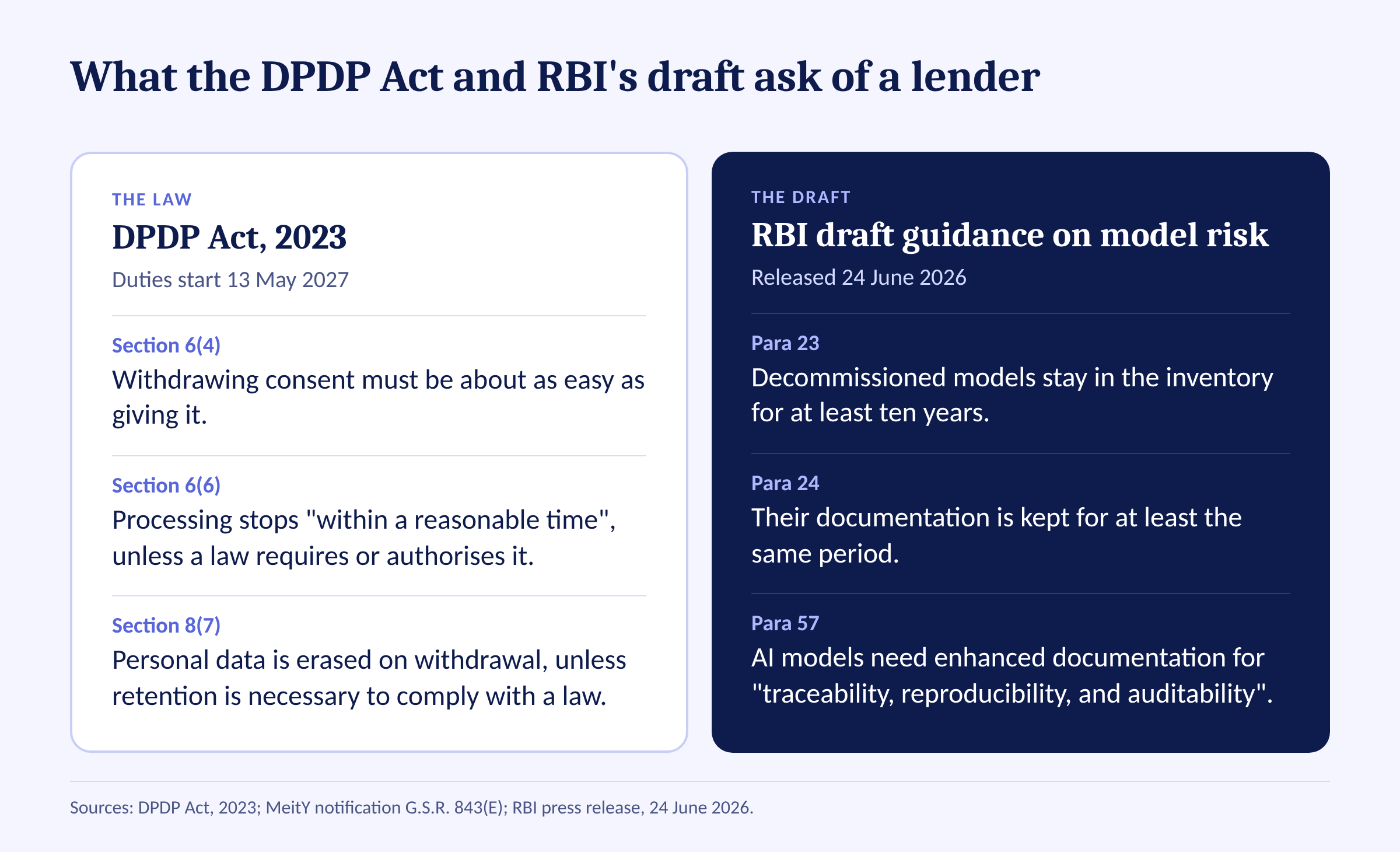
The law behind this is the Digital Personal Data Protection Act. Section 6 lets a borrower withdraw consent at any time, with an ease "comparable to the ease with which such consent was given". Once she does, the lender must, "within a reasonable time", stop processing her data and make its processors stop too, unless another law requires or authorises the processing. She can also withdraw through a registered Consent Manager. Section 8(7) then requires erasure, again unless "retention is necessary for compliance with any law for the time being in force".
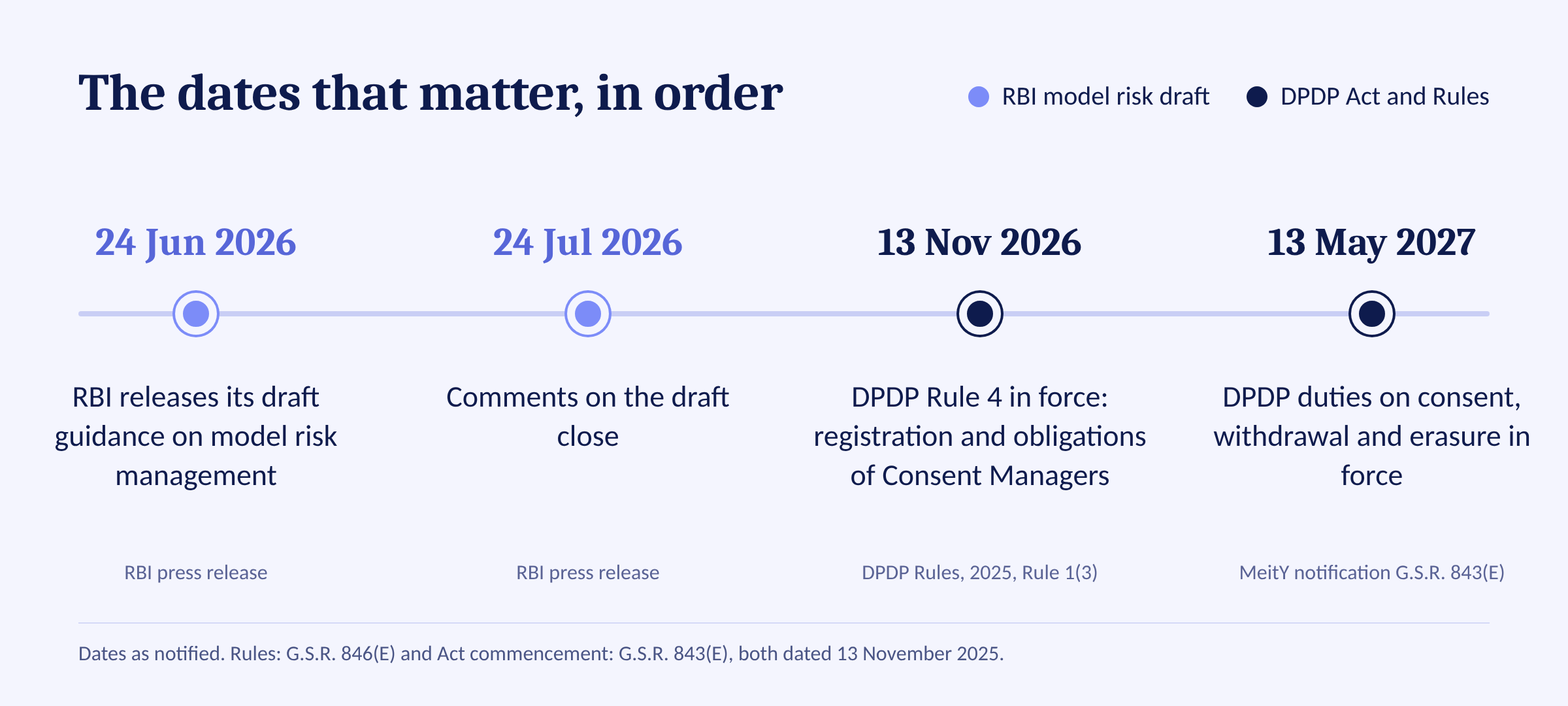
The first date arrives this Friday, 13 November, when Rule 4 on the registration and obligations of Consent Managers comes into force, one year after the Rules were published in the Gazette on 13 November 2025. The Act's duties on consent, withdrawal and erasure come into force 18 months after publication, on 13 May 2027. MeitY has floated shortening that window, and as of 4 November one tracker had found no notification changing the date.
NBFCs have already done part of this. Para 13(2) of RBI’s Credit Facilities Directions for NBFCs, which include its digital lending rules, lets a borrower “revoke consent already granted to collect personal data” and, if required, “make the NBFC / LSP delete / forget the data”. The question now is what deletion means once that data has trained a model.
The experts do not agree on that. Business Standard quotes industry experts who say data behind an already-trained model can be deleted from repositories without affecting the model's efficiency. Ashok Hariharan, CEO of IDfy, says the problem sits with the data behind the models, which often stays in version-controlled systems used during training. Salman Waris of TechLegis calls deleting data and retraining "a nightmare for large models". Two authors writing on SCC Online say one person's data is spread across a model's parameters," making traditional deletion technically ambiguous". They also point out that the Act draws no line between a database and a machine learning training set.
Meanwhile, RBI released its draft guidance on model risk management on 24 June, and it asks for two things. Decommissioned models stay in the inventory for at least ten years, or longer where applicable law requires, and documentation is kept for the matching period. AI models need enhanced documentation to enable "traceability, reproducibility, and auditability”.Put those together and they can collide. Rebuilding a model needs the data it was trained on. The draft says nothing about consent or the DPDP Act, and it does not tell lenders to keep training data. It asks for model records and documentation. What a lender must keep to make a model reproducible once a borrower has withdrawn is left open.
It is tempting to say a legal requirement settles this. The Act does let a lender keep data when retention is necessary to comply with a law. But the draft describes itself as "guidance" intended to assist, and what it asks them to keep is model records and documentation. Whether guidance counts as a law for this purpose is a question for counsel.
What can a lender do before any of this is settled? Keep the record of how each decision was made apart from the borrower's personal data. That record holds the decision and its reason codes, along with the model and policy versions behind it. Then track which datasets and models each borrower's data has touched, so that when someone withdraws, the lender can say what her data fed.
A decision layer that logs each decision with the policy and model version behind it gives a lender something to show without holding the borrower's data. At FinBox, Sentinel AI already works this way, with policies running as governed workflows in which people keep the final call.
So the question for the next model review is a practical one. Can you show how last year's decisions were made without holding the data of a borrower who has since withdrawn?
Until next time,
Srijan
Co-founder
FinBox