Let’s take two people are applying for the same unsecured personal loan at BPI in the Philippines. The salaried applicant needs a gross income of Php 15,000 a month and one of three documents, such as the latest three payslips. The self-employed applicant needs twice that income, two years of profitable operations, either three years of audited financial statements or the latest income tax return, and a business registration certificate.
BPI is one of the more open lenders. Across the markets below, unsecured personal loans are mostly underwritten around a salary paid in to the bank, and several product pages describe no route at all for a trader or the owner of a small business. The gap between those two applicants is usually read as a gap in risk. Part of it is a gap in the cost of preparing the file, and that is the part agents are now in a position to close.
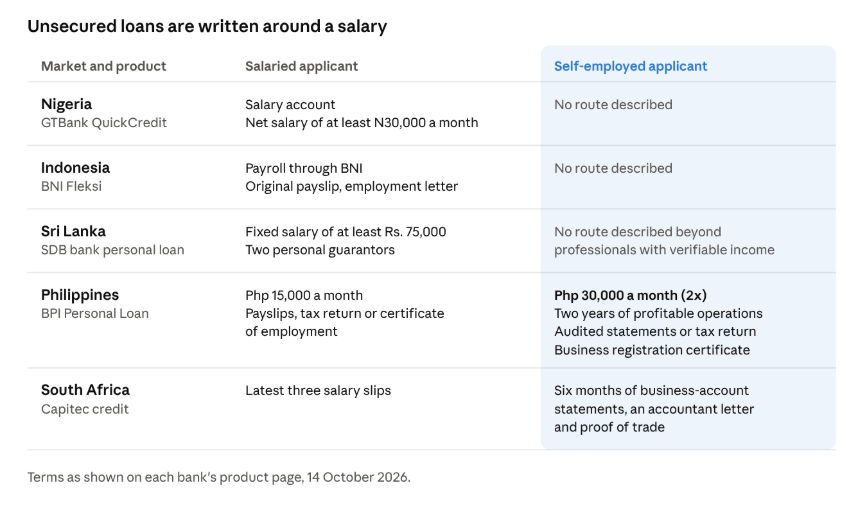
Sources: GTBank, BNI, SDB bank, BPI and Capitec product pages.
The borrower these products skip is a large share of the workforce
The ILO expects 2.1 billion workers to hold informal jobs by 2026, and in the countries above the share of working people without a payslip runs from roughly a quarter to a large majority. Each statistics office measures this in its own way, so the figures below are best read side by side rather than as a ranking.
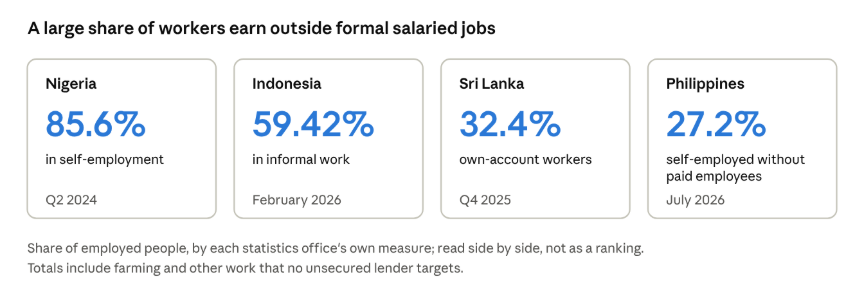
Sources: NBS Nigeria, CNN Indonesia reporting BPS, DCS Sri Lanka and PSA.
South Africa's latest labour force release does not report a comparable share, though it shows informal-sector jobs rising by 34,000 in the second quarter of 2026 while formal jobs fell. These totals include farming and other work that no unsecured lender is targeting, so they describe the size of the gap rather than the size of the market.
The second file is priced on its cost before its risk
The usual explanation is that self-employed borrowers carry more risk, and some of them do. The product terms point to a second reason that gets less attention, which is the cost of finding out how much risk there is. A payslip answers the affordability question before the credit officer starts work: it states an income, names an employer who stands behind the figure, and arrives in a format every bank already knows how to read.
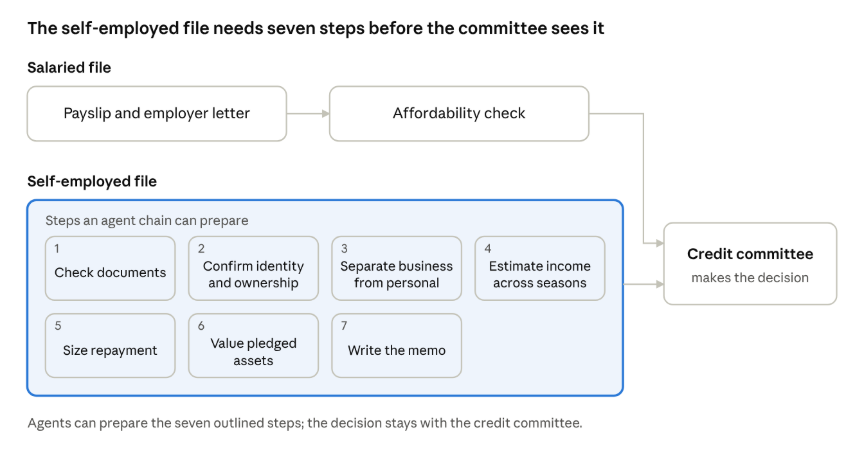
A trader's income has to be rebuilt from what the trader can show. Someone collects statements from every account the business uses, separates sales receipts from transfers between the owner's own accounts and from money borrowed elsewhere, checks that none of the documents has been edited, and estimates a monthly figure from income that rises and falls with the season. After that comes the affordability calculation, a valuation of anything pledged, and a memo the credit committee will accept.
The lender pays for those hours whether the loan is approved or not, and on a small unsecured loan the margin leaves little room for them. Two product designs follow naturally from that cost. One asks the borrower to bring documents that have already done the work, such as audited accounts, tax returns or an accountant's letter; the other leaves the segment out. The product terms above are consistent with both, and in either case the self-employed borrower is priced on the cost of the file before anyone has measured the risk.
The cost and the risk are hard to separate today, and that is part of the problem. A lender that cannot afford to assess self-employed files never builds the repayment history that would tell it how risky those borrowers actually are.
The trail is already in the account
What has changed over the last few years is where self-employed income shows up. According to the Central Bank of Nigeria's fintech report, the country's instant payment platform processed nearly 11 billion transactions in 2024, up from five billion in 2022. In Indonesia, digital payment volume reached 5.50 billion transactions in July 2026, 28.69% more than a year earlier, with QRIS transactions growing by 82.42% over the same period. The Philippine central bank counted 57.4% of retail payments by volume as digital in 2024, up from 52.8% the year before, and Sri Lanka's fast-payment system handled 27.7% more transactions in the first quarter of 2026 than in the same quarter of 2025.
These are national totals, so they do not isolate self-employed income, but they show how much more of everyday commerce now passes through accounts a lender can read.
Each of those payments becomes a line on a bank statement or a record in a payment system. For a growing share of traders, drivers and small manufacturers, the evidence of income now exists in a form a lender can read, as long as the reading can be done at a cost the loan can carry. More data does not lower that cost on its own. Each new source adds another document for a credit officer to open and reconcile, so a richer trail can make the manual file longer to prepare.
Agents change what reaches the credit committee
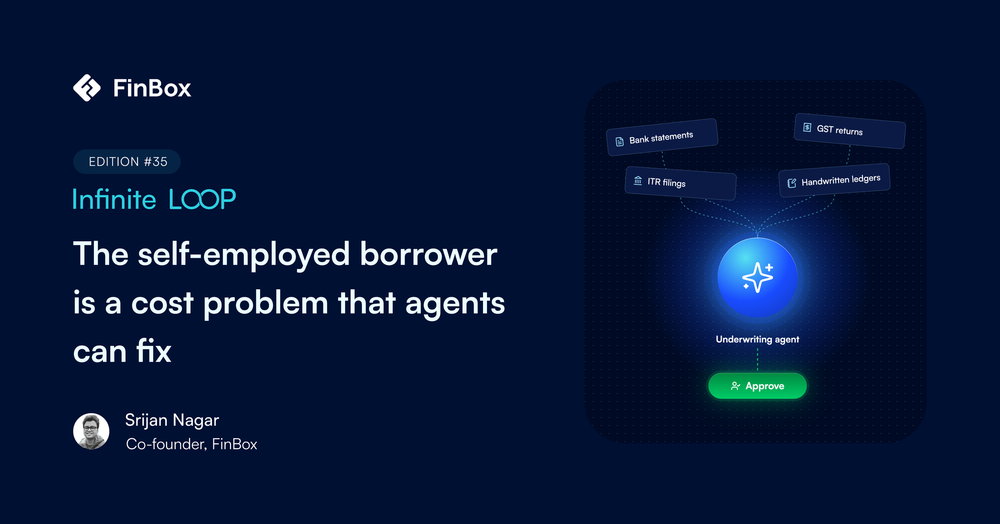
Our May edition argued that agents now take over the assembly of a credit file and leave people to judge it. That shift matters most for the file that has always been the most expensive to build. A chain of agents can work through the seven steps below, from checking the documents to writing the memo, and hand the credit committee a file in which each figure traces back to the transactions behind it. The committee still makes the decision, but it now reviews the self-employed file rather than waiting for someone to assemble it.
The approach stops where the account history thins out
Agents can only read income that passes through an account, and in several of these markets a large share of it still does not. Currency in circulation in Sri Lanka grew by 17.5% in the year to March 2026, alongside the growth in fast payments, and the share of Filipino adults with a formal account fell to 50% in 2025 from 56% in 2021. For borrowers who are paid mostly in cash, the account history will be thin, and lenders will still need other evidence such as bureau records, utility and telecom payments or supplier invoices.
The second limit is time. A lender that begins underwriting self-employed borrowers on account data has little repayment history against which to test its income estimates, so credit limits should start small and grow as each borrower repays. Every decision should also leave a record of the data used and the reason given, which matters more as data protection laws take effect across these markets, including Sri Lanka's, whose core obligations apply from 1 January 2027.
Product terms will follow the cost of the file
If the cost of the self-employed file falls, the terms built around that cost should change with it. I expect the extra conditions placed on self-employed applicants, such as higher income floors, audited accounts and guarantors, to ease first at lenders that prepare these files with agents, and fastest for customers whose income already runs through the lender's own accounts. Anyone can test that over the next two years against product pages like the ones above.
For a credit head, the practical starting point is narrower than the argument. Measure what a self-employed file costs to prepare today, in hours and in hand-offs, so there is a baseline to compare against. Begin with self-employed customers whose income already runs through your own accounts, since their files start with the most data, and set limits that grow as repayment history builds.
This is the kind of work FinBox's pre-LOS agents do. They prepare the file step by step, from the document checks to the credit memo, while Sentinel AI applies the lender's own credit and fraud policy and records the reason behind every outcome. The credit committee keeps the decision, and it receives a file it can review rather than one it has to build.
For most of the history of retail lending, the payslip has decided who gets unsecured credit, because it was the cheapest evidence of income a bank could ask for. Agents narrow that cost advantage for any income that already shows up in an account, and the lenders that redesign their products around the change will reach borrowers their current terms were never written for.
The payslip will keep its place in unsecured lending, though it no longer must be the only way in.
Until next time,
Srijan Nagar
Co-founder, FinBox