Hello everyone,
Welcome to this month’s Common Thread.
I spent a good part of September in Nigeria, in around thirty meetings with banks and lenders. The conversations covered a lot of ground, from SME credit to the systems banks run their loan books on. One product came up in nearly every room: the salary overdraft.
This edition is about why that product is harder to get right than it looks, and why the feature that makes it feel safe is also what hides its risk.
The safest loan in the room
It’s easy to see why banks like salary-backed credit. The customer’s salary is paid into an account the bank already holds, and repayment is swept the day it lands. The employer is a known quantity, often a corporate client of the same bank. Few products give a lender that much visibility and control.
The timing makes it more attractive still. Nigerian banks have just come through the Central Bank’s recapitalisation programme, which closed on 31 March this year. Over ₦4 trillion was raised across the sector, more than thirty banks met the new thresholds, and the exercise pushed consolidation along with it, with Providus and Unity completing their merger in June. Fresh capital has to earn a return, which means it has to be lent, and salary-backed credit is the quickest place to put it to work.
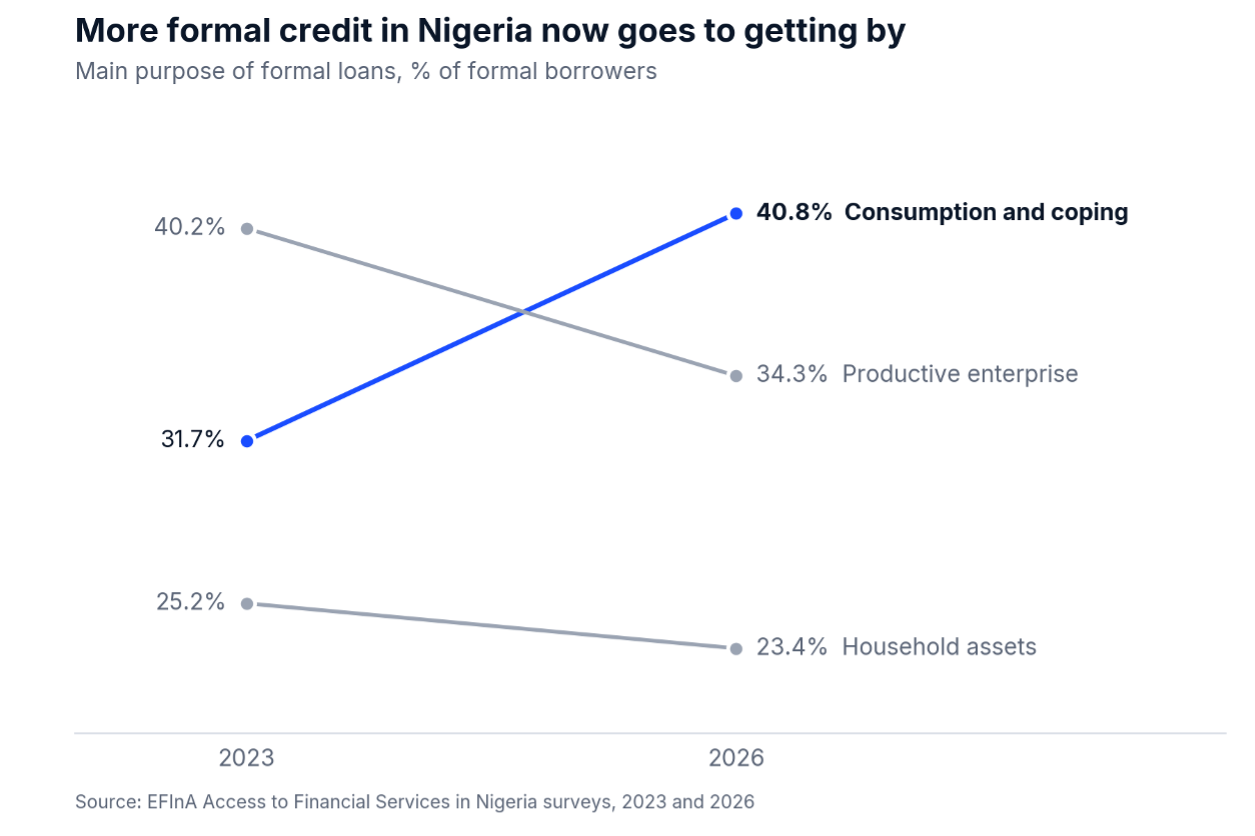
The borrowers on the other side are changing too. EFInA’s 2026 Access to Financial Services survey found that the share of Nigerian adults using formal credit rose from 6% in 2023 to 10%. Over the same period, the share of formal borrowers using loans mainly for consumption and coping rose from 31.7% to 40.8%, and 45.8% now say they find repayment difficult. More capital is heading into lending, and more of the people on the receiving end are stretched.
A ticket everyone holds
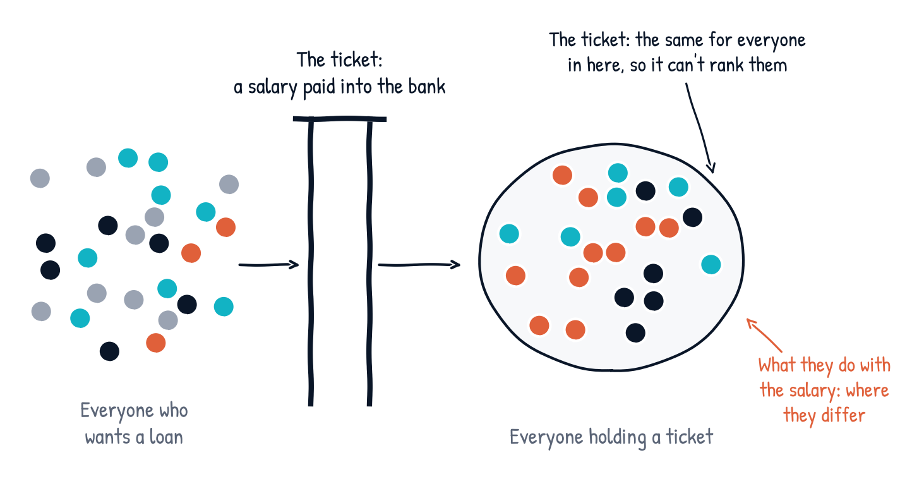
To get a salary overdraft, you need a salary paid into the bank. That requirement is what makes the product feel safe. It is also the ticket that gets every applicant through the door.
Once everyone in the queue holds the same ticket, the ticket stops telling the bank much about them. A filter that every applicant has passed carries almost no information about which of them will repay. Statisticians call this restriction of range: once a group has been screened on a variable, that variable stops predicting much within the group. Banks screen hard on salary, so inside the salary overdraft pool, the salary explains very little.
A requirement can’t also be the thing that tells applicants apart.
The salary tells the bank whether a customer can repay. Whether they will depends on what else is competing for that money each month: other debts, obligations at home, habits, and how the person handles a bad week. None of that is written on the ticket.
What the pool looks like inside
Picture a thousand applicants who all clear the gate. They have steady employers, salaries paid in for years and clean bureau records. To the credit file, they are one uniform group.
Look at how they actually use their money, with their consent, and the group comes apart. Some have several betting apps on their phones and open them most days. Others move a fixed amount into a savings or investment app the day the salary lands. Most sit somewhere in between.
The betting-app count drew the strongest reaction of anything we showed in these meetings. It is a blunt signal and it is no verdict on anyone, but it separates people the salary cannot. In most rooms, the bankers could name customers at both ends of it straight away. The harder question was how to see the difference before lending.
Priced for the average ticket-holder
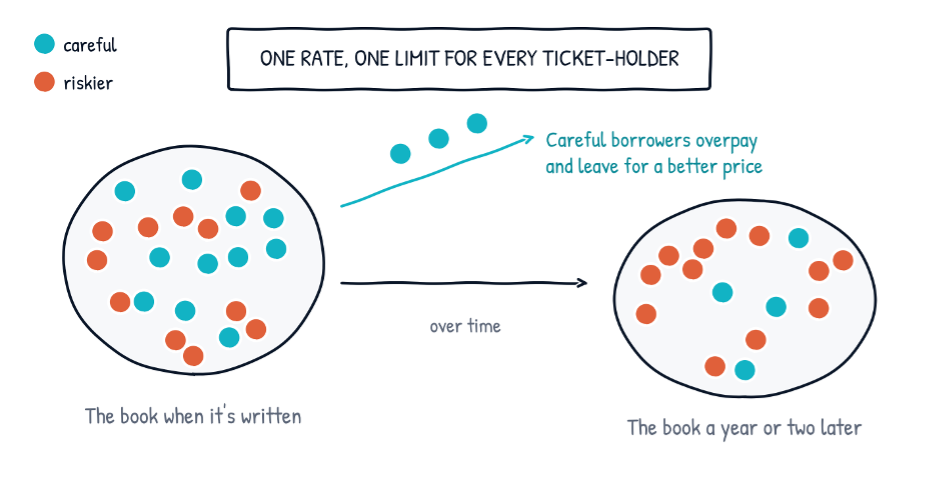
When a bank can’t see inside the pool, it does the sensible thing and prices the pool. Everyone gets the same rate, and a limit set as a fixed multiple of salary.
That is a rational response, and it has a cost. Careful borrowers pay a rate set for the average, so in effect they subsidise the riskier ones. Riskier borrowers get limits sized for someone who manages money better. Over time the careful borrowers are the most likely to leave for a lender who can price them properly, and the book keeps more of the rest. Economists call this drift adverse selection. It shows up slowly, in a book that looked safe when it was written.
The same view finds the upside
The betting-app example tends to be heard as a reason to say no. The second half of the conversation was about saying yes, and it landed just as well.
The customer who saves every payday is a different opportunity altogether. Their spending and investment patterns describe someone who could carry a higher limit, would likely use a card well, and is already looking for somewhere to put money. The view that flags risk in one corner of the pool points to the right next product in another. Cross-sell becomes a decision about fit, made on evidence.
The ticket is checked once
There is one more reason the salary alone isn’t enough. The ticket is checked at onboarding, and the overdraft limit then sits on the account for months or years while the customer keeps changing. Someone who saves today can pick up a betting habit in month seven, and an annual review won’t catch it in time.
This is why banks described what they wanted as something close to an autopilot: alternative data, policy rules and data science working together, so that the decision is re-run as the customer’s behaviour moves, with limits, pricing and offers adjusting alongside it. Once that works for salary overdrafts, they want the same rules engine and agent layer to carry their other products too. SME lending is where many of those conversations went next, and it is a subject for a future edition.
When everyone clears the same bar
The lesson reaches well beyond lending. When everyone in front of you has already cleared the same bar, the bar stops telling you anything about them. A hiring manager learns this when every shortlisted candidate holds the same degree. Nigerian banks are learning it with the salary slip.
It is also the mirror image of a problem my colleague Srijan Nagar wrote about recently in Infinite Loop: households that receive steady money from abroad every month and still never get past the gate, because their income does not look like a payslip. Lenders end up with a gate that keeps out people who could repay, and a pool of ticket-holders they cannot tell apart. Both are fixed the same way, by reading how money actually moves through a customer’s life.
For Nigerian banks with fresh capital to deploy, the advantage will go to those who can see differences inside the pool they already approve, and act on them every month rather than once a year.
That is the work we focus on at FinBox. We build decisioning that reads consented behavioural data alongside the salary, and keeps re-running the decision as the customer changes.
Cheers,
Bindesh Pandey