Key takeaways
- A BRE can automate eligibility, risk grading, pricing, deviation handling and approve-reject-refer decisions.
- A lending-grade engine needs version control, testing, rollback, audit trails and integrations with relevant data sources.
- Rules and machine-learning models serve different jobs. Rules enforce policy guardrails; models can rank risk within those guardrails.
- A BRE supports governance, but it does not make a lender compliant by itself. The regulated entity remains responsible for its policy, controls and decisions.
A BRE in lending is software that converts a lender’s credit policy into executable rules. It evaluates applicant data against those rules and returns a consistent action. These actions can be anything from approvals to routing the application for manual review.
With an agile BRE, credit and risk teams can change policy logic without waiting for developers to rewrite application code. If the team raises the minimum bureau score for a segment from 700 to 720, an analyst updates the rule and the change goes live after approval, outside the engineering release cycle. The engine then applies the approved policy consistently across applications and records how each decision was reached.
What are business rules in lending?
Business rules are predefined conditions that determine an action. A simple rule has two parts:
Rule = condition (if) + action (then)
For example:
If an applicant’s bureau score is above 600, then the maximum loan amount is ₹3,00,000.
If an applicant falls into a medium-risk category, then the interest rate must not exceed 20%.
(These are illustrative rules, not FinBox credit policy or lending advice. A real policy would include more conditions, exclusions, reason codes, data-quality checks and approval controls.)
A single rule rarely decides a loan. Lenders combine several rules into a sequence:
- Verify the applicant
- Check eligibility
- Assess risk
- Set limits and pricing
- Return an outcome
The business rules engine executes that sequence consistently.
What is a business rules engine (BRE) in lending?
A business rules engine is the execution layer for deterministic policy logic. It retrieves approved rules and evaluates the available inputs based on the rules. Then an action is triggered based on the rules.
Here, “deterministic” means the same inputs and the rule version should produce the same output. This makes rule-based decisions easier to trace. The deterministic logic reduces manual errors or varied judgment that happen when several underwriters are involved.
A BRE is narrower than an end-to-end credit decisioning platform. A basic, standalone BRE primarily executes explicit if-then policy.
A credit decisioning platform may also orchestrate data integrations, scorecards and machine-learning models. A loan origination system, or LOS, manages the wider application workflow, including lead capture, document collection and disbursal processing.
How a business rules engine works in loan approval
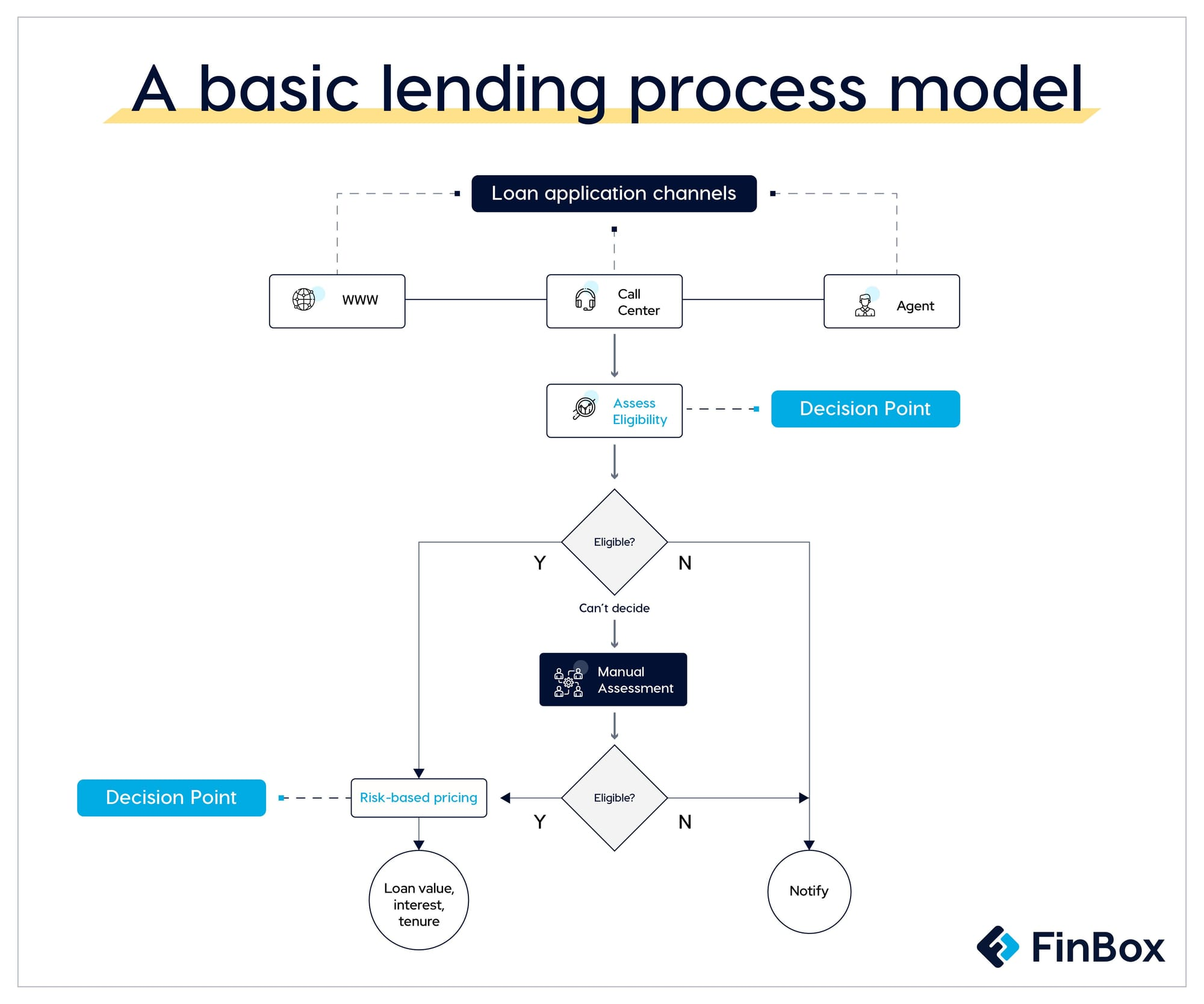
A BRE sits at the decision points in a lending workflow. It doesn't just return a yes-or-no answer. It can evaluate the application in stages and decide what should happen next.
A typical flow is:
- Pull or receive applicant data.
- Check whether required data is present and valid.
- Apply eligibility and exclusion rules.
- Calculate or consume risk scores.
- Determine limits, tenure and pricing.
- Approve, reject or refer the application.
- Record the rule path, outputs and reason codes.
Data pull: bureau, bank statements, Account Aggregator and GST
The engine needs usable inputs before it can apply policy. Depending on the product and the borrower’s consent, these can include:
- Credit bureau data
- Bank statements
- Account Aggregator data
- GST information
- Device signals
- Application data
The integration layer should also flag missing fields and conflicting values before the policy runs, such as a declared income that differs from the bank-statement figure. If a required bureau field is empty, the policy can route the application to an analyst, who decides whether to request the data or decline the case.
Sentinel AI, FinBox’s credit decisioning engine, supports connectors across bureau, bank, GST, device and telecom data. The risk team can then use those inputs in one decision flow instead of reconciling separate outputs manually.
Eligibility and credit policy checks
The first set of rules screens out applications that fall outside the lender’s policy. Common checks include:
- Applicant age and location
- Occupation and business vintage
- Minimum income and existing obligations
- Bureau history
- Product-specific exclusions
A simple rule might cap the loan at ₹3,00,000 for applicants with a bureau score above 600. In production, the policy layers further conditions on top, such as a minimum income and a clean repayment record, and can set different limits for each product or segment. The engine’s job is to carry every condition the credit committee signed off into executable logic.
Risk grading and pricing
After eligibility, the engine can assign a risk band or consume a score from a scorecard or machine-learning model. It can then map that risk result to the constraints involved in disbursing a loan, or an additional verification step.
For example, a lender could define an illustrative rule that caps the interest rate for a medium-risk segment at 20%. The actual policy must reflect the lender’s approved pricing and product economics.
Keeping risk grading separate from pricing also improves control. The team can change a price grid without rewriting the logic that assigns the underlying risk band.
Decision: approve, reject or refer
Clear-cut applications end in an automatic approval or rejection, and the rest go to an underwriter as referrals. Referrals keep edge cases with a person, for example, when documents conflict or the requested amount exceeds the engine’s approval limit.
Policy exceptions, such as a loan above the segment cap, also go to referral. With each referral, the engine should pass along the rule that triggered it and the action the underwriter needs to take, so the case reaches the desk with its context attached.
How a credit policy becomes executable rules
A credit policy is written for governance; a BRE needs logic it can execute. The translation process should preserve the policy’s meaning and approval boundaries.
A practical sequence is:
- Break each policy clause into inputs, conditions and actions.
- Define how missing or conflicting data should be handled.
- Group related rules into decision tables or policy stages.
- Set precedence where two rules may conflict.
- Assign reason codes and owners.
- Test the proposed policy against historical or controlled live data.
- Approve, publish and monitor the new version.
In a low-code environment, the risk team can configure credit policy in a low-code BRE through a visual, drag-and-drop builder. Sentinel AI supports testing, versioning and rollback so a policy change does not begin with an engineering ticket or end as an undocumented code release.
The control principle remains the same: easier authoring should not mean uncontrolled publishing. The lender still needs defined access, review and approval rights.
Business rules engine vs manual underwriting and hard-coded rules
Manual underwriting relies on people to interpret policy and assess each application. It is valuable for complex or exceptional cases, but it can create inconsistent decisions and longer turnaround when applied to every file.
Hard-coded rules automate decisions, but the policy logic is embedded in application code. A policy change then competes for engineering capacity, requires a software release and may be difficult for the risk team to inspect.
An agile BRE separates policy logic from core application code. Authorised users can change the rule set, test it and deploy an approved version while keeping a record of what changed.
This difference is operational, not theoretical. In our IIFL case study on replacing hard-coded rules, IIFL’s turnaround time for policy changes fell from roughly four weeks to a few minutes after moving to Sentinel. The published case study also reports a 60% reduction in application review time. (These are IIFL-specific results, not expected outcomes for every lender.)
Benefits of a business rules engine for lenders
The main benefit of a BRE is controlled policy execution at operating speed. The benefit does not come from automation alone. A poorly governed engine can execute a bad or conflicting policy faster. The value comes from combining speed with testing and ownership.
- Consistent decisions: The same approved rule version is applied to applications with the same inputs.
- Quicker policy updates: Risk teams can tighten a rule soon after spotting a rise in early defaults or a new fraud pattern.
- Shorter turnaround time: Eligible low-complexity applications can move through straight-through processing, while exceptions are referred.
- Simpler product launches: A lender adding a new product can reuse its existing data connectors and eligibility rules, and build only the rules specific to that product.
- Lower operational dependence: Underwriters and engineers spend less time on repetitive decisions and routine rule edits.
- Clearer audits: Each decision carries a reason code and the rule version that produced it, so an auditor can trace any outcome back to the policy in force that day.
Key features of a lending-grade business rules engine
Credit leaders evaluating an engine should look past the rule builder to the controls around it, starting with versioning and deviation handling. Each section below covers one of those controls
For a deeper checklist, check our article on what CROs should evaluate in a BRE.
Versioning, testing and rollback
Every production policy needs a version and a change record.
Before deployment, the team should be able to test a proposed rule set against historical data or compare it with the current policy through champion-challenger or controlled canary trials.
Before release, the risk team can run a proposed rule set against historical applications, or test it on a small share of live traffic alongside the current policy in a champion-challenger setup. If approval rates or early defaults move outside the agreed limits, rollback restores the previous version in one step.
Sentinel AI records policy versions, supports simulation and provides one-click rollback. These controls help the lender move quickly without losing the ability to reconstruct a decision.
Deviation handling
Deviations are part of lending operations. A policy may permit a defined exception when an authorised person reviews and approves it.
A BRE should identify the deviation and route it to the correct authority. They should also record the reason and preserve the final disposition. The BRE should not hide exceptions inside free-text notes or allow an override without an audit trail.
Take an MSME application that falls short of one turnover threshold but qualifies under a secured-loan exception. In that case, the engine refers to the application and names the authority who can sign it off, so the underwriter sees the exception before any decision is made.
Audit trail and explainability
An auditor or support agent should be able to open any decision and see how the engine reached it. Each decision record should include:
- Input values used
- Policy version and rules triggered
- Intermediate outputs, such as the risk band
- Final action and reason codes
With these fields, the team can show why an application received its outcome under the policy active on that date. Internal reviewers use the same records to resolve customer complaints, and examiners use them during regulatory inspections.
Sentinel AI tracks rule and policy versions, changes metadata and processed decision data. The aim is to answer a specific question: why did this application receive this outcome under the policy active at that time?
Real-time decisions and straight-through processing
Real-time execution allows an application to move from validated data to a decision without waiting in an operations queue. Straight-through processing works best for cases that fall clearly inside approved policy.
Measure success by the share of applications decided automatically with every policy check intact and every exception visible.
Business rules engines and RBI compliance
A BRE can help a regulated entity execute and evidence its policy, but the software does not make the lending programme compliant by itself.
A BRE helps a regulated entity apply its credit policy and keep evidence of each decision. Compliance covers the whole lending programme, so the engine is one control among several.
The Reserve Bank of India (Digital Lending) Directions, 2025, dated May 8, 2025, apply to regulated entities' digital lending activities, including all commercial banks. They cover creditworthiness assessment and borrower disclosures, among other areas, and the obligations vary by entity type and operating model
For a BRE implementation, practical controls include:
- Mapping rules to the lender’s board-approved policies and delegated authorities;
- Recording the data and rule version used for a decision;
- Maintaining controlled access to policy authoring and publishing;
- Preserving reasons for approve, reject and refer outcomes;
- Testing changes before production deployment; and
- Reviewing data collection, consent and retention across connected systems.
This section provides operational context, not legal or compliance advice. Lenders should review the applicable RBI directions and other requirements with their legal and compliance teams.
Rules and machine learning models: How they work together
A rule tells the engine what policy allows, and a machine learning model estimates how likely a borrower is to repay. If an applicant lives outside the lender’s permitted geography, a rule rejects the application.
Machine learning models, by contrast, score applicants on patterns in historical data, such as the likelihood of missing an EMI early in the loan.
In a hybrid flow, the model ranks risk and the rules engine sets the boundaries around that ranking. The engine calls the model once eligibility checks pass, then converts the score into a risk band with its own limits. The decision record then stores the model score alongside the rules that set the final outcome.
This combination gives the lender more flexibility than treating rules and models as substitutes. Read the detailed comparison of rule-based vs ML credit decisioning.
Business rules engine use cases in lending
A BRE can support decisions across acquisition, underwriting and verification. The common thread is repeatable policy logic with a defined action.
Pre-qualification in embedded lending
An embedded-lending platform may need to decide whether to show a credit offer before asking for a full application. A BRE can check basic eligibility, partner rules, product availability and existing exposure.
Pre-qualification should not be presented as final approval when additional underwriting is required. The rule flow should distinguish an invitation to apply from a sanctioned offer.
MSME and business loans
MSME lending combines bureau information with business evidence such as bank cash flows, GST data, industry, vintage and existing obligations. A BRE can sequence those checks and apply different policy paths by product or risk segment.
This is particularly useful when the lender changes a policy for one industry or ticket-size band without disturbing every MSME programme. Muthoot FinCorp ONE has stated that Sentinel AI supports changes to its MSME credit policy, showing how configurable decisioning can sit inside an operating lending programme.
For a closer operational view, see how a rules engine for NBFCs supports policy authoring, testing, auditability and local data integrations.
KYC, KYB and fraud checks
Business rules engines are not limited to credit cut-offs. They can route Know Your Customer (KYC), Know Your Business (KYB) and fraud checks based on ticket size, industry, channel and risk band.
Superflows by Sentinel AI can run one configurable KYC or KYB workflow with dynamic rules for those variables. A low-risk case may continue after standard checks, while a mismatch or high-risk signal can trigger enhanced verification or manual review.
Fraud and credit risk should remain distinct in the decision record. A customer can have acceptable repayment capacity and still fail an identity or fraud control.
Where BRE implementations fall short
A BRE does not repair an unclear policy. It exposes that lack of clarity at scale.
Common failures include copying old code into a visual interface, allowing uncontrolled rule creation, omitting exception paths and measuring only approval speed. A lender needs rule ownership, testable definitions and monitoring after deployment.
Rule sprawl and conflicting rules
Rule sprawl occurs when teams keep adding exceptions without retiring or consolidating older logic. Two rules may then issue different actions for the same application.
Control starts with naming standards, reusable components, rule precedence and periodic review. Each rule should have an owner, purpose, approval record and retirement condition. If no one can explain why a rule exists, it should not remain in production by default.
Unclear ownership after go-live
The vendor may provide the engine, but the lender owns the credit policy. Go-live should therefore define who can propose, test, approve, publish, monitor and roll back a change.
Without that operating model, a no-code or low-code tool can recreate the same bottleneck it was meant to remove. Requests still queue up, but it happens with a different team.
Frequently asked questions [New]
How is a business rules engine different from an underwriting engine?
A BRE executes deterministic policy rules. An underwriting engine is a broader term for technology that assesses borrower risk and determines loan terms. It may include rules, scorecards, models and data integrations. A credit decisioning platform coordinates these components to produce an approve, reject or refer outcome.
Can a BRE handle policy changes such as interest-rate updates without IT?
A no-code or low-code BRE can let authorised credit and risk users edit approved pricing rules without changing application code. The lender should still require testing, approval, versioning and controlled deployment. Part II explains why lenders need an agile no-code business rules engine.
Should a credit scorecard sit inside the rules engine?
The BRE can call a scorecard, receive its output and apply policy around that score. Whether the scorecard is hosted inside the same platform or connected as a service depends on the architecture. The decision record should preserve the scorecard version, output and rules that converted it into an action.
What data does a business rules engine use?
A lending BRE can use application data, credit-bureau information, bank-statement or Account Aggregator data, GST information, device and telecom signals, KYC or KYB results, fraud indicators and model outputs. The exact inputs depend on the product, the lender’s policy and permitted data use.