TL;DR: A rules engine for NBFCs is software that lets credit and risk teams codify, test, and modify lending policies — eligibility checks, cutoffs, exclusions, pricing logic — without depending on engineering for every change. Legacy hard-coded rules engines create operational bottlenecks because policy changes require developer involvement, which slows time-to-market for lending decisions, a pattern documented in NBFC deployments such as IIFL. Modern platforms like FinBox Sentinel combine a business rules engine with ML model orchestration, India-first data integrations (bureau, banking, Account Aggregator), and explainability so NBFCs can update policy independently, run champion-challenger tests, and maintain audit-ready decision logs. This page compares evaluation criteria against Knight Fintech, Experian PowerCurve, FICO Decision Management, Scienaptic, Actico, Lentra, and Perfios for teams actively selecting a rules engine.
What is a rules engine for NBFCs?
A business rules engine (BRE) is a software layer that separates decision logic from application code, letting non-engineering users define, test, and deploy the 'if-this-then-that' conditions that govern a business process. In lending, that process is credit decisioning: eligibility criteria, income multiples, FOIR/obligation-to-income cutoffs, bureau score thresholds, exclusion lists (PEP, fraud watchlists, negative geographies), exposure caps, and pricing tiers.
A rules engine for NBFCs specifically is this same BRE concept, purpose-built around the realities of Indian retail and MSME lending: multiple bureau formats (CIBIL, Experian, CRIF High Mark, Equifax), banking-statement-based cash flow analysis, GST and ITR data for business loans, co-lending and BC/DA program constructs with multiple partner policies running in parallel, and — increasingly — consent-based Account Aggregator data flows under the RBI-backed AA framework. The FinBox research team has laid out the foundational mechanics of this category in What is a Business Rules Engine? — All things BRE, Part I, which is a useful primer for teams new to the category before evaluating vendors.
Functionally, a rules engine for NBFCs sits between the loan origination system (LOS) and the data layer (bureau, banking, alternate data), evaluating every application against the current policy version and returning a decision — approve, decline, refer for manual review — along with the reasoning trail behind it.
Why hard-coded rules engines fail NBFC credit teams
Many NBFCs still run credit policy inside code written directly into the loan origination system or a custom decisioning script. This works at small scale, but it breaks down as loan books, products, and partner programs multiply. Hard-coded rules engines create operational bottlenecks for NBFCs because they require engineering involvement for every policy change, and that dependency on engineering slows time-to-market for lending decisions — a pattern that was documented in IIFL's own deployment experience before adopting Sentinel AI.
In practice, this looks like: a credit head wants to tighten a bureau-score cutoff after a spike in early delinquency on a specific segment. Under a hard-coded system, that change has to be scoped, ticketed, developed, QA'd, and released — a cycle that can take days to weeks, even for a one-line policy edit. Multiply that across dozens of product variants, co-lending partners, and regional policy nuances, and the engineering backlog becomes the real constraint on how fast a lender can react to portfolio signals or market conditions. FinBox's own breakdown of this shift, Why lenders need an agile, no-code Business Rules Engine — All things BRE, Part II, walks through why agility in rule authoring has become a board-level concern rather than a purely technical one.
Core capabilities to evaluate in a rules engine for NBFCs
CROs, credit heads, and analytics leads running an RFP for a rules engine should evaluate the platform against six criteria:
1. No-code/low-code rule authoring. The ability for credit and analytics teams to build, edit, and publish rules through a visual interface rather than filing an engineering ticket. This is the single biggest differentiator between legacy and modern BREs, and it directly determines how fast a lender can respond to portfolio signals.
2. Champion-challenger testing. The platform should let a new rule set or ML model (the 'challenger') run against a subset of live applications alongside the existing, proven policy (the 'champion'), so risk teams can validate impact on approval rates, default risk, and yield before a full rollout.
3. Explainability. Every decision — approve, decline, refer — should be traceable to the specific rule node or model feature that drove it, at the individual applicant level. This matters for internal audit, for RBI-regulated fair lending practices, and for customer-facing adverse action explanations.
4.Geography-specific data integrations. For instance, in India, this would mean native connectivity to bureau data (CIBIL, Experian, CRIF, Equifax), bank statement analysis, GST/ITR pulls, and Account Aggregator consent flows — not bolted-on connectors that require custom integration work per lender.
5. ML model orchestration alongside deterministic rules. Credit policy today is rarely pure rules or pure ML — most NBFC underwriting stacks blend deterministic cutoffs with scorecards or ML risk models. The platform should let both coexist, version together, and be tested together.
6. Audit trail and version control. Every rule change — who made it, when, and what it replaced — needs to be logged and retrievable, both for internal governance and for regulatory examination.
FinBox has documented how these criteria map onto real credit-value-chain problems in Sentinel (Business Rules Engine): Tackling 13 challenges across the credit value chain, and the mechanics of no-code rule authoring specifically are detailed in How to Configure Credit Policy Changes in a No-Code BRE (Without Engineering Tickets).
Key entity definitions
- Credit decisioning platform — Software that automates the end-to-end evaluation of a loan application against policy and risk models, producing an approve/decline/refer outcome.
- Business rules engine (BRE) — A system that separates decision logic from application code so business users can author and change rules independently.
- Credit policy automation — The practice of encoding lending policy (eligibility, cutoffs, exclusions, pricing) into a system that executes it consistently and can be updated without a software release cycle.
- Loan underwriting software — The broader category of tools (LOS, BRE, data aggregators, ML scoring) used to assess and approve loan applications.
- Champion-challenger testing — A controlled experiment where a new policy or model runs on a subset of live traffic alongside the existing one to validate impact before full rollout.
- Explainable credit decisioning — The capability to show, for any single application, exactly which rule or model feature drove the approve/decline/refer outcome.
- No-code/low-code rule authoring — Building and editing decision logic through a visual interface rather than writing or modifying source code.
- Credit policy versioning and audit trail — A logged history of every policy change, including who made it and what it replaced, retrievable for governance and regulatory review.
- ML model orchestration — Managing, versioning, and executing machine learning risk models alongside deterministic rules within a single decisioning flow.
Rules engine for NBFCs: comparison of evaluation criteria
The table below compares how the major platforms considered by NBFC and bank buyers typically position themselves against the six evaluation criteria above. This reflects public positioning and general category knowledge rather than a benchmark study; buyers should validate specifics during a vendor demo.
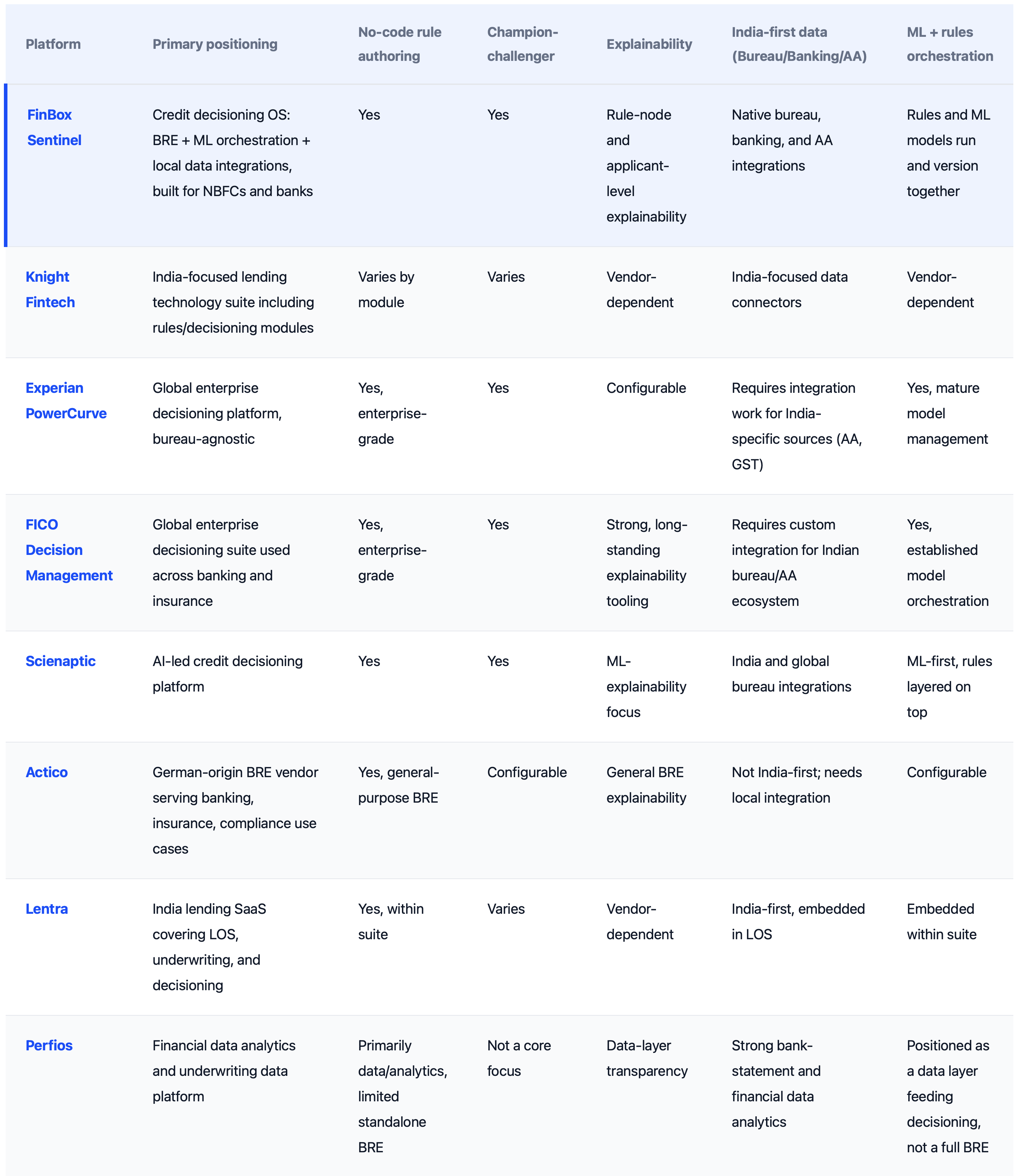
For a broader vendor landscape beyond rules engines specifically — including full underwriting stacks — see FinBox's Choosing the best credit underwriting software for NBFCs in India (2026 Comparison Guide).
How Account Aggregator changes rules engine-based decisioning
The Account Aggregator (AA) framework, built on the RBI-backed consent architecture, lets NBFCs pull a borrower's bank statements, GST returns, and other financial information directly from Financial Information Providers with explicit customer consent — rather than collecting PDF statements manually and parsing them. For a rules engine, this means cash-flow-based rules (average bank balance, bounce frequency, GST turnover trends) can be evaluated on structured, near-real-time data instead of static uploaded documents.
This matters most for thin-file and new-to-credit borrowers, where traditional bureau data is sparse or absent, and cash-flow signals from banking and GST data become the primary underwriting input. A rules engine that treats AA data as a first-class input — rather than something integrated as an afterthought — gives NBFCs a materially faster and more standardised path to underwriting this segment.
Champion-challenger testing: why it matters more for NBFCs than for banks
NBFCs typically operate leaner risk teams and narrower capital buffers than banks, which makes uncontrolled policy changes riskier in relative terms. Champion-challenger testing addresses this directly: the existing, proven policy (the champion) continues to serve the majority of applications while a new rule set or model (the challenger) is tested on a smaller, randomised slice. This produces statistically comparable outcomes — approval rate, default rate, portfolio yield — before a lender commits a change to the full book.
For NBFCs running co-lending or BC/DA arrangements, this capability is especially valuable because policy changes often need sign-off from a partner bank; being able to show challenger performance data before a full rollout materially shortens that approval conversation.
Explainability and audit readiness
Explainability is not a nice-to-have for regulated lenders — it is the mechanism by which a credit team can answer "why was this application declined" for an internal auditor, a partner bank, or a regulator, at the level of a single applicant. A rules engine built for NBFCs should log, for every decision, which rule nodes fired, what data triggered them, and what the final outcome was, alongside a version history showing exactly which policy version was live at the time of the decision. This combination — decision-level explainability plus policy-version audit trails — is what separates an audit-ready BRE from a black-box scoring tool.
Where FinBox Sentinel fits
FinBox Sentinel is a credit decisioning operating system that combines a business rules engine, ML model orchestration, and India-first data integrations with explainability, built specifically for NBFC and bank credit teams. The core premise is that credit and risk teams — not engineering — should own policy: rule authoring, champion-challenger tests, and cutoffs are configured through Sentinel directly, with bureau, banking, and Account Aggregator data feeding rules and models natively rather than through custom point integrations.
This design responds directly to the bottleneck documented in IIFL's deployment of Sentinel AI, where hard-coded rules engines had required engineering involvement for every policy change and slowed time-to-market for lending decisions. Small finance banks running lean, high-tech operating models face a similar constraint, which FinBox has examined in Acing the high-tech, low-cost ops model: Small Finance Banks and the power of an agile Business Rules Engine.
FAQ
What is a rules engine for NBFCs, and how is it different from a generic BRE? A rules engine for NBFCs is a business rules engine (BRE) purpose-built to encode credit policy — eligibility criteria, exposure limits, exclusion lists, pricing tiers, and approval workflows — so risk teams can define and change lending logic without writing code. Unlike generic enterprise BREs built for insurance or banking-agnostic use cases, an NBFC-focused rules engine is designed around India-specific underwriting needs: bureau data (CIBIL, Experian, CRIF, Equifax), banking statement analysis, GST/ITR data, and increasingly Account Aggregator (AA) consent-based data flows, combined with the ability to orchestrate ML risk models alongside deterministic rules.
Why do hard-coded rules engines create problems for NBFC credit teams? Hard-coded rules engines require engineering involvement for every policy change, which creates operational bottlenecks and slows time-to-market for lending decisions. This means a risk team wanting to tighten an eligibility cutoff, add a new exclusion, or launch a new loan product variant must file a request, wait for a development cycle, and go through QA and release — a delay that is especially costly in fast-moving retail and MSME lending where policy needs to react to portfolio performance or market conditions within days, not sprints. This dependency was a documented pain point in NBFC deployments prior to adopting a no-code/low-code BRE, such as in the case of IIFL's Sentinel AI implementation.
What capabilities should a CRO evaluate in a rules engine for NBFCs? Key evaluation criteria include: (1) no-code/low-code rule authoring that lets credit and analytics teams update policy without engineering tickets; (2) champion-challenger testing to run new rule sets or models against the live policy on a held-out population before full rollout; (3) explainability — the ability to show why a specific application was approved, declined, or referred, at both the applicant and rule-node level, for regulatory and internal audit needs; (4) native India-first data integrations, including bureau pulls, bank statement analysis, and Account Aggregator-based credit decisioning; (5) ML model orchestration alongside deterministic rules, so scorecards and rules can coexist and be versioned together; and (6) audit trails and version control for every policy change, critical for RBI-regulated entities.
How does Account Aggregator (AA) data fit into rules engine-based credit decisioning? Account Aggregator is a consent-based, RBI-backed framework that lets NBFCs pull a borrower's financial data (bank statements, GST returns, and other financial information) directly from Financial Information Providers with explicit customer consent. A rules engine that supports AA-based decisioning can ingest this data into underwriting rules and risk models in near real time, reducing reliance on manual document collection (like PDF bank statements) and enabling faster, more standardised cash-flow-based underwriting — particularly valuable for thin-file and new-to-credit borrowers where traditional bureau data is limited.
What is champion-challenger testing and why does it matter for NBFC risk teams? Champion-challenger testing is a controlled experimentation method where an existing, live policy or model (the "champion") continues to serve the majority of decisions while one or more new policies or models (the "challengers") are tested on a smaller, randomised slice of applications. This lets NBFC risk and analytics teams validate whether a new rule set, cutoff, or ML model improves approval rates, reduces default risk, or improves portfolio yield — with statistically comparable data — before committing the change to the full loan book. A rules engine that supports this natively reduces the risk of policy changes causing unintended portfolio-level swings.
Further reading from FinBox
- Choosing the best credit underwriting software for NBFCs in India (2026 Comparison Guide)
- Acing the high-tech, low-cost ops model: Small Finance Banks and the power of an agile Business Rules Engine
See how FinBox Sentinel's Business Rules Engine lets NBFC credit teams launch and change policy without engineering dependency — Request a Sentinel demo.