For years, a Filipino borrower’s phonebook did two jobs for an online lender. At application, the size and makeup of the contact list fed the scorecard. After a missed payment, the same list turned into a collections channel, and the messages sent to bosses, co-workers and relatives earned the country’s lending apps a reputation the industry is still living down.
Regulators went after the second job, and the first one went with it. Privacy rules, SEC enforcement and Google Play's own permissions policy now mean a lender building or refreshing a credit model in the Philippines should assume it will never see the contact list. The SEC’s decision to let new online lending platforms register again from August 2026 adds urgency, because every new entrant has to build its model without that data from day one.
So the useful question is what goes into the scorecard instead.
What the rules say now
A lender in the Philippines cannot treat a borrower's contact list as a scoring input today. The restrictions built up over six years, from the SEC, the National Privacy Commission (NPC) and Google, which sets the rules for lending apps on the Play Store.
Date | Rule | What it means for credit models |
1 Aug 2026 | SEC Memorandum Circular No. 20, s. 2026 takes effect | New online lending platforms can register again after a nearly five-year moratorium, under tougher capital, disclosure and conduct requirements. New entrants build scorecards with no contact data from the start. |
18 Mar 2026 | DICT-NPC-SEC joint advisory on online lending platforms | Reiterates that unnecessary app permissions and excessive processing of contact lists are prohibited, and that only a named guarantor may be contacted for collection. |
31 May 2023 | Personal loan apps can no longer access contacts, photos and videos, external storage, precise location or call logs. | |
Dec 2022 | Contact access is limited to the minimum needed for the borrower to choose character references or guarantors. | |
2020 | Bars harvesting phone and social media contacts for collection or harassment, and requires borrowers to be told when credit scoring or automated decision-making is used. | |
2019 | SEC Memorandum Circular No. 18, s. 2019 | Contacting anyone in a borrower's contacts other than guarantors or co-makers counts as unfair debt collection. |
NPC rules still leave room for limited, proportionate use of contact metadata, but Google Play's ban on contact access closes that route for any lending app distributed through the store. What remains is reference selection.
An app may open the contact list only as far as needed for the borrower to pick their own references or guarantors, and the joint advisory expects that permission to end once the purpose is served. That helps onboarding, but it gives a credit model nothing to work with.
Enforcement is active. The Presidential Anti-Organized Crime Commission (PAOCC) reported 47,446 complaints against online lending firms between August 2024 and early 2026. In late October 2026 the NPC again told the public to treat requests for phonebook and gallery access as a reason to walk away from an app.
What the contact list was actually measuring
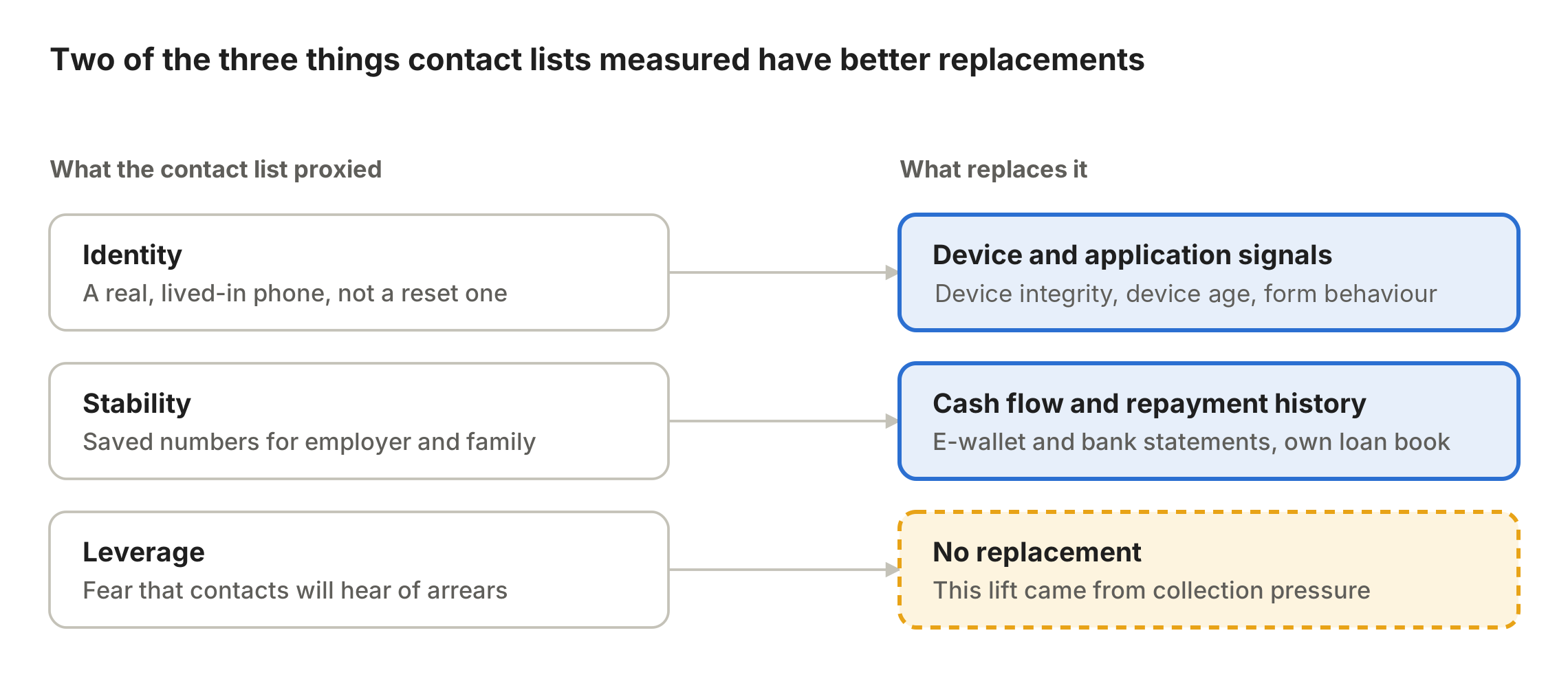
Before choosing a replacement, it helps to be clear about what contact-list features were picking up. Most of the lift came from three things, and only two of them told the lender anything useful about the borrower.
The first was proof of a real, lived-in phone. A device with a few hundred contacts built up over years looks very different from a freshly reset handset with a dozen numbers, and that difference caught a fair share of synthetic identities and loan-stacking rings. The second was a rough read on stability, since saved numbers for an employer, a barangay office or family members suggested someone settled in a job and a community.
The third was leverage. A borrower who knows their sister and their supervisor will hear about a late payment tends to repay faster, and a model trained on that behaviour learns to reward large, dense contact lists. That part of the lift was the collections tactic showing up in the risk data. It disappeared with the tactic, and no new data source should try to recreate it.
So lenders need replacements for identity assurance and stability, and should expect some measured performance to fall away with the leverage effect. A back-test of the old model without contact features will show how much of its lift was real.
What replaces it
The replacements fall into four groups, and because each covers a different slice of borrowers, most lenders end up combining them. Credit data from the Credit Information Corporation (CIC), usually pulled through its accredited credit bureaus, belongs in the mix wherever a borrower has a file, though thin and missing files are the reason alternative data matters so much in this market.
The phone itself, minus the personal data
Much of the identity signal that contacts provided can be recovered from the device without touching anyone’s personal information. Whether the phone is rooted or running an emulator, whether the lending app has been cloned, how long the device has been in use and how consistently it behaves across sessions are all strong fraud signals.
This is the space device-intelligence tools such as FinBox DeviceConnect work in. They turn consented, permission-light device signals into risk features and a score a lender's model can use, without reading contact names or numbers. For thin-file applicants, these features may be the strongest signal available at the point of application.
E-wallet and bank cash flow
Transaction histories answer the stability question far better than a phonebook did, because they show money coming in and going out. In the Philippines the e-wallet is usually the richer source. The BSP’s 2025 Consumer Finance and Inclusion Survey found 36% of adults held an e-money account against 23% with a bank account, and a SWS survey in the first quarter of 2026 put e-money ownership at 43%.
With the borrower’s consent, e-wallet and bank statements can be read for the regularity of inflows, spending against income, existing loan repayments and failed payments. For now, most lenders get this data from statements the borrower uploads, such as bank PDFs or transaction histories exported from their e-wallet app, since API-based sharing under the BSP’s open finance framework is still taking shape. These features work across segments, from salaried workers paid into bank accounts to gig workers and remittance-dependent households who run almost everything through GCash or Maya.
How the application is filled in
The application journey produces its own signals. Time spent on each step, repeated edits to income or employer fields, pasted-in details and multiple attempts from one device all correlate with fraud and misrepresentation. None of this needs extra permissions, because it comes from the lender's own app or web flow.
Your own repayment data
For repeat borrowers, the lender's own history is the best data there is. A small first loan, with limits that grow as the borrower repays on time, lets the borrower build a record directly with the lender. Those repayment outcomes then become the labels that train better models for new-to-credit applicants over time.
Why the decision layer matters as much as the data
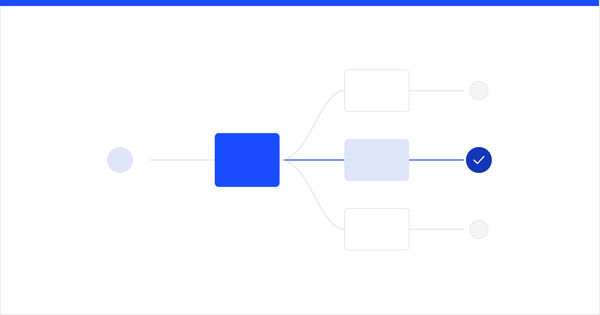
Replacing one data source with four changes how credit decisions get made. A contact-list score was often a single number checked against a cut-off. A model built on device features, cash flow, application behaviour and thin bureau data needs somewhere those inputs are combined, weighted by segment and turned into an approve, decline or limit decision that the credit team can adjust.
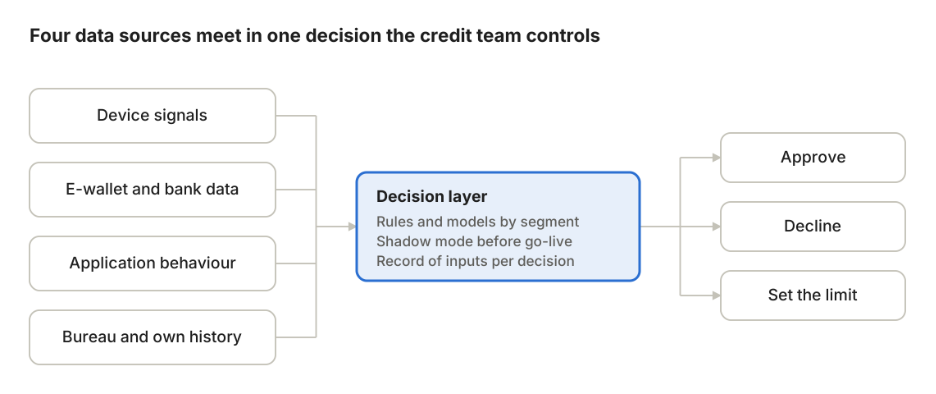
A few capabilities carry most of the weight at this layer. New scorecards should run in shadow mode against live applications before they take over, so the team can watch approval rates and early delinquency shift without putting the book at risk. Policy changes, such as a lower first limit for applicants whose statements show repayments to other lenders.
Every decision also needs a record of the inputs and rules that produced it. NPC Circular No. 20-01 already requires lenders to tell borrowers when credit scoring or automated decision-making is involved, and borrowers and auditors will ask about individual outcomes, especially in a market where data use is under this much scrutiny.
Decisioning platforms like FinBox Sentinel AI are built around that workflow, with AI executing each decision at speed while the credit team owns the policy behind it. Whatever tooling a lender chooses, the test is the same: can you explain any single decision as clearly as you can explain your overall approval rate?
A checklist for rebuilding the scorecard
Whether a lender is refreshing an existing model or launching a new platform under the SEC's 2026 framework, the work tends to run in this order.
- List every feature in the current model and remove anything derived from contacts, call logs, photos, external storage or precise location, including features computed earlier and still cached.
- Back-test the model without those features to separate genuine predictive power from the effect of collection pressure.
- Rank replacement data by how much of your target segment it reaches. For mass-market borrowers, e-wallet data usually comes before bank statements.
- Bring in device-integrity and application-behaviour signals early, since they guard against fraud from the very first loan.
- Run the new scorecard in shadow mode on live traffic, and compare approval and early-delinquency rates before switching over.
- Check that each decision can be explained in plain language to the borrower who received it.
- Rebuild collections so that only the borrower and their named, consenting guarantors are ever contacted.
For the platforms registering under the SEC’s new framework since August, this is where they start. They build their first scorecards with no contact features to strip out and no inflated back-test to explain away, while incumbents have to take their existing models apart feature by feature. Both end up in the same place, and the lenders that get there on data they can defend will be measuring risk better than the contact list ever let them.