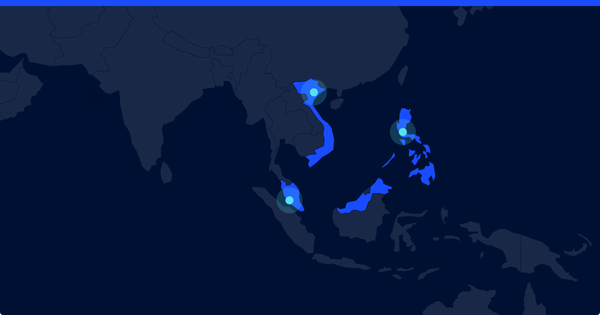
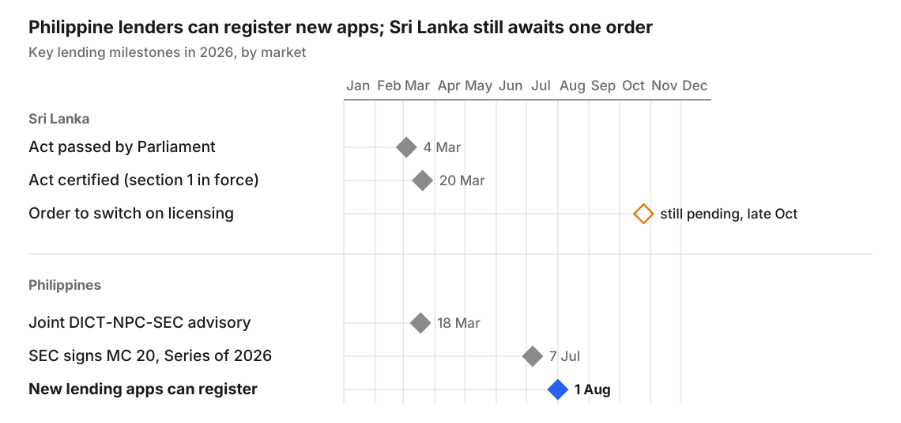
On 1 August 2026, the Securities and Exchange Commission (SEC) let new online lending apps register for the first time since November 2021. Five months earlier, Sri Lanka’s Parliament passed a law that will require every moneylender, including loan apps, to hold a licence from a new regulator.
The two markets are moving differently. The Philippines is reopening to new lending apps under tighter rules, while Sri Lanka is bringing an under-regulated moneylending sector, loan apps included, under licensing. The new frameworks cover capital, consent, disclosure, and credit reporting, and read together, they point to one expectation: a regulator should be able to trace any loan, from the data used to approve it to the terms the borrower accepted.
What follows: what changed in each country, four areas lenders should build into their systems now, and a Sri Lanka checklist for the months before enforcement.
It is written for digital lenders: lending and financing companies that run apps in the Philippines, and moneylenders and loan apps in Sri Lanka. Sri Lanka’s licensed banks and licensed finance companies are exempt from the new Act, but the core of the country’s Personal Data Protection Act applies to them, as to every lender, from 1 January 2027.
What changed in 2026
The Philippines
The SEC issued Memorandum Circular No. 20, Series of 2026 (MC 20) on 7 July, and it took effect on 1 August. Reopening is not automatic approval: the SEC can still refuse, suspend or delist platforms that fail to meet the new rules.
Companies that want to run a borrower-facing app now need paid-up capital that rises with each app they operate, up to PHP 50 million for a lending company and PHP 100 million for a financing company at the five-app limit. They must also register with the Credit Information Corporation (CIC), show borrowers the full cost of the loan before approval or release, and get informed consent before any disbursal or renewal.
MC 20 followed a joint advisory from the DICT, NPC and SEC in March, which restated that lenders may not process borrowers' contact lists beyond narrow, necessary purposes.
Sri Lanka
Parliament passed the Microfinance and Credit Regulatory Authority Act, No. 9 of 2026 on 4 March, and the Speaker certified it on 20 March. It creates a new authority to license and supervise moneylenders and microfinance institutions, with explicit power to regulate lending done through digital or electronic means (s. 37).
Licensed lenders will have to give each borrower a written agreement in Sinhala, Tamil or English, explained before signing (s. 48), that states both the nominal and the annual effective interest rate (s. 46). They must also assess the borrower’s ability to repay before and after lending (s. 46), never recover more in interest than the amount originally lent (s. 49), avoid harassing borrowers or their close relations during collection (s. 49), and protect customer data (s. 64).
Loan agreements made in breach of the Act are void (s. 48), and contraventions can carry a fine of up to Rs. 5 million, up to five years in prison, or both (s. 60). Apart from its opening section, the Act only takes effect once the Minister publishes an order in the Gazette (s. 1), which had not happened as of late October.
Keep a record of every lending decision
Regulators in both countries will want to see how each loan was made. Philippine lenders must be able to show that the borrower saw the full cost and confirmed the terms before disbursal. Sri Lanka’s Act lets the authority examine a lender’s books and records, including those kept in electronic form, and require copies on demand (s. 42).
A supervisor reviewing a loan will typically want to know who the borrower was and what they submitted, which checks ran and what each returned, which credit policy was live that day and who approved the loan, and what terms were offered and when the borrower accepted them.
When the answers are spread across spreadsheets, email threads and individual credit officers, each review takes days to assemble, and the work grows with every loan booked. Gaps in the record carry their own risk too. Under Sri Lanka’s Act, failing to produce requested records, or providing false or incomplete ones, is an offence (s. 43).
The solution is to run origination on a system that tracks and records every step in real time. In FinBox’s LOS, the application, checks and approval sit in one loan record, so a supervisor’s questions can be answered from a single place.
Audit the data behind your scorecard
Borrower consent now sets the limits on what a credit model can use. The March advisory limits an app’s access to a borrower’s contacts to narrow purposes, such as letting the borrower choose a guarantor or character reference. Apps should not ask for permissions they don’t need, and should prompt borrowers to revoke them once the purpose is served. MC 20 adds a requirement to comply with data privacy and credit information laws, and Sri Lanka’s Act requires licensed lenders to protect customer privacy in how they collect, store and use data (s. 64). The wider rules come from each country’s data protection law: the Philippines’ Data Privacy Act of 2012 already applies, and the core of Sri Lanka’s Personal Data Protection Act takes effect on 1 January 2027.
If a scorecard relies on features that need broad device access, such as the size of a borrower’s contact list or how many of their contacts have borrowed before, those features need review now. Pulling them after an enforcement notice leaves little time to test what replaces them.
Review every input in the model. For each feature, ask:
- Where does this data come from, and which app permission does it rely on?
- Did the borrower agree to share it for credit assessment specifically?
- Would we be comfortable explaining this feature to the regulator?
- If we removed it tomorrow, how much would the model’s performance drop?
Replace any feature that fails one of the first three questions. The answer to the fourth tells you how carefully to test the replacement before switching.
DeviceConnect’s SDK collects data only after the borrower grants permission on a screen the lender designs, maps that data to an anonymous customer ID, and is designed not to store or share personally identifiable information. Lenders get credit signals for underwriting along with a clear record of what was collected and what the borrower agreed to.
Approve first-time borrowers with rules you can explain
First-time borrowers are where much of the growth lies. In the Philippines, a TransUnion study of first-time cardholders found that 1.46 million people opened their first credit card in 2024, and that these new-to-card borrowers made up about half of all new cards issued that year. Many first-time borrowers have a phone, an e-wallet or bank account, and regular income, and almost no bureau history.
They also need careful underwriting. TransUnion found that among near-prime borrowers who took their first credit card, 28.2% were 30 days past due after 12 months. Lending to new-to-credit customers works when the rules behind each approval are clear and tested.
That starts with a written credit policy, one that states which signals can raise or lower a limit, by how much, and under what conditions. That makes each decision explainable to the borrower and the regulator, and it supports Sri Lanka's requirement to assess repayment capacity before lending. It also lets credit teams widen approvals in stages and track the results.
When you add a new data source, test it against your current policy first:
- Simulate it on past loans. Run the new policy on historical cases, including loans already tagged for delinquency, to see its effect on approval rates and risk and which rules best predict NPAs.
- Run it in shadow. Score live applications with the new policy in shadow mode, while your active policy keeps making the decisions.
- Shift traffic gradually. Use champion/challenger mode to send a small share of applications to the new policy, compare outcomes side by side, and scale only once the results hold up.
- Keep the record. Keep a full version history and a decision trail for every loan, so you can see which rules drove each approval or rejection and roll back if needed.
In Sentinel AI, every decision is logged with the rules that fired and the policy version behind it, which gives a lender evidence that it assessed repayment capacity before each loan.
Put disclosures and credit reporting inside the loan journey
Disclosures and bureau reporting are often handled by separate teams after a loan is booked. Under the new rules, a gap in either becomes a compliance issue on every loan it touches.
The new rules are specific about each. Philippine lenders must show the full cost of a loan before approval or release, and online platform operators must register with the CIC. In Sri Lanka, agreements must state the nominal and annual effective interest rates, and the Minister can, on the authority’s recommendation, declare licensed lenders to be lending institutions under the Credit Information Bureau of Sri Lanka Act, which would bring them into CRIB reporting.
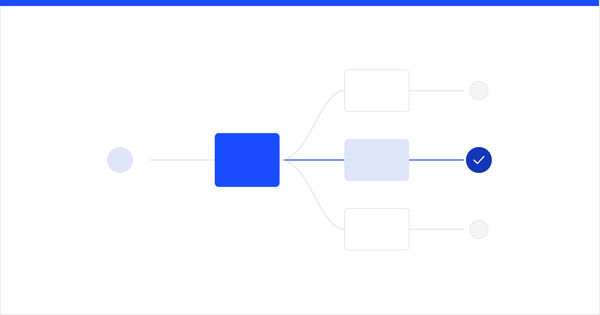
Each works better as a step in the loan journey itself. A disclosure screen should show the rate, fees, total amount repayable, the amount the borrower will receive and the repayment schedule in plain language, ask the borrower to confirm, and store a copy of exactly what they accepted. Bureau reporting should draw on the same loan record your servicing team uses, so what goes to the bureau matches what the borrower owes, every cycle.
The diagram below shows a compliant digital loan journey and what gets recorded at each stage.
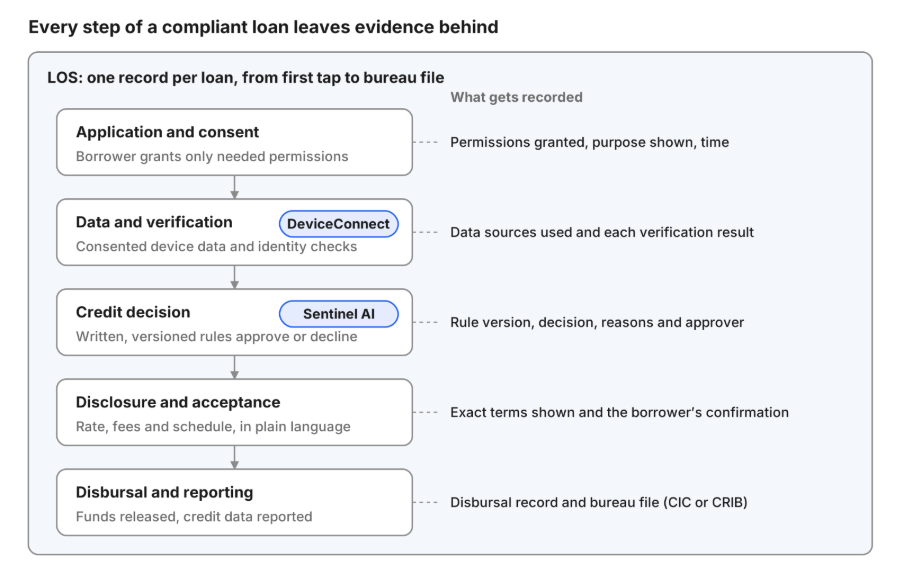
This is where FinBox’s products fit together. DeviceConnect collects device data only after the borrower grants permission on a screen the lender designs, maps that data to an anonymous customer ID, and is designed not to store or share personally identifiable information. Sentinel AI makes the credit decision and records which rules fired. The LOS holds the full record, from the first permission to the bureau file, so the evidence a regulator asks for is already in one place.
Sri Lanka: use the time before enforcement begins
Sri Lanka’s licensing rules and penalties start on a date the Minister sets by Gazette order. As of late October 2026, that order had not been issued, and the Central Bank of Sri Lanka remains the active supervisor in the meantime.
The Act covers moneylenders, microfinance institutions and lending through digital channels. Licensed banks and licensed finance companies are exempt, as they already fall under the Central Bank. Once the order is published, existing moneylenders can keep operating for up to 24 months and must apply for a licence when the authority calls for applications, which it has to do within 12 months. Microfinance companies licensed under the 2016 Act are treated as licensed from the start.
Digital lenders should use this window to fix the areas that usually take longest:
- Origination workflows that don’t leave a complete decision record
- Loan agreements that can’t be produced in Sinhala, Tamil or English on request
- Interest calculations that don’t account for the cap on total interest (s. 49), and fee and penalty schedules that will need to follow the authority’s directives once they are issued (s. 37)
- Collections scripts and practices that haven’t been checked against the Act’s ban on harassment and intimidation (s. 49)
Fixing them now means a lender can apply for its licence with the required records already in place.
Building compliance in early
The new rules favour lenders who can track and explain their own decisions. In both markets, getting licensed is only the first step, and what lenders will be judged on is the record behind each loan.
If you’re preparing to lend in Sri Lanka or the Philippines, we’d be glad to show you how FinBox’s LOS, DeviceConnect and Sentinel AI fit your setup.