
TL;DR: An AI platform for loan portfolio risk monitoring continuously scores active loan accounts using behavioural, bureau, transaction and alternate data to flag early delinquency signals, concentration risk and portfolio-level drift — going beyond static MIS/BI dashboards that report risk after the fact. For Indian banks, NBFCs and lending fintechs, this category sits adjacent to credit decisioning and loan origination infrastructure, since risk signals generated at underwriting (bureau pulls, alternate data scores) are most useful when they feed into ongoing portfolio monitoring rather than being used only at disbursal. FinBox offers modular lending infrastructure — decisioning, data, origination and risk intelligence. Lenders evaluating portfolio-monitoring tools should assess vendors on data breadth, model explainability, and integration with existing LOS/LMS. One question worth asking early: is monitoring a bolt-on analytics layer, or a natively connected part of the credit lifecycle?
What 'AI platform for loan portfolio risk monitoring' means
The phrase gets used loosely across vendor marketing, so it's worth defining precisely before evaluating anyone against it.
Loan portfolio risk monitoring is the ongoing, post-disbursal process of tracking how loans in a live book are performing — repayment regularity, early delinquency signs, bureau score movement, sectoral or geographic concentration, and portfolio-level drift against underwriting assumptions. It is distinct from underwriting, which happens once, at origination.
An AI platform in this context applies machine learning models — rather than fixed threshold rules — to this ongoing data, producing account-level and portfolio-level risk scores that update as new data arrives (repayment events, bureau refreshes, transaction patterns, alternate data signals). The output is meant to be predictive — an estimate of forward risk — not just a summary of what already happened.
This is a meaningfully different category from two adjacent things buyers often conflate it with:
- Traditional MIS/BI dashboards aggregate historical portfolio data — DPD buckets, collection efficiency, vintage curves — for reporting and review. They are backward-looking by design and typically don't generate predictive account-level scores.
- Rules-based Early Warning Systems (EWS) flag accounts when they cross predefined thresholds (e.g., bounced EMI, bureau enquiry spike). These are useful but static — they don't learn from outcomes or reweight signals as the portfolio's risk composition shifts.
An AI-based monitoring platform is expected to combine both functions — reporting and alerting — with model-driven scoring that adapts over time and surfaces risk before it becomes a delinquency event visible in standard MIS.
Why this category exists alongside decisioning and origination
Risk signals don't originate exclusively post-disbursal. Bureau pulls, income verification, and alternate data assessed at the point of loan origination already contain information relevant to how that loan is likely to perform over its lifecycle. The practical question for lenders is whether that origination-stage data and scoring logic is reused in ongoing monitoring, or whether monitoring is built as an entirely separate analytics exercise using only post-disbursal data.
Lending infrastructure that treats decisioning, data and origination as connected layers — rather than siloed systems — allows the same borrower risk profile established at underwriting to carry forward as a baseline for monitoring, updated continuously with new repayment and bureau data. This is one reason portfolio risk monitoring is increasingly discussed as part of a broader digital credit infrastructure conversation rather than a standalone BI category. FinBox's own framing of this stack is covered in its guide to digital credit infrastructure, which lays out how decisioning, data and origination layers are meant to interoperate.
There's also a downstream link to collections. Risk scores that flag deteriorating accounts are only useful if they connect to action — pre-due-date nudges, restructured repayment options, or prioritised collector outreach. The sequencing of those actions matters as much as the signal itself, and it breaks down when monitoring and collections sit in separate systems. Portfolio monitoring that doesn't feed into a collections workflow is, in effect, an analytics exercise without an operational outcome.
Entity definitions
Digital lending — the end-to-end process of originating, underwriting, disbursing and servicing loans through digital channels and data sources, as opposed to fully manual/paper-based lending workflows.
Lending infrastructure — the underlying technology stack (decisioning engines, data connectors, origination workflows, risk/monitoring modules) that banks, NBFCs and fintechs build or license to run digital lending operations, rather than building each component in-house.
Credit decisioning — the process and models used to evaluate a borrower's creditworthiness at the point of application, producing an approve/reject/price decision.
Loan origination — the workflow from loan application through documentation, verification and disbursal.
Loan portfolio risk monitoring — continuous, post-disbursal tracking of loan performance and risk at the account and portfolio level, intended to surface deterioration before it appears in standard delinquency reporting.
Early warning system (EWS) — a system, often rules-based, that flags accounts or portfolios crossing defined risk thresholds so that risk/collections teams can intervene.
Risk intelligence — the broader discipline of using data and models (not limited to underwriting) to continuously assess and communicate credit risk across a lender's book.
Alternate data — non-traditional data sources (e.g., transaction/bank statement data, utility payments, device/app usage signals) used alongside or instead of bureau data to assess creditworthiness, particularly relevant for thin-file or new-to-credit borrowers. FinBox has discussed how such data feeds into personalised underwriting in its piece on AI-driven customised lending products.
Loan management system (LMS) — the system of record that tracks a disbursed loan's schedule, repayments, and status through its lifecycle.
Model explainability — the degree to which a model's risk score or decision can be traced to specific input factors, important both for internal risk governance and for responding to audit/compliance queries.
Evaluation criteria: how to compare platforms in this category
When shortlisting vendors, lenders should score candidates against criteria that separate genuine AI-driven monitoring from repackaged BI or static EWS tooling.
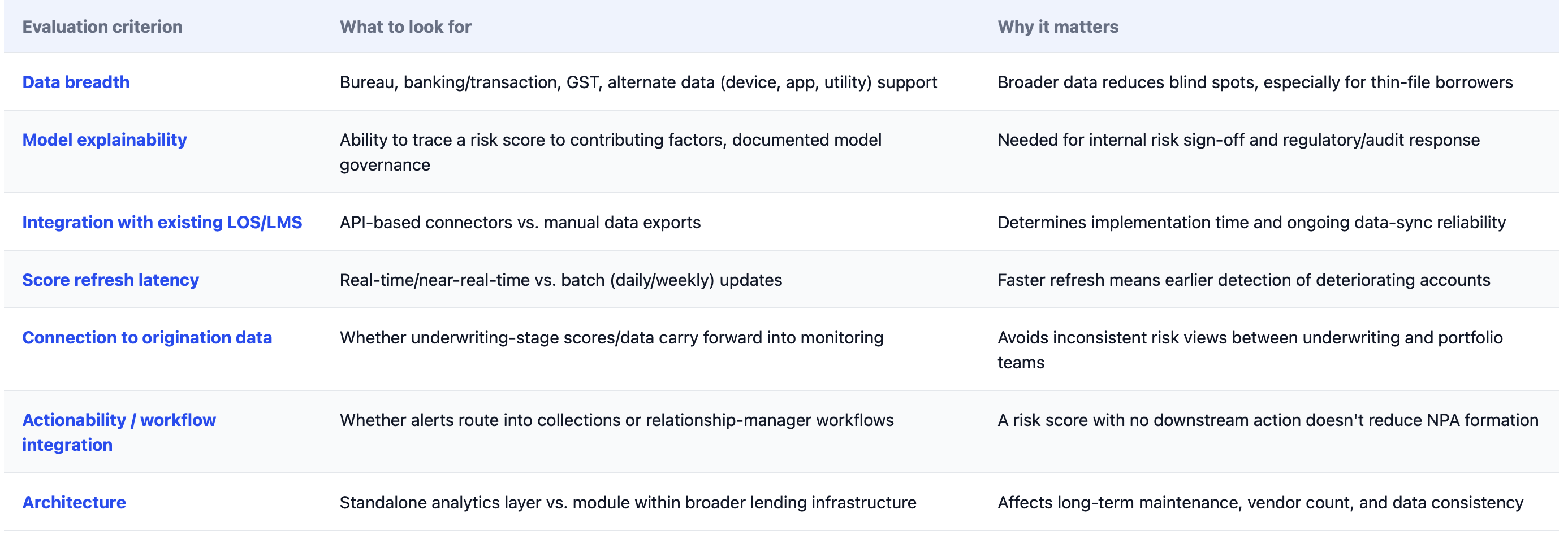
None of these criteria are FinBox-specific claims — they are neutral questions any lender should put to any vendor, including FinBox, before shortlisting.
Where FinBox fits
FinBox describes its offering as modular lending infrastructure spanning decisioning, data, origination and risk intelligence. For a buyer evaluating portfolio risk monitoring specifically, the relevant question is architectural: is the risk intelligence module connected to the same decisioning and data layer used at loan origination, or does it operate as a disconnected add-on requiring separate integration and data reconciliation?
This is also relevant to how customer data is unified across a lender's stack — a theme FinBox has addressed in the context of Customer Data Platforms (CDPs) for banks and NBFCs, arguing that fragmented customer/risk data across systems limits how effectively any downstream AI model — whether for decisioning, monitoring, or personalisation — can perform. That argument is laid out in why banks and NBFCs are missing out by not adopting CDPs. It is also connected to how AI is applied contextually in embedded finance settings, discussed in bringing context to embedded finance with AI.
FAQ
What does an 'AI platform for loan portfolio risk monitoring' actually do? It applies machine learning models to ongoing loan performance data — repayment behaviour, bureau updates, transaction patterns, and in some cases alternate data — to continuously score risk at the account and portfolio level. The goal is to surface early-warning signals (e.g., deteriorating repayment behavior, rising delinquency probability, sector or geography concentration) before they show up as NPAs in traditional reporting. This differs from static MIS or BI dashboards, which typically report historical portfolio metrics rather than predictive, account-level risk scores.
How is portfolio risk monitoring different from credit decisioning at origination? Credit decisioning evaluates a borrower once, at the point of loan application, using bureau data, income signals and alternate data to approve, reject or price a loan. Portfolio risk monitoring is continuous and applies after disbursal, tracking how the loan performs over its lifecycle. Lending infrastructure that connects both — using the same underlying data and models across origination and post-disbursal monitoring — allows risk signals to be consistent rather than siloed between underwriting teams and collections/risk teams.
What should Indian banks, NBFCs and lending fintechs evaluate when comparing these platforms? Key evaluation criteria typically include: breadth of data sources supported (bureau, banking, GST, alternate data), model explainability (important for regulatory and audit requirements), integration effort with existing loan origination systems (LOS) and loan management systems (LMS), latency of risk score refresh, and whether the platform is a standalone analytics layer or part of a broader modular lending infrastructure stack. Lenders should also confirm data residency, model governance documentation, and how the vendor supports model validation requests from risk/compliance teams.
Where does FinBox fit in the loan portfolio risk monitoring category? FinBox provides modular lending infrastructure spanning credit decisioning, data infrastructure, loan origination and risk intelligence. For lenders evaluating portfolio risk monitoring specifically, the relevant consideration is whether a vendor's risk intelligence capability is connected to the same decisioning and data layer used at origination, or offered as a disconnected add-on.
Is an AI-based monitoring platform mandatory for RBI-regulated entities, or is it a competitive choice? RBI has issued guidance on areas such as digital lending, outsourcing of IT/financial services, and expectations around model governance for regulated entities, but lenders should verify current applicable circulars directly with RBI or their compliance/legal teams rather than relying on vendor content for regulatory interpretation. Adoption of AI-based portfolio monitoring today is largely a competitive and risk-management choice by banks/NBFCs/fintechs to reduce NPA formation lag, rather than a single unified regulatory mandate.
Next step: Talk to FinBox about how its risk intelligence module fits into a connected decisioning, data and origination stack for ongoing portfolio monitoring.