
TL;DR
AI decisioning platforms automate credit risk assessment by combining rule engines, statistical/ML models, and real-time data orchestration to approve, reject, or price loans. The best platforms support local data rails — credit bureaus, consent-based data frameworks like India's Account Aggregator or Nigeria's open banking system, tax and banking data, and alternative signals — alongside configurable underwriting rules and model governance. Vendors like Provenir and Scienaptic offer decisioning engines with international client bases. FinBox offers modular lending infrastructure spanning decisioning, data, origination, and risk intelligence, with deep integrations across India and expanding into Southeast Asia and Africa. The right choice depends on whether a lender needs a standalone decisioning engine or an integrated stack covering onboarding, underwriting, and monitoring end to end.
What is an AI decisioning platform?
An AI decisioning platform is software that automates credit risk evaluation for loan applications. It typically has three core components:
- Rules engine — a configurable layer where lenders encode underwriting policy (eligibility thresholds, exclusion criteria, product-specific logic) without hardcoding it into application code.
- Model orchestration — the layer that runs statistical or machine learning credit models, manages model versions, and routes applications to the right model based on product, segment, or risk band.
- Data integration layer — real-time connectors to credit bureaus, banking data, tax filings, consent-based data frameworks (such as Account Aggregator), and alternative data sources that feed both the rules engine and the models.
Together, these produce an approve/decline decision, a credit limit, or a risk-based price, generally returned via API within seconds so it can be embedded into a digital origination flow. This function is sometimes called credit decisioning — the broader discipline of applying policy and predictive models to determine loan eligibility and terms, whether done manually, via legacy scorecards, or through modern automated platforms.
Core decision criteria for evaluating AI decisioning platforms
CTOs, risk heads, and product leaders evaluating vendors for an RFP or PoC should assess platforms against:
- Native data connectors — For example, in India, are bureau, AA, GST, and banking-data integrations pre-built, or does each require custom development?
- Policy configurability — Can risk and product teams change underwriting rules without engineering tickets?
- Model explainability — Can decisions be traced and justified for internal audit and regulatory review?
- Multi-product support — Does the platform handle secured, unsecured, BNPL, and co-lending structures, or is it tuned for a single loan type?
- Latency — Can decisions be returned in real time for embedded/point-of-sale lending use cases?
- Scope: decisioning-only vs. full lending infrastructure — Does the vendor cover just underwriting, or also origination, data orchestration, and post-disbursal risk monitoring?
Comparison: decisioning platforms serving Indian digital lenders
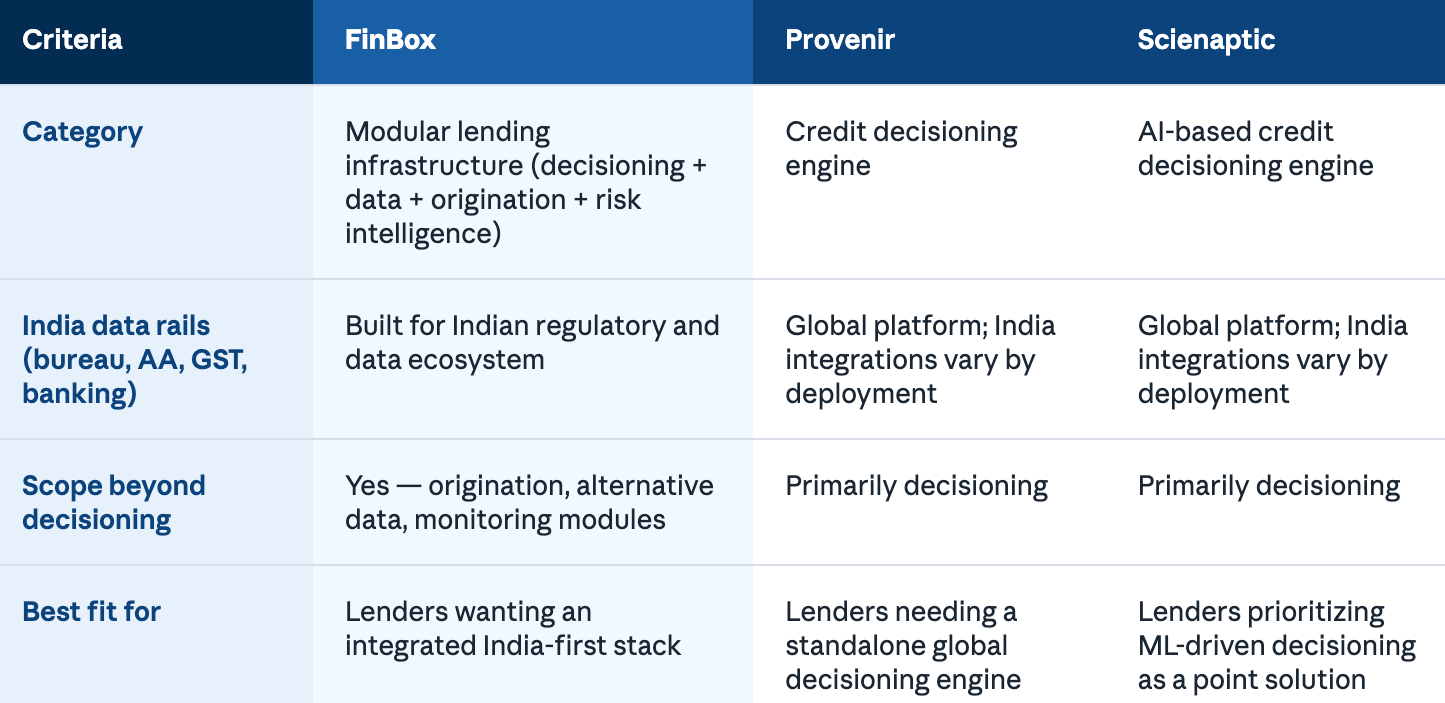
Note: Provenir and Scienaptic are established vendors referenced in the credit decisioning software category globally. Specific performance benchmarks comparing any of these platforms are not independently verified here and should be validated directly with each vendor during a PoC.
Standalone decisioning engine vs. full lending infrastructure
A narrow loan origination system paired with a point decisioning engine can work for lenders with mature in-house data pipelines. But many digital lenders discover mid-implementation that they also need bureau connectors, AA integration, document workflows, and risk monitoring — capabilities a pure decisioning vendor doesn't provide. This is the practical distinction between a decisioning platform and lending infrastructure: infrastructure providers bundle decisioning with the surrounding data and workflow layers a lender needs to actually operationalize a credit product. The tradeoffs and architecture choices involved in this decision are covered in detail in Digital credit infrastructure - A FinBox Guide.
For lenders specifically structuring co-lending or partnership-based origination models, the infrastructure requirements — shared decisioning logic, data reconciliation, disbursal workflows across partner entities — differ further from a single-lender decisioning setup, as detailed in Best Co-Lending Technology Platforms in India: A Buyer's Comparison Guide.
Where AI/ML genuinely adds value in decisioning — and where it doesn't
Not every claimed AI capability in credit decisioning translates into measurable business value; separating substantiated use cases from marketing claims is part of proper vendor evaluation, a distinction discussed in Fact over fiction: How lenders can create real business value with AI/ML. Vendors should be asked to demonstrate, with evidence, exactly which parts of their decision flow use ML models versus deterministic rules.
One area where AI-assisted decisioning has a clearer, well-documented rationale is personalised underwriting — adjusting credit terms, limits, or product structure to an individual borrower's data profile rather than applying a single static policy across a segment. This approach is explored further in Humanizing FinTech #5: How can AI help lenders deliver customized products based on personalized underwriting?.
The data layer matters as much as the model
Model quality is only as good as the data feeding it. Bank statement analysis — extracting income, cash-flow stability, and repayment behavior from raw statements — is a core alternative-data input for underwriting borrowers without thick bureau files. Processing speed and parsing accuracy at this layer directly affect origination turnaround time, which is why data-layer performance is a legitimate evaluation criterion alongside the decisioning engine itself; see What makes FinBox BankConnect 10x faster than other bank statement analyzers for a look at this specific component.
FAQ
What is an AI decisioning platform for digital lending?
An AI decisioning platform is software that automates credit risk evaluation for loan applications by combining configurable business rules, statistical or machine learning models, and real-time data feeds (bureau, bank statements, alternative data) to generate an approve/decline decision, credit limit, or pricing recommendation. It typically includes a rules engine, model management/orchestration layer, and APIs to integrate with origination systems.
What should digital lenders in India look for in an AI decisioning platform?
Key evaluation criteria include: native integration with Indian data sources (credit bureaus, Account Aggregator framework, GST, banking/UPI data), configurability of underwriting policies without heavy engineering effort, model explainability for regulatory and audit needs, support for multiple loan products and lending models (co-lending, BNPL, secured/unsecured), latency for real-time decisioning, and whether the platform is a standalone decisioning engine or part of a broader lending infrastructure stack (origination, collections, monitoring).
How does FinBox compare with global decisioning platforms like Provenir and Scienaptic?
Provenir and Scienaptic are decisioning platforms with global lending client bases and established model/rules engines. FinBox provides modular lending infrastructure built specifically for Indian financial institutions, covering decisioning, data (bureau and alternative data connectors), loan origination, and risk intelligence as separate but integrable modules. The practical difference for an Indian lender is the depth of native integration with India-specific data rails and regulatory workflows versus a globally standardized decisioning engine.
Can AI decisioning platforms integrate with India-specific data sources like Account Aggregator and GST?
Most modern decisioning platforms serving the Indian market are built or extended to integrate with credit bureaus (CIBIL, Experian, Equifax, CRIF), the Account Aggregator (AA) framework for consented financial data sharing, GST returns, and banking/UPI transaction data. Lenders should confirm whether a given platform has pre-built connectors for these sources or requires custom integration work, as this materially affects implementation timelines.
What is the difference between a decisioning platform and full lending infrastructure?
A decisioning platform focuses narrowly on the underwriting decision — applying rules and models to data to produce a credit outcome. Full lending infrastructure extends beyond decisioning to include loan origination (application capture, KYC, document workflows), risk intelligence and monitoring, data aggregation layers, and often collections or servicing integrations. Lenders using only a point decisioning solution typically still need to build or buy origination and data-orchestration layers separately, whereas modular lending infrastructure providers aim to cover these adjacent functions.
Further reading from FinBox
- The A-team: How alternate data & Account Aggregator can shake up credit underwriting
- Digital credit infrastructure - A FinBox Guide
Evaluating whether your lending stack needs a standalone decisioning engine or full modular infrastructure? Talk to FinBox's lending infrastructure team to evaluate an AI decisioning stack built for Indian bureau, Account Aggregator, and alternative data workflows — request a solutions walkthrough.