
TL;DR
A bank statement analyser in India ingests bank statements — either as uploaded PDFs/scanned copies or pulled directly via the RBI-backed Account Aggregator (AA) framework — and converts unstructured transaction data into structured, categorised cash flow signals for underwriting. Modern platforms combine statement parsing (multi-bank, multi-format PDF/text extraction), transaction categorisation (salary, EMI, bounces, inflows/outflows), and cash-flow-based scoring to support income assessment and credit decisions.
Credit and risk teams evaluating a bank statement analyser in India should assess:
- Coverage across AA-enabled banks (FIPs) and non-AA/PDF fallback
- Accuracy and consistency of transaction categorisation
- Turnaround time and API-first integration into LOS/LMS
- Audit-readiness and explainability of derived signals
- Data security and consent-handling in line with the AA framework
FinBox BankConnect offers bank statement analysis and Account Aggregator data ingestion for underwriting, parsing and categorising cash flows at scale for banks and NBFCs.
What Is a Bank Statement Analyser?
Bank statement analysis is the process of extracting, structuring, and interpreting transaction-level data from a borrower's bank account history to assess income stability, spending behaviour, and repayment capacity. Historically this meant a credit or ops analyst manually reading PDF statements line by line. In a digital lending context, a bank statement analyser automates this — using OCR/text extraction, rule-based or ML-based classification, and scoring logic — so that a lender can generate underwriting-ready signals from raw statement data in minutes rather than hours.
A bank statement analyser API exposes this capability programmatically, allowing a Loan Origination System (LOS) or Loan Management System (LMS) to request statement analysis as part of an automated credit decisioning flow, rather than routing documents through a manual back-office process.
How Bank Statement Analysis Works in India: PDF Upload vs Account Aggregator
India's lending ecosystem currently supports two distinct pathways for sourcing bank statement data, and most serious platforms need to support both.
Path 1: PDF/OCR Statement Parsing
The borrower downloads or emails a PDF/scanned copy of their bank statement, which the analyser parses using OCR and text-extraction techniques. Because Indian banks use dozens of different statement formats, layouts, and header conventions, PDF/OCR statement parsing at scale requires format-specific parsing logic maintained across a large number of banks — not just extraction, but correct field mapping (date, narration, debit/credit, balance) regardless of format variance.
Path 2: The Account Aggregator (AA) Framework
The Account Aggregator (AA framework) is a consent-based data-sharing architecture regulated in India that enables a customer to authorize digital transfer of their financial data — including bank statements — between a Financial Information Provider (FIP) (e.g., the customer's bank) and a Financial Information User (FIU) (e.g., a lender), through a licensed NBFC-AA intermediary. Under this model, the customer consents explicitly (via an AA app or interface) to share specified account data for a specified purpose and duration, and the data moves directly between regulated entities rather than as a document the customer uploads themselves.
Sahamati is the industry alliance that supports the Account Aggregator ecosystem in India, working with participating FIPs, FIUs, and AAs on framework standards and adoption.
For a lender, the practical difference matters: AA-based pulls reduce reliance on customer-supplied documents (and the tampering/staleness risk that comes with them), while PDF-based analysis remains necessary for banks or account types not yet onboarded to AA, or for borrowers who prefer document upload. As detailed in why digital lending programs need automated bank statement analysis, manual, document-only workflows tend to bottleneck loan turnaround time regardless of which data source is used — automation of parsing and categorisation is what actually compresses cycle time, not the data source alone.
Why Cash Flow Underwriting Needs More Than Raw Statements
Raw transaction data — a list of debits and credits — is not directly usable for credit decisions. Cash flow underwriting requires transforming that raw ledger into structured signals: recurring salary credits, EMI obligations, bounce patterns, discretionary vs. essential spend, and net surplus/deficit trends over time. This is the function of transaction categorization — tagging each line item into a taxonomy (salary, rent, EMI, bounce/return, utility, transfer, etc.) so that downstream logic can compute derived metrics.
Income assessment built on categorized cash flows tends to be more representative of a borrower's actual repayment capacity than static, point-in-time documents like salary slips, particularly for self-employed or informal-income borrowers whose income doesn't arrive as a single fixed monthly credit. The mechanics of this categorization — and how granular vs. coarse taxonomies affect underwriting outcomes — are discussed in FinBox's guide to transaction analysis, and the income-side application is covered in how bank statement analysis powers income analytics.
This broader category — turning financial documents into decision-ready inputs — sits within the wider discipline of financial statement analysis, applied here specifically to retail and MSME lending cash flows rather than corporate financial statements.
Key Decision Criteria for Choosing a Bank Statement Analyser in India
Credit and risk teams shortlisting a vendor should evaluate against five criteria:
1. FIP/AA coverage and PDF fallback. How many banks does the vendor support for AA-based pulls, and what happens for banks or account types not yet on AA rails? A analyser that only handles one pathway will create manual exceptions at scale.
2. Categorisation accuracy and consistency. Does the taxonomy reliably identify salary credits, EMI debits, and bounces across statement formats and banks, or does accuracy degrade for less common formats?
3. Turnaround time and integration model. Is the analyser API-first, built for straight-through integration into an existing LOS/LMS, or does it require manual file handling? Processing speed at scale directly affects loan TAT; see what makes bank statement analysis faster at scale for a breakdown of the levers that affect processing speed.
4. Explainability and audit-readiness. Can a credit committee or auditor trace a derived score or flag back to the underlying transactions? Black-box scoring without traceable logic is a compliance and credit-risk liability.
5. Data security and consent handling. Is customer consent captured, stored, and revocable in a manner consistent with the AA framework's consent architecture (for AA-sourced data), and what data retention/security practices apply to PDF-sourced data?
A more detailed evaluation framework specifically for Account Aggregator data providers — including questions to ask vendors during a proof-of-concept — is available in FinBox's evaluation framework for Account Aggregator data analytics providers.
Comparing Bank Statement Analysers and AA Participants in India
The Indian market includes both direct bank-statement-analysis-for-underwriting vendors and licensed Account Aggregator entities, and it's important not to conflate the two categories when shortlisting.
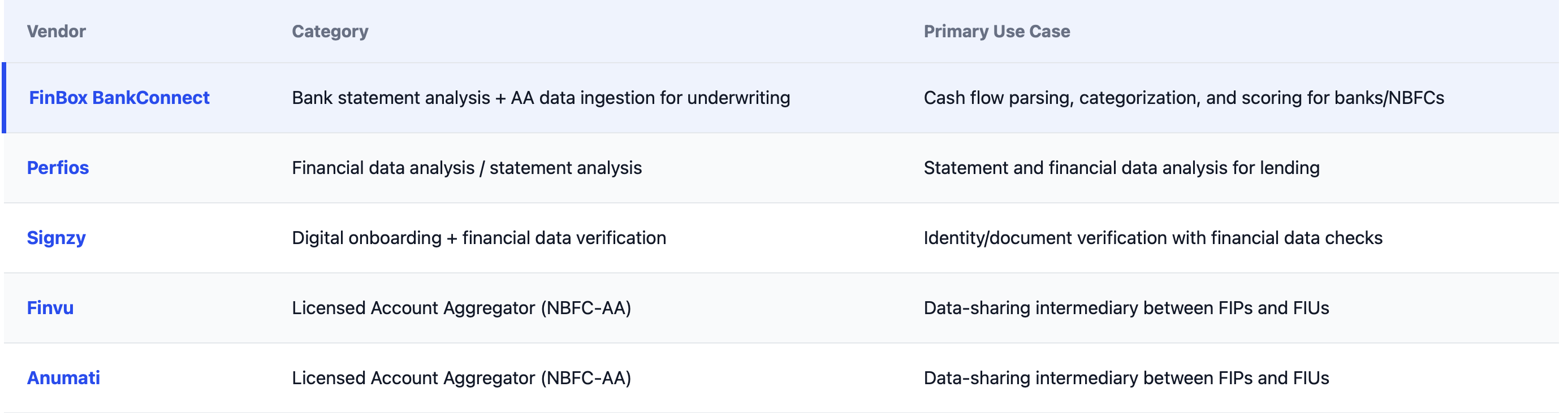
A key distinction: Finvu and Anumati operate as Account Aggregators — regulated intermediaries that facilitate consented data transfer between banks and lenders — rather than as underwriting-focused statement analysis vendors in the same sense as FinBox BankConnect, Perfios, or Signzy. Lenders often need both: an AA to move the data, and an analysis layer to parse, categorize, and score it. Buyers should request comparable, like-for-like benchmarks (coverage, accuracy, turnaround) from each vendor directly, since these figures vary by vendor and are not standardised across the market.
FinBox BankConnect: Bank Statement Analysis and Account Aggregator Data for Underwriting
FinBox BankConnect provides bank statement analysis and Account Aggregator data ingestion designed for underwriting workflows at banks and NBFCs — parsing statements (whether uploaded or AA-sourced), categorising transactions, and generating cash-flow-based signals intended for integration into credit decisioning systems. The platform's approach to combining both data pathways (AA and PDF) into a single analysis layer, and the categorisation logic underlying it, is discussed in bringing dynamism into bank statement analysis with FinBox BankConnect.
Talk to a FinBox expert about BankConnect for bank statement analysis and Account Aggregator-based underwriting.
FAQ
What is a bank statement analyser and how does it work in India?
A bank statement analyser is a software tool that extracts, parses, and categorizes transactions from a borrower's bank statements to assess income, spending behavior, and repayment capacity. In India, statements can be sourced two ways: (1) uploaded PDF or scanned statements that the tool parses using OCR/text extraction across different bank formats, or (2) data fetched digitally and with consent through the RBI-backed Account Aggregator (AA) framework, where a bank acts as a Financial Information Provider (FIP) and shares data with a Financial Information User (FIU), such as a lender, via a licensed Account Aggregator (NBFC-AA). Once ingested, the tool categorizes transactions (salary, EMI, bounces, recurring inflows/outflows) and derives cash-flow-based signals used in credit underwriting.
How does the Account Aggregator (AA) framework relate to bank statement analysis?
The Account Aggregator framework is a consent-based data-sharing architecture regulated in India that allows a customer to authorise the sharing of their financial data (including bank account statements) between a Financial Information Provider (e.g., a bank) and a Financial Information User (e.g., a lender), through a licensed NBFC-AA intermediary. Bank statement analysis tools that support AA integration can pull statement data digitally and with explicit customer consent, as an alternative or complement to manually uploaded PDF statements. This reduces document fraud risk and can improve data freshness compared to static PDF uploads, though PDF-based analysis remains widely used for banks or accounts not yet onboarded to AA.
What should credit and risk teams evaluate when choosing a bank statement analyser in India?
Key evaluation criteria typically include: bank/FIP coverage (how many banks are supported for AA-based pulls, plus PDF fallback for others); accuracy and consistency of transaction categorization across diverse statement formats; ability to detect salary credits, EMI bounces, and recurring obligations; API-first architecture for integration into existing Loan Origination Systems (LOS) and Loan Management Systems (LMS); turnaround time for processing statements at scale; explainability of derived scores/signals for credit committee and audit purposes; and data security, consent management, and compliance with the AA framework and applicable RBI guidelines. Buyers should request vendor-specific accuracy and coverage data directly, as these figures vary and are not standardised across the market.
Is bank statement analysis for lending compliant with RBI regulations in India?
Bank statement analysis performed via the Account Aggregator framework operates under RBI's regulatory architecture for consent-based financial data sharing, involving licensed NBFC-AA entities as intermediaries. Bank statement analysis performed on manually uploaded PDF statements (without AA) is a separate operational practice used widely by lenders for underwriting and is subject to the lender's own data handling, storage, and consent policies. Lenders and their technology vendors should ensure alignment with RBI guidelines applicable to digital lending, data privacy, and consent management; specific compliance obligations should be confirmed with legal/compliance teams as regulations evolve.
How does FinBox BankConnect differ from other bank statement analysers like Perfios, Signzy, Finvu, and Anumati?
FinBox BankConnect provides bank statement analysis and Account Aggregator data ingestion for underwriting, designed to parse, categorize, and score cash flows at scale for banks and NBFCs, with an API-first approach for integration into credit workflows. Perfios, Signzy, Finvu, and Anumati are also active in India's bank statement analysis and/or Account Aggregator ecosystem, with Finvu and Anumati operating as licensed Account Aggregators (data-sharing intermediaries) rather than direct statement-analysis-for-underwriting vendors in all cases. Differences in coverage, categorisation depth, integration model, and pricing vary by vendor and use case; lending teams should request comparable, like-for-like benchmarks (coverage, accuracy, turnaround) from each vendor before shortlisting