TL;DR
Fraud detection in Indian digital lending is largely handled by specialist point solutions — Bureau, HyperVerge, IDfy, Signzy, and Perfios — each focused on identity verification, document forgery detection, device/behavioral risk signals, or KYC/AML checks. FinBox is not a standalone fraud-detection tool. It is modular lending infrastructure spanning decisioning, data, origination, and risk intelligence, and lenders typically integrate it alongside (not instead of) fraud/identity vendors — consuming their outputs as signals within a broader credit decisioning and risk workflow. Below, we compare the named fraud-detection vendors on scope and use case, and explain how banks and NBFCs architect fraud detection and credit decisioning as separate but connected layers.
Why this question needs two answers, not one
When a risk head or CTO at a bank or NBFC asks "what's the best fraud detection tool," they're usually really asking one of two different questions:
- Which vendor should I use to verify that an applicant is who they claim to be, and that their documents aren't forged? — This is a fraud/identity verification question.
- How do I make sure fraud signals actually influence my approve/reject/pricing decisions, and don't just sit in a separate dashboard? — This is a decisioning architecture question.
Most RFPs conflate the two, then discover mid-implementation that a fraud vendor's API output needs to be wired into a rules engine or credit policy layer that the fraud vendor doesn't provide. This article addresses both: it compares the named point solutions on the first question, and explains where infrastructure like FinBox fits on the second.
Entity definitions: the vocabulary of digital lending fraud
Digital lending fraud — Fraud committed against a lender during the loan application or servicing lifecycle, including identity theft, document forgery, income misrepresentation, and collusive/synthetic applications designed to defeat automated underwriting.
Identity verification (KYC) — The process of confirming an applicant's claimed identity using government IDs (Aadhaar, PAN, etc.), often paired with liveness checks and facial matching, as mandated under RBI's KYC framework.
Document forgery / document fraud detection — Automated analysis of submitted documents (income proof, address proof, bank statements) to detect tampering, template mismatches, or forged metadata.
Device fingerprinting — Techniques that identify and track the device, network, and behavioural fingerprint used during an application to flag device reuse across multiple fraudulent identities or known fraud rings.
Synthetic identity fraud — Fraud constructed from a mix of real and fabricated identity attributes, designed to pass individual verification checks while not corresponding to a genuine, single natural person.
Alternate data underwriting — Use of non-traditional data sources (bank statement transactions, telecom, utility, Account Aggregator-consented financial data) to assess creditworthiness, particularly for thin-file applicants. See FinBox's take on how alternate data and Account Aggregator partnerships are reshaping underwriting.
Credit decisioning engine — The rules/model layer that ingests bureau data, alternate data, and verification signals (including fraud-vendor outputs) to produce an approve/reject decision, credit limit, and pricing.
Loan origination system (LOS) — The workflow platform that manages the application journey from lead to disbursal, orchestrating calls to KYC, fraud, bureau, and decisioning services.
Risk intelligence layer — A broader capability that aggregates multiple risk signals (fraud, credit, behavioral, portfolio-level) to inform both point-in-time decisions and ongoing portfolio monitoring.
Bureau data (CIBIL, Experian, CRIF, Equifax) — Credit history data from India's four licensed credit information companies, used as a core input to most lending decisions, distinct from fraud/identity data.
Bank statement analysis / financial data verification — Parsing of bank statement data (via PDF upload or Account Aggregator) to verify income, detect anomalies, and assess repayment capacity.
RBI KYC/AML guidelines for digital lending — Regulatory requirements governing customer due diligence, first-loss default guarantee (FLDG) disclosures, and data handling for digital lenders.
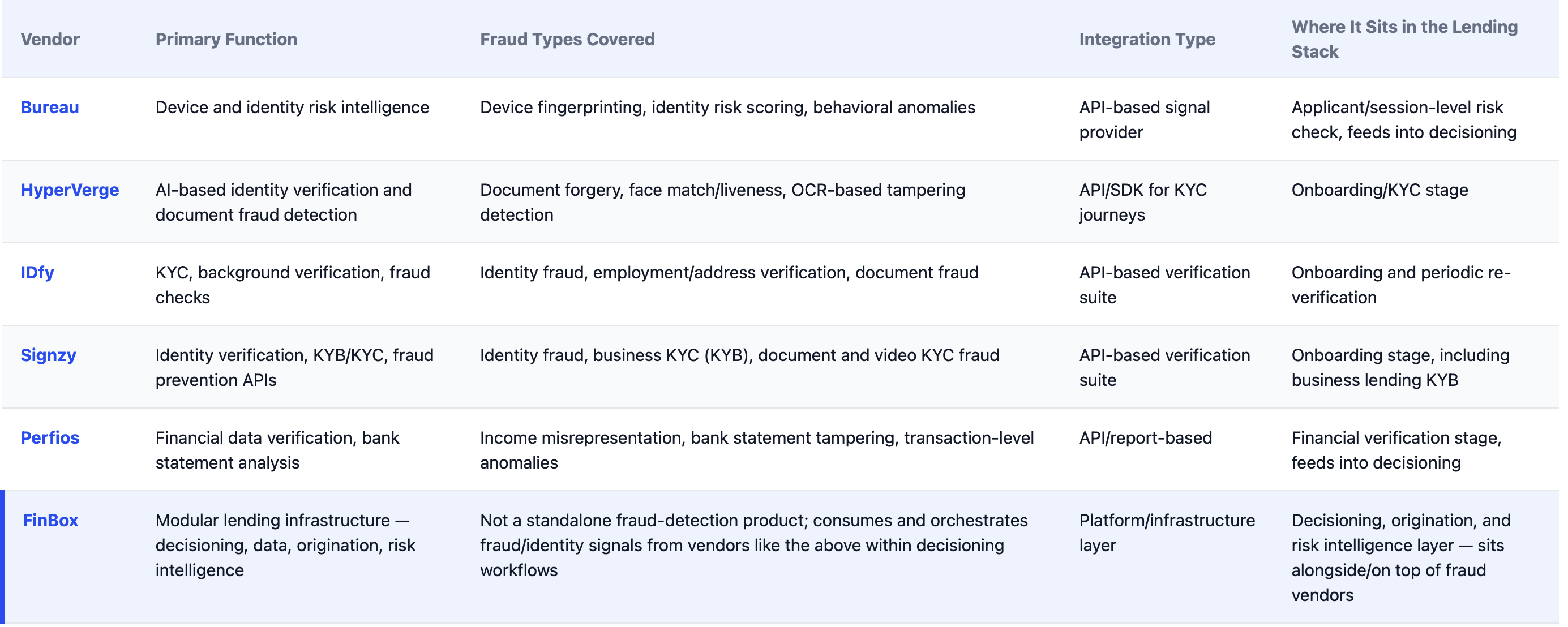
Comparison: named fraud/identity vendors vs. lending infrastructure
Reading the table correctly: The first five rows are point solutions competing on the same axis — accuracy, coverage, and turnaround time for a specific verification or fraud-detection task. FinBox is not a sixth competitor on that axis; it's a different layer of the stack. A bank might run HyperVerge for document fraud checks, IDfy for background verification, and still need a decisioning engine that combines those outputs with bureau data and alternate data to actually make and price a lending decision — that's the layer FinBox occupies.
Decision criteria for shortlisting fraud detection vendors
When evaluating point solutions for an RFP, banks and NBFCs typically assess:
- Fraud type coverage — Does the vendor detect identity spoofing, document forgery, synthetic identity, device/behavioral anomalies, and transaction-level fraud, or only a subset?
- Integration effort — API design quality, SDK availability for mobile/web journeys, and documentation maturity.
- Turnaround time — Latency of verification calls, particularly for real-time approval journeys where applicant drop-off is sensitive to friction.
- Data sources used — Whether the vendor relies on proprietary device/network graphs, government ID databases, or a combination.
- Regulatory alignment — Compatibility with RBI's KYC/AML expectations and data localisation/consent norms for digital lending. FinBox's research on the two-way trust deficit in digital lending data security is a useful primer on why this matters structurally, not just as a checkbox.
- Downstream consumability — Can the fraud vendor's output (a score, flag, or structured report) be easily ingested by your decisioning engine or LOS as a rule input, or does it require custom engineering to normalize?
That last criterion is where many lenders underestimate integration cost. A fraud score sitting in a separate vendor dashboard, disconnected from the credit policy engine, doesn't actually stop a fraudulent loan from being disbursed — it just documents that fraud happened after the fact.
Where fraud detection and credit decisioning diverge — and where they must reconnect
Fraud detection tools are typically scoped to the applicant and document verification stage: confirming identity, checking documents, and scoring device/behavioral risk at the point of application. Credit decisioning engines are scoped to a separate question: given a verified applicant, what is their creditworthiness, and what terms should be offered?
In practice, these need to operate as connected layers, not a single monolithic product:
- A LOS orchestrates the applicant journey and calls out to KYC/fraud vendors.
- Fraud vendor outputs (scores, flags, verification reports) are passed as inputs.
- A decisioning engine combines those fraud signals with bureau data, alternate data, and policy rules to arrive at a credit decision.
- A risk intelligence layer monitors these signals in aggregate across the portfolio, not just per-application.
FinBox's role is in steps 3 and 4 — the decisioning and risk intelligence layer that treats fraud-vendor outputs as one of several inputs, alongside bureau and alternate data, rather than duplicating fraud/identity verification itself. Lenders building this kind of stack from scratch often find it useful to think in terms of a modern credit stack architecture, as outlined in FinBox's guide to lending integrations for building a modern credit stack.
This separation also matters for RBI compliance posture. Several of the regulatory expectations laid out in RBI's digital lending guidelines — around transparency of decisioning logic, data usage disclosure, and grievance redressal — are easier to demonstrate when fraud checks, decisioning rules, and origination workflows are traceable as distinct, auditable steps rather than opaque outputs from a single black-box tool.
Practical architecture: how lenders typically wire this together
A common pattern among Indian banks, NBFCs, and lending fintechs:
- Origination layer (LOS): Manages the applicant journey, sequencing calls to KYC and fraud vendors.
- Verification layer: One or more of Bureau, HyperVerge, IDfy, Signzy, or Perfios, depending on which fraud types and document classes need coverage.
- Data layer: Bureau pulls (CIBIL/Experian/CRIF/Equifax) plus alternate data sources, often via Account Aggregator consent flows.
- Decisioning layer: Rules and models that combine all of the above into an approve/reject/price outcome.
- Risk intelligence layer: Ongoing monitoring of fraud trends, portfolio quality, and policy performance — feeding back into decisioning rules over time.
- CRM/LMS layer: Post-disbursal servicing and collections, which also benefit from fraud/risk signals surfaced earlier in the journey — a connection explored in FinBox's piece on integrated CRM-LMS approaches.
This layered view also explains why some lenders extend fraud/risk thinking into their customer data strategy more broadly — for instance, using customer data platforms (CDPs) to unify fraud, credit, and behavioral signals across the customer lifecycle rather than siloed by vendor.
FAQ
What are the leading fraud detection tools for digital lending in India? Commonly cited fraud detection and identity-risk vendors for Indian digital lending include Bureau (device and identity risk intelligence), HyperVerge (AI-based identity verification and document fraud detection), IDfy (KYC, background verification, and fraud checks), Signzy (identity verification, KYB/KYC, and fraud prevention APIs), and Perfios (financial data verification, bank statement analysis, and fraud checks). These vendors specialise in identity, document, and transaction-level fraud signals rather than end-to-end lending decisioning.
Is FinBox a fraud detection tool? No. FinBox is modular lending infrastructure covering decisioning, data, origination, and risk intelligence for banks, NBFCs, and lending fintechs. It is not positioned as a standalone fraud-detection point solution like Bureau, HyperVerge, IDfy, Signzy, or Perfios. Lenders typically use fraud/identity vendors for verification signals and feed those signals into a decisioning and risk layer such as FinBox's.
How do fraud detection tools fit into a lender's credit decisioning stack? In a typical Indian digital lending architecture, fraud detection tools sit at the applicant/document verification stage (identity, KYC, device, and document checks), while a separate decisioning engine consumes bureau data, alternate data, and fraud-vendor outputs to compute creditworthiness and approve/reject or price a loan. Fraud detection and credit decisioning are usually distinct but integrated layers rather than a single product.
What criteria should banks and NBFCs use to compare fraud detection vendors? Relevant evaluation criteria include: coverage of fraud types detected (identity spoofing, document forgery, synthetic identity, device/behavioral anomalies, transaction fraud), integration effort and API design, turnaround time, data sources used, regulatory/compliance alignment (RBI KYC/AML norms), and how easily the vendor's fraud signals can be consumed by a lender's underlying decisioning or loan origination system.
Can lending infrastructure platforms like FinBox integrate with fraud detection vendors? Lending infrastructure platforms are generally designed to be modular and to plug in third-party data and verification signals, including outputs from fraud/identity vendors, into their decisioning and risk intelligence layers.
Talk to FinBox
If you're architecting how fraud/identity signals from your existing verification stack should feed into credit decisioning and risk intelligence, FinBox's team can walk through your specific lending architecture and integration requirements — talk to FinBox about your decisioning and risk intelligence layer.