
Hello everyone,
Welcome to the 224th edition of The Pattern, a weekly newsletter on the latest in finance, technology, and the economy.
Put two lines from the RBI's July credit data side by side. Bank loans against gold jewellery grew 88.1% from a year earlier. Credit card dues grew 2.3%, and consumer durable loans 0.4%. The households and the month are the same, yet one line is growing nearly forty times as fast as the other.
For most of the past two years I've read that gap as a gold story. Prices rose, the same jewellery could raise more, and lenders followed. That is still a big part of it. But this week added two pieces. Money got more expensive, and two large lenders said publicly what some of that gold-loan growth is paying for.
That's what I want to talk about in this edition: where credit goes when money gets tight, and why the gold vault can end up holding more than gold.
Money just got dearer
On October 7, the RBI raised the repo rate to 5.50%. The minutes, published on Wednesday, show four of six MPC members voting to move the stance to "calibrated tightening". At the end of September, bank credit was growing at 19.4% and deposits at 17.8%, according to CareEdge.
Deposits had help getting even that far. The RBI's special FCNR(B) swap window brought in about $127 billion of foreign-currency deposits after it opened in June. That window has closed, and the liquidity surplus it helped build has more than halved, from about ₹11.2 lakh crore in early September to ₹4.86 lakh crore on September 30.
ICICI Bank's results last Saturday show the same thing inside one balance sheet. Reported loans grew 30% and deposits 27%. Take out the FCNR(B)-linked book and loans grew 24.1% against deposits at 17%, while the net interest margin slipped to 4.18% from 4.36% in the June quarter. Over at Bajaj Finance, management flagged margin pressure from rising rates and said it plans to raise equity, with leverage above five times.
Money is still available. The next rupee just costs more, so lenders will think harder about where it goes.
Both sides head for the vault
When funding is expensive, a lender wants loans it can price quickly, keep short and recover if something goes wrong. A gold loan does all three. Gold loans already make up about 28% of the non-housing retail book, according to Macquarie's Suresh Ganapathy, and bank gold loans were up 83% to roughly ₹5.6 lakh crore by the end of August, with NBFC gold loans up 69% to about ₹3.6 lakh crore.
Borrowers are making the mirror-image choice. Card dues have barely grown, and when unsecured credit slows, the jewellery at home is the one asset most families can turn into cash the same day. I'd be careful about how much of the growth is need and how much is price, though. As Rajat Deshpande wrote in The Big Picture on Wednesday, CRIF High Mark data shows active gold loans grew 12.6% in a year while the average ticket size grew 37.5%. A good share of the boom is the same jewellery being worth more.
Each of these choices makes sense on its own. The trouble shows up when you add them together.
Stress changes address
On Wednesday, Business Standard reported that Piramal Finance's CEO, Jairam Sridharan, estimates between 15% and 23% of the industry's gold-loan disbursements in 2025-26 went to borrowers already more than 90 days overdue on another loan. He put the value of those disbursements at ₹4.7 lakh crore and called it "a shockingly high number". In the same story, Bajaj Finance said ₹1,047 crore of the rise in its Stage 2 assets came from short-tenor gold-loan schemes, which it stopped offering in August.
Walk through one of those loans from each lender's seat. The gold lender is covered, because RBI rules cap the loan at 75–85% of the jewellery's value. The lender with the overdue loan gets repaid, so its book improves. Neither has a reason to worry. The borrower ends up with one more loan, less jewellery and the same income.
The gold lender's loan is safe. The gold lender's borrower may not be.
I've started calling this the collateral detour. When money gets tight, credit keeps flowing but routes around the borrower, through whatever asset is at hand, and every lender along the way sees a well-covered loan. The stress is still in the system. It has simply changed address.
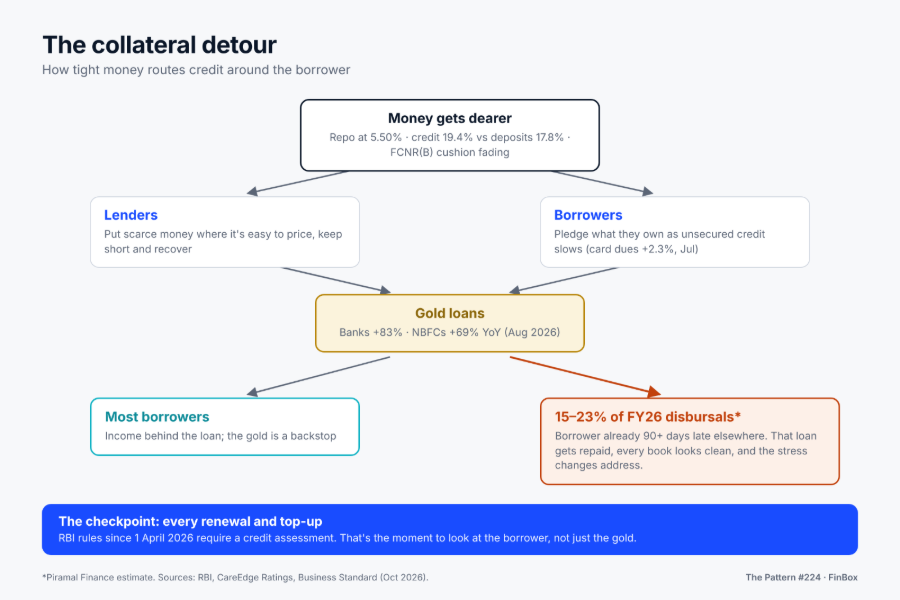
The collateral detour: how tight money routes credit around the borrower.
The detour also leans on the gold price. Spot gold fell to a two-month low near $4,025 an ounce this morning as oil spiked. Ganapathy warned that a sharp fall in gold prices arriving alongside rising defaults would test the assumption that the collateral alone protects lenders.
Why I might be wrong
I could be over-reading one quarter of commentary from two lenders. Bajaj says most of its Stage 2 bump is temporary, about ₹550 crore has already moved back to Stage 1, and it doesn't expect credit costs to rise. Sridharan himself said having a gold loan on file "is not an indicator of higher risk". India Ratings' Jinay Gala pointed out that risk varies by segment, since a family in a smaller town may hold most of its savings as gold. For that family, pledging a bangle to clear an overdue EMI can be the most sensible thing to do.
So my worry is narrower. A gold loan to a stretched borrower can be a perfectly reasonable loan. What concerns me is a system where everyone looks at the jewellery and nobody looks at the borrower.
The renewal is where you see the borrower again
Since April 1, the RBI's directions on lending against gold and silver allow renewals and top-ups only within the LTV limits, only on loans still classed as standard, and only after a credit assessment. Bullet loans can be renewed only once the interest is paid. In effect, every renewal is now a checkpoint.
The Big Picture argued this week that renewals belong on the customer's phone, because the renewal date decides whether a lender keeps, grows or loses a customer. I'd add that it is also the cheapest moment to ask the bureau whether this borrower is 90 days late somewhere else. Piramal says it already screens for this, and that such borrowers made up under 1% of its gold-loan disbursements in October.
So why doesn't every lender do it? The gold already covers the loan, a bureau check feels like friction on a product that sells on speed, and turning away someone with good jewellery mostly sends them to the lender down the road. Those are real reasons. They are also why this kind of stress stays invisible until gold prices or incomes turn.
If I ran a gold book, I'd want a renewal the customer can finish from home and a bureau check that runs every single time.
What I'm taking away
In #194 back in February, I wrote that gold lending comes down to whether the gold does the heavy lifting or the underwriting does. This week gave me a partial answer. As long as money stays tight, more of India's retail credit will take the collateral detour, and the lenders who check the borrower at every renewal will see the stress while it is still in someone else's book.
Before I sign off, a question for you. How much of this year's gold-loan growth do you think is price, how much is need, and how much is unsecured credit moving house? Just write back. I'd especially like to hear from anyone who runs a gold book.
Until next week,
Mayank
If this was useful, forward it to one person who works on gold loans, collections or bank funding.
Views are personal and do not reflect those of FinBox or its promoters.
Reading list
- Large non-bank lenders flag early signs of stress in gold loan portfolios
- ICICI Bank Q2 net rises 20% to ₹14,843 crore as provisions fall
- Bajaj Finance shares fall 4% on margin pressure: what analysts said about Q2
- Bank credit growth jumps to 19.4% on quarter-end surge, outpacing deposits (CareEdge Ratings)
- Why gold-loan renewals belong on your customer's phone (The Big Picture)