Hello everyone,
Welcome to the 211th edition of The Pattern.
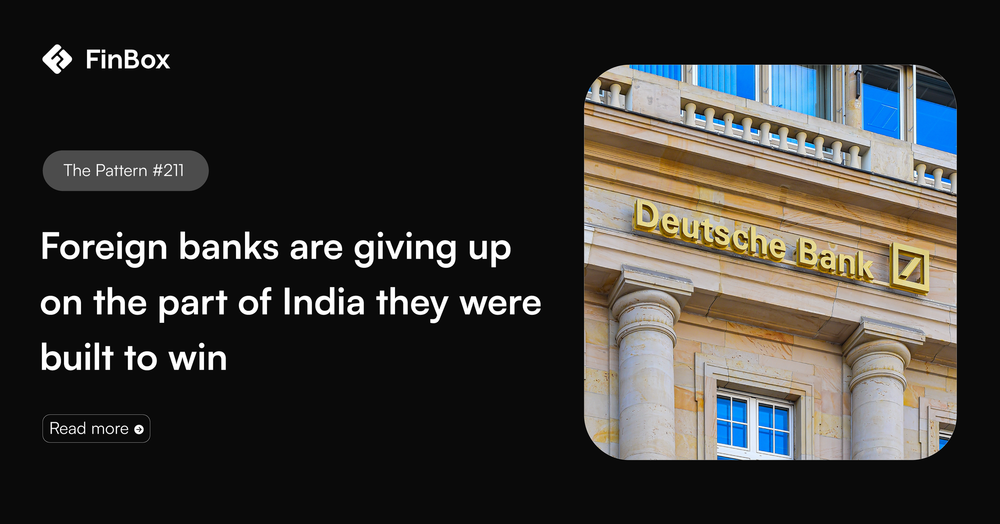
On July 1, Kotak Mahindra Bank agreed to acquire Deutsche Bank's retail banking, private banking and wealth management business in India—a portfolio comprising about ₹29,000 crore in loans, ₹16,000 crore in deposits, ₹10,500 crore in assets under management, and roughly 150,000 customers. You'd be forgiven for considering it just another M&A. But peel back the layers, it reveals the latest step in a much larger shift.
What was sold
Look closely at what changed hands. This wasn't a mass-market book. Deutsche's India retail business consisted primarily of affluent retail, private banking and wealth management clients. Kotak CEO Ashok Vaswani said the acquisition strengthens the bank's focus on the "affluent and SME segments." Deutsche's India CEO Kaushik Shaparia said the sale would allow the bank to focus on businesses with "scale, strength, and the ability to deliver sustained returns."
The affluent segment is the part of Indian retail a global bank should find easiest to win. High balances, higher margins, fewer customers to serve, and a clientele that values international capabilities. If foreign banks were going to build durable retail franchises in India, this was the segment where the odds looked most favourable. Plot twist: they're leaving anyway.
A pattern, not a one-off
Deutsche isn't the first to walk. Citi sold its India consumer business to Axis Bank in 2022 (the transaction was completed the following year). RBS exited India retail years earlier. One by one, global banks that once viewed India as a major retail opportunity have narrowed their ambitions or handed their consumer businesses to domestic players. The Kotak–Deutsche deal extends that pattern to the premium end of the market.
Why the retreat is rational
The economics of the decision offer a simple explanation.
Winning Indian retail banking, at any income level, requires branch density, distribution, local trust and years of customer acquisition. Kotak operates more than 5,500 branches and manages over ₹10 lakh crore in assets. Most foreign banks operateonly a small branch network concentrated in a handful of metros. Competing against domestic institutions from that position means carrying the costs of a national retail business without achieving national scale.
The distinction also explains where these banks are staying. Deutsche was explicit that India remains a core market, with its future centred on corporate banking and investment banking. That's where a global balance sheet, international network and cross-border capabilities create a genuine competitive advantage. Those strengths matter enormously to multinational corporates and institutional clients, but much less to a retail customer choosing where to keep a salary account or fixed deposit.
What it says about Indian lending
Indian retail banking increasingly looks like a market where domestic institutions hold the structural advantage.
At the mass end, that advantage has been visible for years. India's largest private banks built nationwide branch networks, deep customer relationships and low-cost deposit franchises that foreign banks struggled to match. At the same time, fintech lenders have gained significant share in small-ticket digital lending, accounting for 56.8% of personal loans below ₹50,000 as of March 2026,
The Kotak–Deutsche transaction suggests a similar dynamic is now playing out at the affluent end. If even the premium segment is no longer strategically attractive for a global bank to own, the competitive advantage increasingly lies with institutions that have already built scale, distribution and long-term customer relationships in India.
The takeaway
Deutsche isn't leaving India. The bank has been clear that it's doubling down on corporate banking and investment banking, where its global capabilities provide a clear edge. What has changed is the expectation that foreign banks could build meaningful retail franchises in India. That idea has been fading for years. With Deutsche transferring even its affluent retail business to Kotak, it looks increasingly difficult to argue otherwise.
Indian retail banking is becoming a market where scale, distribution and local relationships matter more than international pedigree.
Reading list
- Credit card penetration lower in India despite asset quality improvements: CIBIL
- Worst global money exodus barely bruises India
- India's private credit turning mainstream, experts project massive headroom for alternative debt in India
- Fintech firms report reputation, infrastructure, data risks as top threats: Report
Thank you for reading. If you liked this edition, forward it to your friends, peers, and colleagues. You can also connect with me on X here and follow FinBox on LinkedIn to get the latest updates.
Cheers,
Mayank