Key takeaways
- Embedded finance places a financial product, such as a loan or an insurance policy, inside a non-financial app or platform.
- The platform handles distribution and customer context, while a bank or NBFC supplies the regulated product and makes the credit decision.
- In B2B commerce, credit can appear when a retailer places an inventory order; for consumers, it often shows up as an instalment option at checkout.
- Indian programmes need to meet the RBI’s Digital Lending Directions, 2025 and build consent and fraud checks into the lending flow.
- Account Aggregator gives lenders consented cash-flow data, and credit lines on UPI let approved borrowers spend sanctioned bank credit through a UPI app.
Embedded finance helps you integrate payments, credit, insurance, banking or investments into a non-financial platform. It lets customers access a financial product at the point of need without leaving the app or service they are already using.
For example, a retailer can access working-capital credit while placing an inventory order, or a customer can convert a purchase into instalments at checkout. Behind that short interaction, a digital platform and a regulated financial institution share a common layer for distribution and underwriting. An infrastructure provider takes care of the technology and servicing.
India’s embedded finance market is projected to reach a value of approximately US$33.69 billion by 2030, according to a Research And Markets report.
What is embedded finance?
Embedded Finance, also known as embedded banking, integrates financial services into a traditionally non-financial service or platform. Embedded finance infrastructure enables customer-facing digital platforms or the “anchor platforms” to embed payments, credit, insurance, banking or investments into their existing products.
Until recently, if a business wanted to offer financial services, they had to create a FinTech arm within their organisation. This included significant expenditure, took years to build, and even longer to become profitable. Embedded finance infrastructure reduces the barrier (by 10x) for digital platforms to natively offer financial services to their customers.
For the customer, Embedded finance enables native FinTech experiences inside the non-FinTech digital platforms that are closest to the customer.
How does embedded finance work?
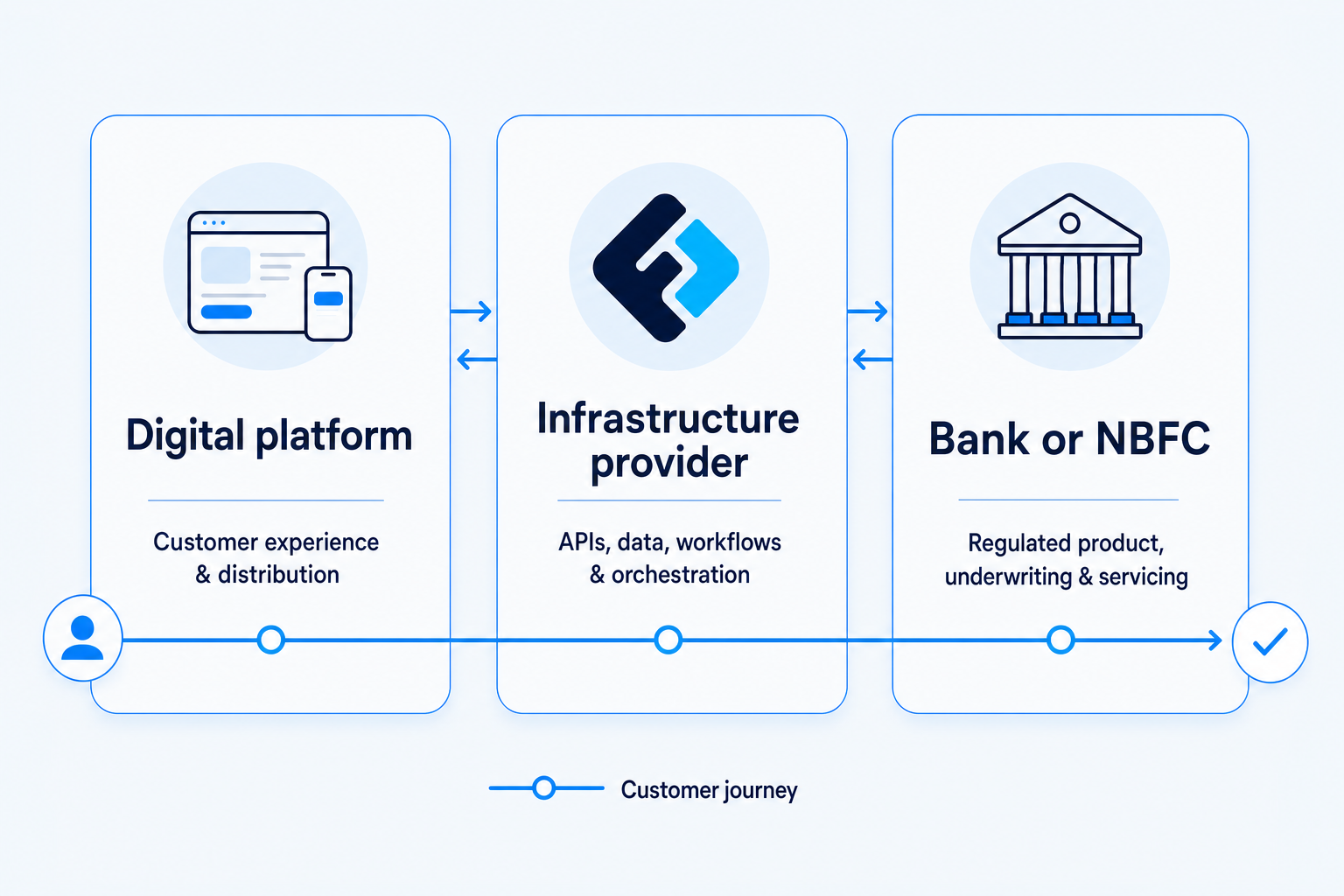
Embedded finance connects three operating layers – the digital platform, the infrastructure provider, and the bank/NBFC. The customer sees one experience, but the platform, regulated financial institution, and infrastructure provider perform different jobs.
Digital platforms (the distribution layer)
Non-FinTech companies own the customer-facing mobile app, website or software product. They identify where a financial service is relevant and present it within the existing customer flow.
A B2B marketplace, for example, can offer inventory finance when a retailer places an order. The platform contributes distribution, customer context and transaction data. It does not become the regulated lender merely because the loan appears in its interface.
Banks and NBFCs (the regulated lender)
Banks, non-banking financial companies (NBFCs) and other regulated financial institutions provide the underlying financial product. For lending products, they set credit policy, assess creditworthiness, approve or reject applications, price the loan and retain the responsibilities assigned to them by regulation.
The Reserve Bank of India’s Digital Lending Directions, 2025 cover regulated entity and Lending Service Provider arrangements, borrower disclosures, creditworthiness assessment, disbursal and repayment, data practices, grievance redressal and reporting.
Embedded finance infrastructure providers
Infrastructure providers connect platforms and financial institutions through application programming interfaces (APIs), software development kits (SDKs) and configurable workflows. They can support application capture, verification, consent, data retrieval, lender matching, decision orchestration and servicing updates.
A typical embedded lending flow works as follows:
- The customer reaches a relevant point inside the platform, such as checkout or invoice creation.
- The platform presents an eligibility or credit option.
- The customer provides the required information and permissions.
- The regulated lender applies its credit policy.
- The customer receives an offer, decline or request for more information.
- The lender disburses and services the loan through the agreed operating model.
- The platform shows relevant application or repayment updates without hiding the lender’s identity.
Examples of embedded finance
Businesses are increasingly collaborating with embedded finance companies to offer financial services. Here are the main types of embedded finance.
Embedded payments
Payments were among the first financial services built into non-financial apps. A food-delivery order or a SaaS subscription renewal today ends with a UPI or card payment that is embedded inside the same app. NPCI data shows UPI clocked 25.47 billion transactions in October 2026, an average of 821 million a day.
Common embedded payment use cases include:
- In-game purchases inside mobile and console games
- Salary payouts sent directly from payroll software
- Wallet checkout on e-commerce apps
- Fee collection through a school or college ERP
- Recurring billing for SaaS subscriptions
Many embedded payment systems also allow users to pay in installments. This case is covered in the Embedded Credit section.
Embedded lending (credit)
Embedded lending places a credit product inside a non-financial digital platform. It lets a customer apply for credit within the product when a financing need arises.
Common examples of embedded lending include offerings such as:
- Adding installment options at checkout
- Working-capital finance inside a B2B marketplace
- Invoice finance within accounting software
- Salary-linked credit on an employee platform
- Vehicle or maintenance finance within a logistics platform
While embedding these services offers a point of distribution for the lender, the borrower’s profile still needs to be assessed by the lender. After proper scrutiny, the lender sets the prices and terms of the loan.
Embedded insurance
Embedded insurance is the bundling of insurance within the purchase of a product or service. For example, Tesla offers auto insurance at the online point-of-sale and also as part of in-showroom purchases. Embedded insurance helps companies with transactional APIs and technologies that allow insurance solutions to integrate with mobile apps, websites, and other partner ecosystems.
Platforms prefer to partner with external insurance companies instead of building the complex capability internally. However, insurance companies work with outdated tech stacks that are hard to integrate. Embedded Insurance infrastructure companies provide an easy way to connect with insurance companies through their tech stack.
Embedded investments
In its most basic form, embedded investments allow platforms to integrate stock market investing into their vertical offerings. API-based brokerage firms have led the embedded investment trend.
Be it a messaging or payment platform, embedded investments allow investors to invest in the stock market without leaving the platform they’re on. Some employee portals let employees buy stocks directly through the portal.
Brokers make this possible by publishing APIs for account opening and order placement. Platforms build the investing screens on top of those APIs, and the broker executes each trade. They have built APIs to reflect every microservice, ranging from opening an account to portfolio management. These APIs also provide investors access to market data.
One example is Acorns, an app that invests people's spare change by rounding up purchases in a seamless and touch-free process.
Embedded banking
Embedded banking places banking capabilities inside another product. The customer interacts with the digital platform while a regulated bank provides the underlying account or banking function.
The term is sometimes used as a synonym for embedded finance. A more precise distinction is that embedded banking covers banking products, while embedded finance also includes payments, lending, insurance and investments.
Benefits of embedded finance
Embedded finance brings together several parties and allows each to contribute its strengths.
A deep dive on Embedded Finance - Embedded Finance Stories by FinBox
In this fireside chat between FinBox Founder and CEO Rajat Deshpande and Deepak Dhanotiya, Founder of ShopKirana, the two discuss the ways in which Embedded Finance impacts the latter’s business metrics. ShopKirana is a B2B E-Commerce platform that connects over 5,00,000 retailers across India with brands.
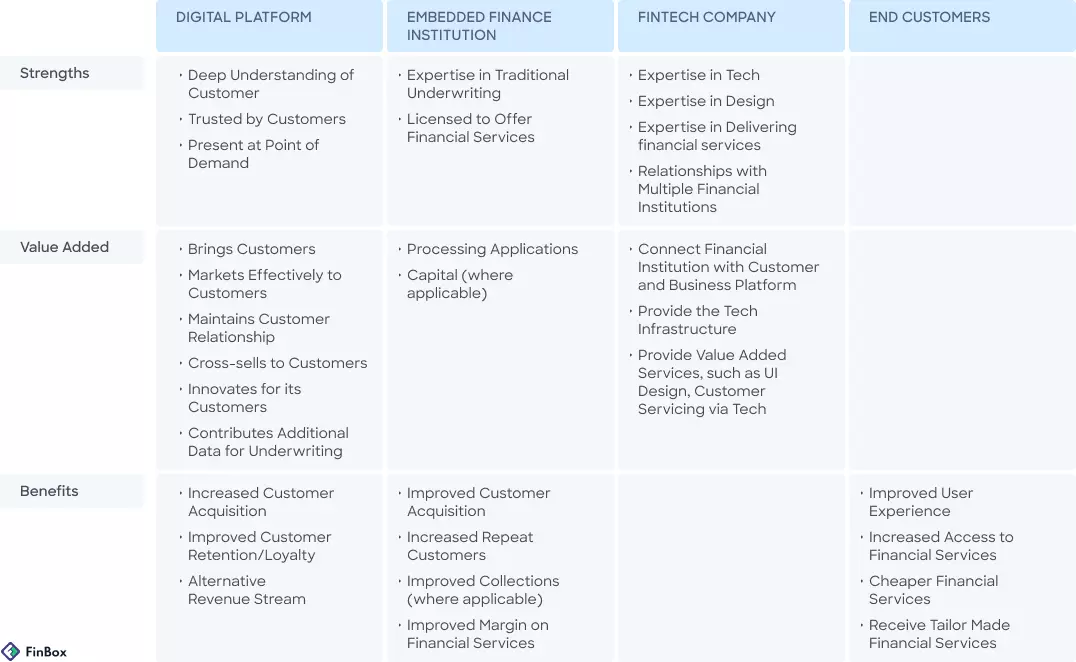
For digital platforms
- Raises order value and lifetime value: A retailer who can pay for stock on short-term credit can place a larger order today and come back to the platform for the next one.
- Earns new revenue: Platforms can earn a fee or a revenue share from the lending or insurance partner, depending on how the partnership is set up.
- Converts first-time buyers: A new merchant can place a first order with credit offered at checkout and repay it from the sales that order generates.
- Makes the core product more useful: A travel booking app that adds trip cover gives customers one more reason to book through it.
- Adds customer insight: Transaction and repayment data, shared with the customer’s consent, shows the platform which segments buy most often and how they prefer to pay.
For banks and NBFCs
- Reaches customers in an established segment: An NBFC that partners with a B2B ordering platform such as ShopKirana can reach the kirana retailers already buying stock through it.
- Contextual distribution: The product appears when the customer has a visible need, such as buying inventory or paying an invoice.
- More underwriting evidence: Platform, bank-statement and device data may supplement bureau history for thin-file and new-to-credit customers.
- Potentially better unit economics: Qualified platform demand can reduce acquisition friction, although lenders still need to measure operating cost and portfolio performance.
For customers
- Shortens the application: A shopper can convert a phone purchase into EMIs at checkout in a few steps, using account details they agree to share.
- Matches the loan to the purchase: A loan offered on a two-wheeler booking app can be sized to the on-road price of the model the customer has chosen.
- Keeps repayment in one place: EMI reminders and payment status appear inside the app the customer already uses, so they can track the loan alongside their orders.
These benefits are not automatic. Poor product placement can encourage unnecessary borrowing, and weak data controls can damage trust. Lenders must assess both conversion and portfolio quality.
Embedded finance regulations and risks in India
A short customer flow does not make the underlying financial product less regulated. Platforms, lenders and technology providers need a clear operating model for disclosures, consent, credit decisions, data handling, servicing and grievances.
RBI Digital Lending Directions, 2025 and the LSP model
The RBI’s Digital Lending Directions define a Lending Service Provider (LSP) as an agent of a regulated entity that performs one or more digital lending functions.
The directions cover the following:
- Regulated entity–LSP due diligence
- Multi-lender arrangements
- Creditworthiness assessment
- Disclosures
- Disbursal and repayment
- Cooling-off periods
- Grievances
- Data requirements
- Technology standards and reporting
As per these regulations, a platform should therefore document:
- Who presents the offer,
- Who collects each data field,
- Who makes the credit decision,
- Who sends disclosures,
- Who handles grievances
- How the customer identifies the regulated lender
Data consent, DPDP Act and Account Aggregator
Data collection should be tied to a defined purpose. The Digital Personal Data Protection Rules, 2025 follow a phased commencement schedule. Product teams should check which provisions are in force when designing or updating a flow.
The customer should be told what data is requested, why it is needed, who will use it and how the relevant consent or rights can be exercised.
The RBI Account Aggregator Directions, 2025 require explicit customer consent for Account Aggregator services. AA consent covers financial-information sharing within that framework.
Credit risk and fraud
Platform data can strengthen underwriting, but more data does not eliminate credit risk. Activity can be seasonal, customer behaviour can change, and transaction or identity data can be manipulated.
Identity or transaction data can also be manipulated. A clear control sequence gives risk teams a stronger audit trail:
- Identity verification: Confirm the person or business applying for credit.
- Anomaly checks: Flag inconsistencies in documents and transaction records.
- Affordability assessment: Estimate repayment capacity under the lender's policy.
- Offer controls: Set the amount and price for the observed risk.
- Early monitoring: Track repayment behaviour by platform and borrower segment.
Fraud controls assess whether the application and evidence are genuine. Creditworthiness assessment estimates the borrower's ability and willingness to repay.
Impact of embedded finance in India
The next phase of embedded finance in India will be shaped less by the number of apps adding a loan button and more by the quality of the operating models behind them.
Digital platforms will play a key role in distributing financial services
Platforms can identify demand from a live commercial or consumer activity. That makes them useful distribution partners for lenders. The strongest platforms will use that context to present fewer, more relevant offers rather than placing finance everywhere.
Banks will partner with technology providers
Banks and NBFCs hold the capital and credit policy. They also carry the servicing obligations attached to the loan.
Technology providers can reduce integration effort across partner platforms. Their workflows should make the lender's controls visible and easier to operate.
Data will support more specific financial products
Consented borrower information such as bank information and platform activity can help a lender evaluate cash flow. Device signals can add evidence about behaviour and potential fraud.
BankConnect, FinBox’s bank-statement analysis product, identifies income, expenses, merchants and obligations. DeviceConnect supports thin-file and new-to-credit assessment using device and behavioral signals.
Using additional data should make decisions more explainable and easier to monitor. Adding signals without clear policy can create complexity without improving risk selection.
Vertical SaaS will continue to add financial products
Accounting and procurement software already sit inside frequent business processes. Logistics and payroll platforms hold another set of transaction contexts.
A financial product becomes useful when it supports the job the software already performs. Invoice finance inside accounting software is specific. A generic loan banner on every screen offers weaker context.
Credit lines on UPI will widen embedded credit
A customer with a pre-sanctioned credit line from their bank can link it to a UPI app and pay merchants from it. They can link their bank accounts to prepaid wallets and credit cards. Also, an RBI circular dated September 4, 2023, added credit lines as a funding account.
In February 2025, RBI extended the facility to small finance banks. For platforms, this puts bank credit inside the UPI checkout they already run.
The bank sets the terms around credit limit and interest rate and the customer gives prior consent before the line is used for UPI transactions. Under a later RBI amendment, the prudential treatment of these lines depends on the nature of the underlying credit facility, irrespective of how the credit is delivered.
How FinBox enables embedding financial services
FinBox provides effective customer-centric Embedded Credit solutions that comply with the highest regulatory standards with its tech-focused approach and proven underwriting stack. The best part? You can go live in 3 weeks.
Request a demo to discuss the operating model for an embedded-credit programme.
Frequently Asked Questions
What is embedded finance in B2B?
B2B embedded finance places payments, working-capital loans, invoice finance, insurance or banking capabilities inside software and marketplaces used by businesses. A procurement platform offering inventory credit during checkout is one example. The platform provides transaction context while a bank or NBFC provides the regulated credit product.
What are some examples of embedded finance in India?
Examples include instalment or credit offers inside commerce apps, working-capital finance in B2B marketplaces, invoice finance in accounting software, insurance during travel booking, and pre-sanctioned bank credit used through UPI. Account Aggregator can support consented financial-data sharing within some lending flows.
Who are the main embedded finance companies in India?
India’s embedded finance market includes regulated banks and NBFCs, payment providers, Account Aggregators, LSPs and technology companies that supply onboarding, decisioning, verification and integration infrastructure. The right provider depends on the financial product and which responsibilities the platform needs the partner to perform.
Read our comparison of lending-as-a-service companies in India for a lending-focused shortlist.