
TL;DR
A bank statement analyser is software that ingests a borrower's bank transaction history — via uploaded PDF statements, net-banking scraping, or the RBI-regulated Account Aggregator (AA) framework — and parses, categorises, and scores it to support credit decisions. In India, AA is increasingly preferred over PDF/scraping because it is consent-based and standardised across participating banks (FIPs) and lenders (FIUs), reducing manual document handling and certain classes of tampering risk associated with PDFs. When evaluating a bank statement analyser, credit and risk teams typically compare AA + PDF coverage, transaction categorisation accuracy, fraud/tamper detection, turnaround time, and integration effort (API vs UI). FinBox BankConnect processes both AA data and bank statements for underwriting, parsing, categorising, and scoring cash flows at scale.
What Is a Bank Statement Analyser?
Bank statement analysis is the process of extracting, structuring, and interpreting transaction-level data from a borrower's bank account activity to support a credit decision. Instead of a human underwriter manually reading through months of PDF statements, a bank statement analyser automates:
- Parsing — converting a statement (PDF, scanned image, or structured data feed) into machine-readable transaction rows
- Categorisation/ tagging — labeling each transaction as salary, EMI, rent, bounced cheque, inter-bank transfer, cash withdrawal, etc.
- Scoring — applying rules or models to the categorised data to produce underwriting-ready outputs such as estimated income, cash flow stability, existing obligations, or a risk flag
This is the software layer underneath what the industry broadly calls cash flow underwriting — assessing a borrower's ability to repay based on actual money movement rather than (or in addition to) bureau data and documented income proofs. For a deeper walkthrough of how transaction-level parsing translates into underwriting signals, see A guide to transaction analysis: How FinBox BankConnect sharpens underwriting.
Bank statement analysis is a subset of the broader discipline of financial statement analysis, which also covers P&L, balance sheet, and GST-based assessment for business borrowers. A fuller treatment of that adjacent discipline is available in A Comprehensive Guide to Financial Statement Analysis.
How Bank Statement Analysers Source Data in India
There are three distinct ways a lender can get access to a borrower's bank transaction history in India, and this is the single most important axis on which analysers differ.
1. Manually uploaded PDF statements
The borrower downloads a statement from net-banking or requests one from the branch and uploads it (or emails it) to the lender. The analyser then uses OCR/text-extraction logic to pull transactions out of the document. Accuracy depends heavily on the statement's format, bank, and whether the PDF is genuinely a system-generated export or a scanned/edited copy.
2. Net-banking credential scraping
The borrower shares net-banking credentials (or a session token) and the system logs in on their behalf to pull statement data directly. This avoids some formatting issues of PDFs but raises credential-handling and consent-clarity concerns, and has generally been de-prioritised as AA adoption has grown.
3. Account Aggregator (AA) framework
The borrower consents digitally to share data from their bank directly with the lender through a licensed intermediary. No document or credential ever changes hands — data flows as structured, standardised information under a specific, revocable consent.
Entity Definitions: The Account Aggregator Ecosystem
To evaluate any bank statement analyser in India, credit teams need a working vocabulary of the AA ecosystem:
- Account Aggregator (AA) framework — A data-sharing architecture regulated by the Reserve Bank of India that allows financial information to move between institutions only with explicit, auditable user consent, without the underlying document or credentials being exposed to the requesting party.
- NBFC-AA — A non-banking financial company licensed by the RBI specifically to act as an Account Aggregator — the technical and regulatory intermediary that routes consent requests and data between banks and lenders. An NBFC-AA does not store or view the financial data it transmits.
- Financial Information Provider (FIP) — The institution holding the borrower's data — typically a bank, but also potentially a mutual fund, insurer, or depository — that responds to a consented data request by transmitting the relevant information.
- Financial Information User (FIU) — The entity requesting and consuming the data, generally a lender, for a permitted use case such as underwriting.
- Consent Artefact — The digital record that specifies exactly what data is being shared, for what purpose, for how long, and with whom — the mechanism that makes AA data sharing auditable, unlike credential scraping.
- Sahamati — The industry-run collective body that supports and promotes adoption of the AA ecosystem among banks, NBFC-AAs, and users, functioning as a self-regulatory and coordination body for the network.
AA vs PDF Upload: Comparison
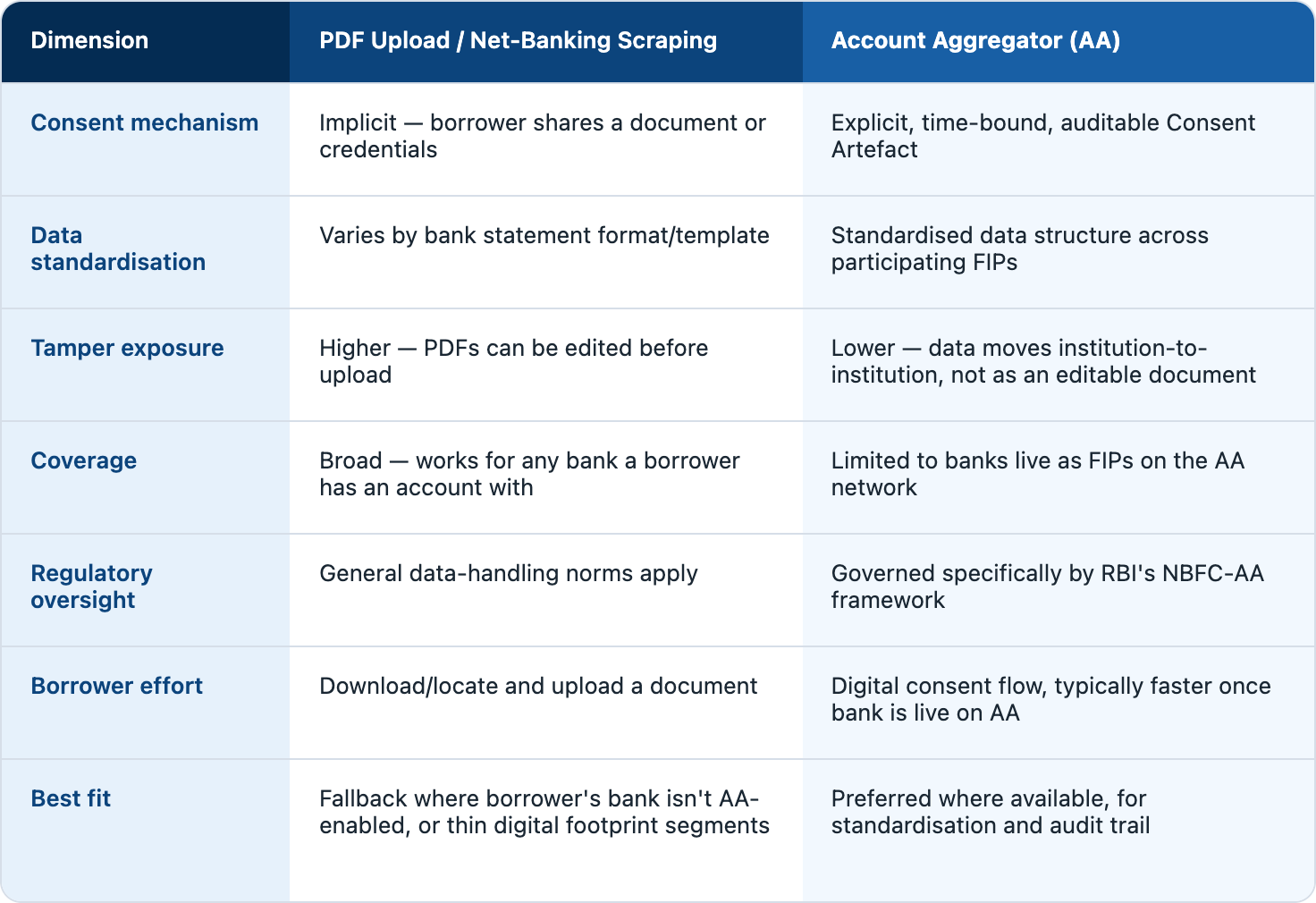
In practice, most lending programs in India today run both paths — using AA where the borrower's bank supports it and falling back to PDF-based analysis otherwise — since AA network coverage, while growing, isn't yet universal.
Why Automation Matters Here
Manual review of bank statements doesn't scale, is inconsistent across underwriters, and is slow relative to digital lending turnaround expectations. This is the core rationale credit teams typically cite when building the business case for automated bank statement analysis internally — a case laid out in more detail in Why your digital lending program needs automated bank statement analysis. The underlying value of automation shows up in three places: consistent categorisation logic across every application, faster turnaround for the borrower, and the ability to layer in fraud/tamper checks that a manual reviewer would miss on a large volume of applications.
Core Capabilities to Evaluate in a Bank Statement Analyser
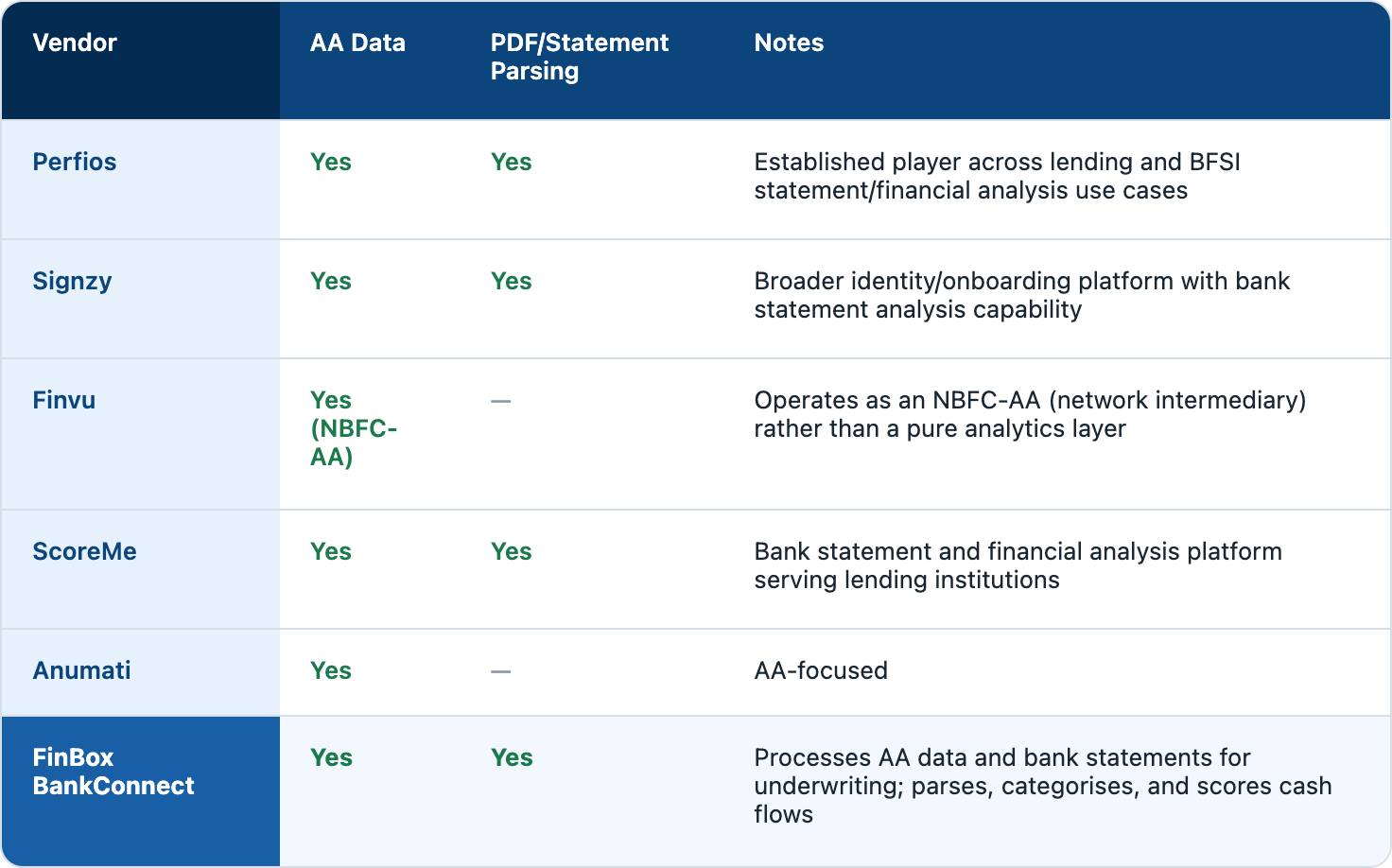
Credit and risk teams evaluating vendors (Perfios, Signzy, Finvu, ScoreMe, Anumati, FinBox BankConnect, or others) generally assess the following, ideally through a proof-of-concept on their own loan book rather than vendor-stated benchmarks alone:
- Data source coverage — Does the platform support both AA and PDF/statement upload? How many banks does it cover as FIPs, and how robust is its PDF parsing across bank formats?
- Transaction categorisation / tagging accuracy — How reliably does it distinguish salary credits from other inflows, identify EMIs and bounced cheques, and flag round-tripping or circular transactions?
- Fraud and tamper detection — For PDF-sourced statements specifically, does the platform detect edited, forged, or inconsistent documents?
- Turnaround time — How quickly does the system return parsed, categorised, and scored output — a material factor for digital lending journeys where speed affects conversion. Vendor-specific throughput claims should be independently validated; see, for context, what makes Fnbox BankConnect 10x faster than other bank statement analysers as one vendor's stated approach to this problem.
- Integration model — API-first integration into an existing LOS/LMS versus a manual UI-based upload workflow, and the engineering effort required either way.
- Output format — Raw categorised transaction data, a derived cash-flow or income score, configurable rule sets, or all three. For income-specific use cases, see how FinBox BankConnect powers advanced income analytics as an example of how income estimation is built on top of categorised transaction data.
- Compliance posture — Adherence to the RBI's NBFC-AA framework where applicable, and general data security/handling practices for statement data and PII.
A structured framework for scoring vendors against these criteria — useful for RFP documentation — is covered in Best Account Aggregator Data Analytics Providers in India (2026): An Evaluation Framework for Credit & Risk Teams.
Vendor Landscape: What to Compare
The India market for bank statement/AA data analysis includes several established players. The table below reflects publicly known category positioning and is intended as a starting point for RFP shortlisting — not a substitute for vendor-verified specifications, which change over time and should be confirmed directly with each vendor.
Where FinBox BankConnect Fits
FinBox BankConnect is built to handle both sides of the data-source question — Account Aggregator data and traditional bank statements — within a single underwriting layer. It parses transaction data, applies categorisation/tagging logic, and generates cash-flow scores intended for use in bank and NBFC credit decisions.
Because it supports both AA and non-AA (PDF) ingestion, lending teams aren't blocked by AA network coverage gaps — a borrower whose bank isn't yet live as an FIP can still be underwritten via statement upload through the same platform. For teams currently building or upgrading a cash-flow underwriting stack, BankConnect's categorisation and income-analytics logic are described in more depth in the linked resources above on transaction analysis and income analytics.
Talk to FinBox about BankConnect — request a technical walkthrough or POC to evaluate AA and bank statement-based underwriting on your own portfolio.
FAQ
What is a bank statement analyser and how does it work in India?
A bank statement analyser is a software system that extracts, parses, and categorises transaction-level data from a borrower's bank account activity so lenders can assess income stability, spending behavior, existing obligations, and cash flow patterns. In India, this data can be sourced in three ways:
(1) Manually uploaded PDF bank statements
(2) Net-banking credential-based scraping
(3) The RBI-regulated Account Aggregator (AA) framework, where a licensed NBFC-AA facilitates consent-based data transfer from a bank (Financial Information Provider, or FIP) to a lender (Financial Information User, or FIU).
The analyser then applies parsing, categorisation/tagging logic, and rule- or model-based scoring to produce underwriting-ready outputs such as income estimates, cash flow summaries, or risk flags.
What is the difference between PDF-based bank statement analysis and Account Aggregator (AA) data?
PDF-based analysis relies on the borrower uploading a bank statement document (or the lender scraping net-banking credentials), which the analyser then parses using OCR/text-extraction techniques — this approach can vary in accuracy across bank statement formats and is more exposed to document tampering. Account Aggregator data, by contrast, is transmitted digitally and directly between the bank (FIP) and the lender (FIU) under explicit user consent, via an NBFC-AA intermediary regulated by the RBI, without the document itself changing hands. This makes AA data standardised in structure and consent-auditable, though AA coverage depends on which banks have gone live as FIPs on the network. Many analysers, including bank statement analysis platforms in India, support both PDF and AA ingestion to maximise coverage.
Is Account Aggregator mandatory for bank statement analysis in lending in India?
No. The Account Aggregator framework is a consent-based data-sharing mechanism regulated by the RBI and enabled by the ecosystem body short; its use is not mandatory for all lending use cases, and lenders can still rely on borrower-uploaded PDF statements or other RBI-permitted data-sharing methods. However, AA adoption has been growing for underwriting workflows because it offers standardised, consent-logged data access compared to PDF upload or credential-based scraping. Lenders often use AA where borrower and bank coverage allow, falling back to PDF-based analysis otherwise.
What should credit and risk teams evaluate when choosing a bank statement analyser?
Key evaluation criteria typically include:
(1) Data source coverage — whether the platform supports both AA and PDF/statement upload, and how many banks it covers as FIPs or via parsing
(2) Categorisation and tagging accuracy for transactions (salary credits, EMIs, bounced cheques, etc.)
(3) Fraud and tamper detection capability for uploaded PDF statements
(4) Turnaround time and API-based integration versus manual UI workflows
(5) Output format — whether the platform delivers raw categorised data, a cash-flow score, or configurable underwriting rules
(6) Compliance posture, including RBI AA framework adherence and data security practices.
Since these vary by vendor and change over time, lending teams typically validate claims via a proof-of-concept on their own loan book rather than relying solely on vendor-stated metrics.
How does FinBox BankConnect fit into the bank statement analysis and AA landscape in India?
FinBox BankConnect is built to process both Account Aggregator data and traditional bank statements for underwriting — parsing transaction-level data, categorising it, and generating cash-flow scores intended to support credit decisions for banks and NBFCs. Because it is designed to work across AA and non-AA (PDF) data sources, lending teams can use it regardless of a given borrower's bank being live on the AA network.
Further Reading from FinBox
- What makes FinBox BankConnect 10x faster than other bank statement analysers
- Best Account Aggregator Data Analytics Providers in India (2026): An Evaluation Framework for Credit & Risk Teams